
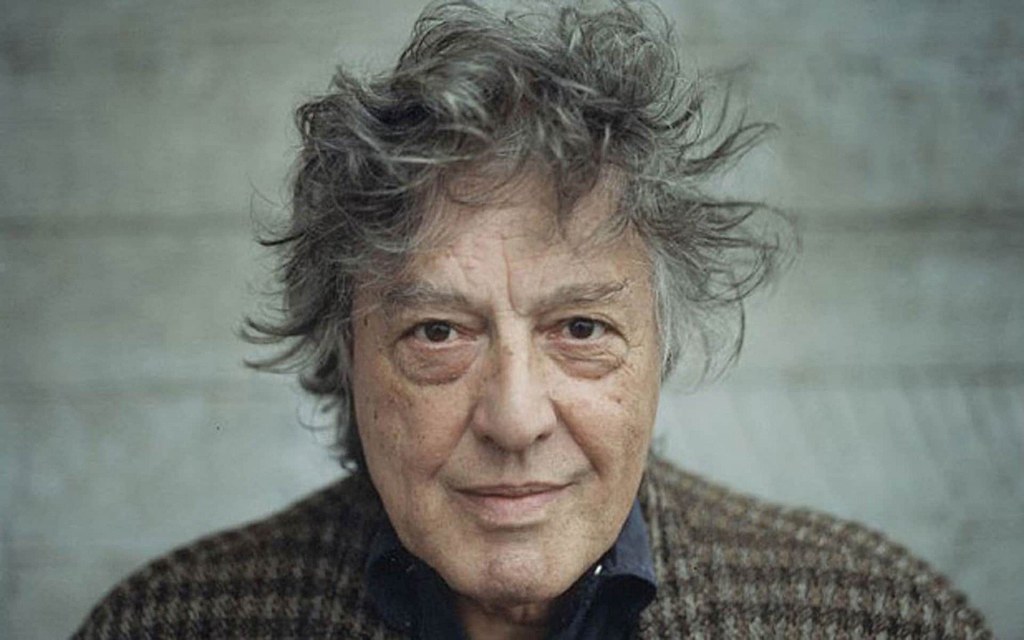


“It’s the wanting to know that makes us matter.”
Tom Stoppard , Arcadia


“It’s what will keeps me coming back to Stoppard: both the ideas and the bursts of emotional truth. Amidst all the history, the Marxism, the music, the fragments of Sappho, the question he makes us confront is how are we to live.“
Lisa at Thoughts and Critiques blog
About the course
Tom Stoppard, the critically and popularly renowned English playwright, has been a constant presence on world stages since his 1966 hit play Rosencrantz and Guildenstern Are Dead. One of the reasons for his celebration in the worlds of theater and film is his ability to write what some term “comedies of ideas”—plays that can engage entertainingly the worlds of philosophy, science, and human relationships. How does Stoppard create these intricate stories that are engaging, human, and intellectually vibrant? Stoppard himself once offered an answer, “The whole difficulty of doing plays — the reason one doesn’t do two or three a year — is this very thing of trying to subsume thought and calculation into the interior of, say, a love story or a story of triumph and failure.” Stoppard uses various narrative and dramatic techniques to drop his audiences into scientific subjects or fraught marriages. But can we see the workings of his craft if we listen, watch, and read closely some of his plays?
Over five weeks, this course led by local playwright and director, T.J. Elliott (also Chief Learning Officer of ETS for fifteen years), will explore how that weaving of quandaries and concepts into compelling theatre occurs in three of Stoppard’s most famous plays Arcadia, The Real Thing, and The Hard Problem. The Hard Problem explores the philosophical question of consciousness, while The Real Thing delves into the nature of love and relationships, and Arcadia examines the relationship between the natural and intellectual worlds. Participants will read, watch, discuss, and perhaps debate the ways in which the playwright mixes ideas and emotions that are both deep and provocative.
Using performances of these works available on YouTube and Audible, participants in the class will experience the plays so that together they can explore Stoppard’s mix of “theatricality as well as textuality” to discern how his ‘thought and calculation’ shape stories that tell us about ourselves and our world. The first class will introduce Stoppard and his techniques. The next three will each focus one of the trio of plays selected. The final class will sum up what participants have concluded about Sir Tom’s thought and calculation.


“We attempt to be coherent tellers of tales…. Plays are events rather than texts. They’re written to happen, not to be read”
Tom Stoppard“I’m a very nosy author. I try to channel things discreetly through the director. With an optimum situation, with the most sensitive director, the best actors, and the most brilliant designers, you get about 65 or 70% of what you mean — and that’s the top. The other 30% consists of secrets between you and the play. You can’t ever get a play on paper like a music score.”
Tom Stoppard


“The unpredictable and the predetermined unfold together to make everything the way it is.”
Tom Stoppard, Arcadia
A Game Within A Game
“Stoppard thinks of art as a game within a game” thought Kenneth Tynan pondering in part Stoppard’s re-imagining of Hamlet “Rosencrantz and Guildenstern Are Dead“. A smattering of the movie scenes are here but the coin-tossing can be seen at this link
Introductory Letter of 09/08/2025
Good day,
I’m writing to you because the Evergreen Forum included your name and email on a list of registrants for the class that I will be leading this fall: ‘THOUGHT AND CALCULATION’: EXAMINING THE THEATRICAL INVENTION OF TOM STOPPARD IN 3 PLAYS. (Indeed, the first session is one month from today on October 8th.) Being informed that this class is already fully subscribed is both humbling and exciting. This email will provide you with some background material that I hope will make your experience rewarding. (And you can always contact me with additional questions about this course at the above email. Our CMA course manager is Andrea Schwarz whose email is also up top)
Please note that none of the resources introduced here or via the course webpage are requirements for participation. Your presence, willingness to ask questions, and share your thoughts are the only elements required. Of course, a better time will be had by all if you’re able to read this trio of plays as we go through our five week journey.
You already know from the course description that the plan of this course is to “explore how the weaving of quandaries and concepts into compelling theatre occurs in three of Stoppard’s most famous plays Arcadia, The Real Thing, and The Hard Problem”. A Thought and Calculation course web page with many relevant resources is now available to you at this link. Scrolling down a little there you’ll find a table of contents for the page and almost at the top of that list there is a link to the section where you can download digital copies of the scripts. (Or click on this link to go to that spot in the page directly.)I will use some but not all of the resources on the webpage to shape and augment our conversations depending upon which way they sprout and bend.
Downloading and printing digital scripts or reading them online likely is not for everyone; therefore, I checked with Labyrinth Books in downtown Princeton about ordering these published plays. The kind folks there stated to me that they could definitely obtain any or all of the three scripts with 7 to 10 days advance purchase. That’s my attempt to try to support our local bookstore, but the scripts are also available via Barnes & Noble, Abe’s Books, Powells, and, of course, Amazon. There are recorded — audiobook — versions of The Hard Problem, The Real Thing, and Arcadia. The versions to which these links connect are by LA Theatre Workshop, which is a great group of actors.
An Outline of Our Sessions
- Session 1: The Field of Play
- Session 2 The Real Thing
- Session 3 Arcadia
- Session 4 The Hard Problem
- Session 5 Colliding Ideas And Concluding Insights
Session 1 introduces some of the ideas that are found within these plays while also reviewing a little bit about Stoppard’s biography and his way of working.
A General Scheme for Sessions 2-5
- What’s going on here in this play?
- What thoughts — ideas, calculations, did you perceive as part of the play TS constructed?
- How would you characterize your post-reading or viewing experience?
- Did you have questions afterwards?
- Use a few scenes to flesh out examples of these thoughts and calculations of TS; NOTE: that ‘looking’ will happen by watching some videos of scenes or volunteers reading them in class. I emphasize that only volunteers will read; no one will read who does not wish to do so.
Katherine E Kelly in her introduction to The Cambridge Companion to Tom Stoppard, which was published before his later plays such as The Hard Problem, credits the author with a development that “extended his early preoccupation with memory, uncertainty, and ethics but also deepened the sense of human consequence growing from ethical conflict and intellectual doubt…. Stoppard has overcome the charge of emotional coldness, especially the claim that he had failed to represent human love. In slowly dropping his emotional guard, he has imbued his writing with a depth of compassion hinted at in the early work through his consistent appeals to humor.” My intention for the class is that all of us get to experience the dazzling way in which Stoppard brings those highly complicated and intellectual topics into our own minds while enjoying the compassion and humor present in his work and that I trust will also bubble up in our discussions.
All the best and thanks for signing up,
T.J. Elliott
Digital Scripts
The Real Thing
Arcadia
The Hard Problem
Some Links
The Cricket Bat Speech from The Real Thing
The Real Thing: Stoppard’s cricket bat incites to write – Simon Ogden https://share.google/9yMbUlBA8SN1GrcGp
Knock! Tom Stoppard Writes a Cricket Bat | Observer https://share.google/hGippJNI72YKBxTl7


The Real Thing Synopsis by Henry Oliver is here

Irons and Close in TRT 
2nd time in Arcadia for Crudup 
Arcadia Cast THT cast


Above Clockwise: Scenes from Arcadia, The Real Thing, The Hard Problem & Arcadia Again
“We shed as we pick up, like travellers who must carry everything in their arms, and what we let fall will be picked up by those behind. The procession is very long and life is very short. We die on the march. But there is nothing outside the march so nothing can be lost to it. The missing plays of Sophocles will turn up piece by piece, or be written again in another language. Ancient cures for diseases will reveal themselves once more. Mathematical discoveries glimpsed and lost to view will have their time again. You do not suppose, my lady, that if all of Archimedes had been hiding in the great library of Alexandria, we would be at a loss for a corkscrew?”
― Tom Stoppard, Arcadia
What is Stoppard saying here about progress? About nostalgia? About regret? About Invention and creativity?
Theatre and Love: Tom Stoppard, The Real Thing – Professor Belinda Jack” on YouTube


A Trove of Arcadia Links Can Be Found at THIS SITE

Amazon.com: The Hard Problem (Audible Audio Edition): Tom Stoppard, Eddie Cahill, Rosie Fellner, Adhir Kalyan, Desiree Mee Jung, Julian Morris, Hannah Murray, Moira Quirk, Alex Wyndham, L.A. Theatre Works: Books
https://www.amazon.com/The-Hard-Problem/dp/B087NFC4NB
Another possible audio performance of The Hard Problem is here; registration is required

The Real Thing Audio: 1984 Irons Close Baranski
https://archive.org/details/stoppard-the-real-thing-1984-irons-close
A cold reading of The Real Thing script by the Corona players
Stoppard on Charlie Rose — Tom Stoppard interview (2000)
The Hard Problem
Watch “Playwright Tom Stoppard in Conversation with Cognitive Scientist David Chalmers—The Hard Problem” on YouTube.
The Hard Problem Synopsis and Commentary

The Hard Problem: New Yorker Review

Stoppard Working an Idea into Story: Shakespeare in Love
https://www.facebook.com/reel/942647720980050
The Thoughts and The Calculations
Session 1: The Field of Play
https://1drv.ms/p/c/bdc1f311ae670521/Ec8nCy8IKE9NjZmPx5sSinEBLBCmmWHA5S_-YWI19d2B0w?e=i711uF
Stoppard on Charlie Rose: go to 13:26 run to 19:26
Playwrighting in Stoppard
Theater is a storytelling art form •1:28 – 4:24
“There comes a time when you realize that everything is a dream, and only those things preserved in writing have any possibility of being real.”
― James Salter
Why write, but specifically why playwright? The word ‘wright’ is one of our oldest in the English language and that should not surprise us because it came about to describe “an artificer or handicraftsman; esp. a constructive workman.” The making and doing of things that people need and use is important in any society and various portmanteaus or combinations of words: eye-, glassen-, mill-, tile-wright
Ben Jonson seems to have been the first to join the words play and wright together to indicate a builder of theatrical performances.
A Stoppard Timeline
Go to this link in Google Books and scroll down to the first chapter
Session Two
The Real Thing: Ideas and Themes
https://1drv.ms/p/c/bdc1f311ae670521/ERgOf0DAr_JEiXY1i5UYwcMBHsnW_el1HtT92XbcEHTixw?e=uicpcI
Download the PowerPoint

https://charlierose.com/videos/7204#
Words
“Words… They’re innocent, neutral, precise, standing for this, describing that, meaning the other, so if you look after them you can build bridges across incomprehension and chaos. But when they get their corners knocked off, they’re no good any more… I don’t think writers are sacred, but words are. They deserve respect. If you get the right ones in the right order, you can nudge the world a little or make a poem which children will speak for you when you’re dead.”
― Tom Stoppard, The Real Thing
HENRY: Shut up and listen. This thing here, which looks like a wooden club, is actually several pieces of particular wood cunningly put together in a certain way so that the whole thing is sprung, like a dance floor. It’s for hitting cricket balls with. If you get it right, the cricket ball will travel two hundred yards in four seconds, and all you’ve done with it is give it a knock like knocking the top off a bottle of stout, and it makes a noise like a trout taking a fly… (He clucks his tongue again and picks up the script.) Now, what we’ve got here is a lump of wood of roughly the same shape trying to be a cricket bat, and if you hit a ball with it, the ball will travel about ten feet and you will drop the bat and dance about shouting ‘Ouch!’ with your hands stuck into your armpits. (Indicating the cricket bat.) This isn’t better because someone says its better, or because there’s a conspiracy by the MCC to keep cudgels out of Lords. It’s better because it’s better. You don’t believe me, so I suggest you go out to bat with this and see how you get on. ‘You’re a strange boy, Billy, how old are you? ‘Twenty, but I’ve lived more than you’ll ever live.’ Ooh, ouch!
What’s real versus what is not real
“It’s to do with knowing and being known. I remember how it stopped seeming odd that in biblical Greek knowing was used for making love. Whosit knew so-and-so. Carnal knowledge. It’s what lovers trust each other with. Knowledge of each other, not of the flesh but through the flesh, knowledge of self, the real him, the real her, in extremis, the mask slipped from the face. Every other version of oneself is on offer to the public. We share our vivacity, grief, sulks, anger, joy … we hand it out to anybody who happens to be standing around, to friends and family with a momentary sense of indecency perhaps, to strangers without hesitation. Our lovers share us with the passing trade. But in pairs we insist that we give ourselves to each other. What selves? What’s left? What else is there that hasn’t been dealt out like a pack of cards? Carnal knowledge. Personal, final, uncompromised. Knowing, being known. I revere that. Having that is being rich, you can be generous about what’s shared – she walks, she talks, she laughs, she lends a sympathetic ear, she kicks off her shoes and dances on the tables, she’s everybody’s and it don’t mean a thing, let them eat cake; knowledge is something else, the undealt card, and while it’s held it makes you free-and-easy and nice to know, and when it’s gone everything is pain. Every single thing. Every object that meets the eye, a pencil, a tangerine, a travel poster. As if the physical world has been wired up to pass a current back to the part of your brain where imagination glows like a filament in a lobe no bigger than a torch bulb. Pain.”
― Tom Stoppard, The Real Thing
Relationships
“There are no commitments, only bargains. And they have to be made again every day. You think making a commitment is it. Finish. You think it sets like a concrete platform and it’ll take any strain you want to put on it. You’re committed. You don’t have to prove anything. In fact you can afford a little neglect, indulge in a little bit of sarcasm here and there, isolate yourself when you want to. Underneath it’s concrete for life. I’m a cow in some ways, but you’re an idiot.”
― Tom Stoppard, The Real Thing
“I believe in mess, tears, pain, self-abasement, loss of self-respect, nakedness. Not caring doesn’t seem much different from not loving.”
― Tom Stoppard, The Real Thing
Sex
“When I was twelve I was obsessed. Everything was sex. Latin was sex. The dictionary fell open at ‘meretrix’, a harlot. You could feel the mystery coming off the word like musk. ‘Meretrix’! This was none of your mensa-a-table, this was a flash from a forbidden planet, and it was everywhere. History was sex, French was sex, art was sex, the Bible, poetry, penfriends, games, music, everything was sex except biology which was obviously sex but not really sex, not the one which was secret and ecstatic and wicked and a sacrament and all the things it was supposed to be but couldn’t be at one and the same time – I got that in the boiler room and it turned out to be biology after all.”
― Tom Stoppard, The Real Thing
Happiness
“HENRY: You don’t get visited by happiness like being lucky with the weather. The weather is the weather.
DEBBIE: And happiness?
HENRY: Happiness is . . . equilibrium. Shift your weight.”
― Tom Stoppard, The Real Thing
For extra commentary, try these links
A Podcast discussing The Real Thing here
Short video on Tom Stoppard’s Play within a Play: ‘The House of Cards’ in ‘The Real Thing’ – Professor Belinda Jack
Session Three
Play file from link below
Stoppard-Session3-Arcadia.pptx
Download file from link below
Arcadia: Ideas and Themes
HANNAH: Don’t let Bernard get to you. It’s only performance art, you know. Rhetoric, they used to teach it in ancient times, like PT. It’s not about being right, they had philosophy for that. Rhetoric was their chat show. Bernard’s indignation is a sort of aerobics for when he gets on television.” ― Tom Stoppard, Arcadia
“If everything from the furthest planet to the smallest atom of our brain acts according to Newton’s law of motion, what becomes of free will?”
― Tom Stoppard, ArcadiaLook for the connection to two other plays in our trio: the first to The real Thing and The Second to The Hard Problem. What do you think the connections are?
A page of Arcadia quotes is hereLandscape
Marianne Drugeon’s article — ‘But Sidley Park’s Already A Picture’: Playwrighting and Painting in Stoppard’s Arcadia is at this link
Science
A good paper with a funny title — Genius Isn’t Like Your Average Grouse: the Science and Politics of the particular in Tom Stoppard’s Arcadia — is at this link
Fractals
from Marianne Drugeon
“…when Thomasina imagines a formula for all the future, she has to create in her mind the image, the picture, of everything that she would then be able to describe, to depict, in mathematical words, colours, shapes or numbers: ‘If you could stop every atom in its position and direction, and if your mind could comprehend all the actions thus suspended, (…) you could write the formula for all the future‘ . The problem here seems to be at least as well one of scale as one of algebra: the difficulty of being able to “comprehend”, here not only in the sense of understand, but also in the sense of contain, comprise, embrace in only one picture, the whole of the universe, jeopardizes the ability of the scientist turned artist to write the formula. Thomasina also expresses the link between science and drawing – for here it is more drawing than painting – in scene 3: she, as a genius, has understood how the theoretical equations that she plots in her mathematics lessons are to be turned into geometrical figures. She literally visualizes science, so much so that the “commonplace geometry, as if forms were nothing but arcs and angles” that is the result of the simple equations that her algebra suggests, is not enough for her. She wants to be able to draw the equation corresponding to every shape in nature, which means that she wants to draw the mathematical likeness of the landscape, its image in mathematical terms. Indeed her models are all taken from the natural environment: “if there is an equation for a curve like a bell, there must be an equation for one like a bluebell, and if a bluebell, why not a rose?” (Stoppard 51), and she starts with a leaf: “we must work outward from the middle of the maze. We will start with something simple. (She picks up the apple leaf.) I will plot this leaf and deduce its equation.’”

Session Four
The Hard Problem: Ideas and Themes
“The Hard Problem of the play’s title is a phrase coined by the Australian philosopher David Chalmers to describe the way in which consciousness arises from a physical world. What makes it hard is that we don’t understand it. What makes it a problem is slightly different. It isn’t the fact of consciousness, but our representations of consciousness, that give rise to most of the difficulties. We don’t know how to fit the first-person perspective into the third-person world that science describes and explores. But this isn’t because they don’t fit: it’s because we don’t understand how they fit. For some people, this becomes a question of consuming interest.”
A New York Times article on the friendly 25-year bet about consciousness between David Chalmers and a neuroscientist, Christof Koch: Can scientists find a clear neural correlate of consciousness?
An explanation of why Chalmers called consciousness the hard problem is here
Motherhood and trade-offs
Tom Stoppard’s The Hard Problem (2015) from Kathleen R. Hart
Hart writes about the play offers “a unique window onto two types of biases that affect people contending with Sarah Hrdy’s revelation that women weigh the costs as well as benefits of nurturing”
The principal setting of The Hard Problem is “The Krohl Institute for Brain Science,” a British think tank founded by American “squillionaire” (13) hedge fund owner Jerry Krohl. Unlike Jerry, who only values research for predicting stock trends, psychology chair Leo Reinhart is open-minded enough to hire Hilary Matthews, a doctoral candidate from a lackluster university who shares Leo’s interest in what philosopher David Chalmers calls “the hard problem” of why consciousness exists. What is the relationship between physical properties and subjective experience? If science can’t account for “what consciousness is like,” then do mind and matter have different properties? (Chalmers, 1995, 201-2). Hilary’s attraction to the Hard Problem is fueled by her desire to believe in a benevolent force that would protect the child she relinquished at the age of fifteen. As she tells her high school friend Julia Chamberlain, she initially “felt relieved” when the adoption was prearranged, since she had no mother or “granny” and “wasn’t into babies.” But, she adds, “it was different when it came to it” (20). Hilary has since prayed nightly for “forgiveness” (9) and a chance to learn that her daughter, Catherine, is “all right” (52). The possibility that her prayers will be answered rests on the hope that human consciousness and altruism operate in a realm distinct from the body. Her outlook is scorned by the play’s neuroscientists, who take for granted that natural selection favored aid-giving behavior due to the benefits accrued to an organism or its genetic kin.
Stoppard shares Hilary’s outlook. Speaking of The Hard Problem, he remarked: “I’m exploring myself.” Troubled by claims that “altruism has a secret agenda which is self-serving,” he “invented a young woman who doesn’t think that it’s necessarily true. In fact, she’s pretty damn sure it’s not true” (“Interview” 2018). We might expect Stoppard to reject Richard Dawkins’ assertion in the 1976 bestseller The Selfish Gene—recanted by Dawkins in the 30th-anniversary edition—that “we are born selfish” (Dawkins 2006, 4). But the playwright also takes issue with David Sloan Wilson’s view that helping behavior prompted by concern for others emerged because parts of the brain evolved by group selection (Wilson and Sober, 1999). As Stoppard explained in a joint interview with Wilson, evolutionary explanations fail to “touch the mystery of altruism” or “do justice to the way we shape our lives.” People won’t feel morally accountable, he argues, unless they conceptualize “goodness” as something “outside the orbit” of science. Whether or not Stoppard sees himself “mixing facts with values,” as Wilson puts it (Wilson and Stoppard 2015 TVOL), the playwright holds out, like Hilary, for the possibility of a spiritual force that transcends physicality (Lee 2021 711-12). For Stoppard, the universe only seems indifferent to morality because humans can never see “the whole picture” (Demastes 2012, 26). And yet, despite his rejection of evolutionary approaches to altruism, Stoppard enlists them in order to work through what may be his own fantasy of sacrificial motherhood. The result is a maternal melodrama that concludes not with the reunion between mother and daughter but with Hilary’s transition from the field of psychological science to philosophy.
Throughout the play, Hilary seems in search of her true calling. In some ways, her character sustains the melodramatic fantasy of a penitent fallen woman who dreams only of restoring her maternal role: “I missed her like half of me from the first day.” Her guilt takes the form of classic mother-blame when she pictures herself callously deserting her baby for “a career: “I’ve been letting her go, as though I’d swapped her for a doctorate” (44). Hilary’s weakness in math, resulting in a study compromised by missing data, reinforces the Victorian notion that she was destined for motherhood, not science. And yet, if Hilary is correct that “people out for themselves” could “think they’re justified by biology” (40), then dramatically central is what role Hilary could play in scientific debates, and not just whether she can find Catherine. Indeed, though it implies that Hilary too must change, the play is primarily an indictment of the institutional structures and attitudes that exclude her.
The opening scene, presumably set in the late 1990s, points to a mutually reinforcing relationship between indifference to mothers’ perspectives and “an intellectual pecking order in which an egoistic explanation for a given behavior, no matter how contrived, [was] favored over an altruistic explanation” (Wilson and Sober 1999, 8). Hilary, twenty-two, is being prepped for job interviews by Spike, her thirty-year-old tutor who has her role-play the Prisoner’s Dilemma of game theory according to which “two rational prisoners will betray each other even though they know they would have done better to trust each other” (4). Hilary stubbornly opts to sacrifice herself to give the other prisoner, whom she fancifully calls her lover, “a chance to go straight”; when an exasperated Spike demands to know why, she replies “Because I’m good.” Spike’s lecture of rebuke parodies the overreaching claims of gene-centered evolutionary psychology that had yet to incorporate research by feminist and female sociobiologists who were more likely to “see human behavior as responsive to its current environment and capable of within-individual change” (Liesen 2007, 52-3). His declaration that the human brain is “hard-wired for me first” and that “altruism is an outlier unless you’re an ant or a bee,” echoes Dawkins’ explanation of Robert Trivers’ theory of reciprocal altruism as it applies primarily to non-human species (Dawkins 2016 216-244). Furthermore, Spike’s claim that “a statistical tendency” proves “self-interest is bedrock” is contradicted in Scene III by Amal, a Krohl candidate who calls “the Dilemma” “oversold” “with the one-shot game” (18), as research confirms (Raihani and Bshary, 2011). However, audience members need not be acquainted with the science to perceive Spike as less preoccupied with truth than with his own status in a male-dominated environment that equates kindness with being what biologist Maynard Smith called a “sucker.” In addition to uncritically dismissing Hilary’s objections in favor of his totalizing narrative, he exploits his pupil’s pessimism over her job prospects to engage her in a sexual relationship.
Altruism
“The first hard problem is altruism and goodness in all of its forms. For Tom and his protagonist Hilary, science is a parched desert when it comes to explaining the nature of goodness. As Spike, the supremely confident scientist in the play puts it, ‘Above all, don’t use the word good as though it meant something in evolutionary science!’”
“The second hard problem is that everything cannot be reduced to physical causes, but science pretends that it can. We don’t need a fictional character to express this opinion because we have Sir Francis Crick, the co-discoverer of DNA, who is quoted in the playbill of The Hard Problem as writing in his book The Astonishing Hypothesis: ‘You, your joys and your sorrows, your memories and your ambition, your sense of personal identity and free will, are in fact no more than the behaviour of a vast assembly of nerve cells and their associated molecules’”. [TJE Note, I think that Spike says it more entertainingly than Crick]
“The third hard problem is that even if science can explain the kind of instinctive altruism found in bees and brainworms (an example that Tom lifted from Unto Others to use in his play!) it can’t or at least hasn’t explained the kind of consciously motivated altruism found in humans.”
David Sloan Wilson
More of the exchange in the topic between TS and DSW can be found here
“Stoppard’s characters argue not just about machine intelligence, but about the possibility of altruism as humans experience it, rather than as evolutionary biologists can analyse it. Consciousness can’t be reduced to brain mechanisms, says the heroine, and love can’t be understood entirely as self-delusion, or as a tarpaulin thrown over the horrible mechanisms of genetic selfishness to conceal our real motives from ourselves.”
Andrew Brown in The Guardian
Bo: I think it’s good to be good, I don’t see that it matters what makes you good.
Hilary: It might matter if people who are out for themselves think they’re justified by biology.
—Tom Stoppard, The Hard Problem
consciousness, free will
A pivotal scene setting out the argument is here
“Someone tells you you can run the film backward billions of years to an enormous bang and nothing but particles joining up into big clumps like this one, except not like this one—because on this one the chemistry came alive and kicked into an algorithm that kept unspooling till there was you collecting spit from a poker game, and you don’t bat an eyelid.”
–Tom Stoppard, The Hard Problem
TS: There’s an exchange in THP where a young woman, (Hillary) believes X and a man (Spike) who believes Y, and the man asks her why she’s afraid to make her own values instead of wanting them underwritten by a “supreme being”, and she says to him something like, “What is the difference between a supreme being and being programmed by your biology?” He replies: “Freedom. I can override the programming.” And she says: “Who can? Who is the you outside your brain? Where?” And I still do not understand how you escape that loop.”
More from DSW and TS on what consciousness is
Wilson: There’s a moment in the play where Hilary challenges Spike to explain consciousness, and he grabs her finger and pushes it into a candle flame and when she quickly withdraws it, he says: “That’s consciousness for you – the signal went to the brain … and that’s all there is to consciousness.”
Stoppard: She rejects that with contempt and asks him to do the same thing for sorrow … I think the reason we’re talking about this at all is that for most people that doesn’t do justice to the way we shape our lives, and this is why I asked you about using a word such as transcendence. There’s a discontinuity that shows up at various points in the sciences. There’s a moment of discontinuity when brain activity becomes content, and that is our mystery, it’s what makes us human. Human beings of course are animals, but are we just very, very sophisticated animals or does being human mean something beyond biology, and if it seems to, is that something only our illusion, our conceit?
Science looks fair to solve the technical mysteries one by one. And when they are solved the question is: what is the meaning of that, does it have any meaning? I think a lot of our altruism, which we all exhibit, happens on a one-to-one level, with family, for example. You’re impassioned about making the world a better place in your town and ultimately in the planet and you’re going to do it by manipulating the environment so that the environment produces objectively better social behaviour. That’s admirable, but in the truest kind of way it misses out altruism completely. Altruism is what you do for somebody you love, and you don’t love good order and sociality in the same sense that you love your family.
Session Five
Conflicting Idea and Conclusions
Stoppard-Session-5-Ideas-collide.pptx
The Playwrighting Process
“Stoppard, who has written only one novel, Lord Malquist and Mr Moon (1966), quips that “dialogue is the most respectable way of contradicting myself”. His imagination is drawn to situational paradox. Yet he waits for a spark. “I’m so grateful to grab hold of something that wants to be a play,” he says. “It doesn’t happen very often. I don’t have unwritten plays waiting for their turn.”
“After The Real Thing (1982) – for Billington, ‘one of the most painful plays about the agony of infidelity written since the war’ – his work became even more of an intellectual stretch. In Hapgood (1988), he combined quantum mechanics with cold-war spying, and in Arcadia, chaos theory with Byron and 18th-century landscape gardening. He says he reads popular science “for pleasure, not research – and not for the prose. I do try to be as accurate as I can.” Yet he can also be ‘completely cavalier: if I discover something didn’t really happen, I say the whole thing’s made up, a parallel world.’”
The Guardian
Further References
Tom Stoppard’s Plays Patterns of Plenitude and Parsimony By Nigel Purse
https://pubmed.ncbi.nlm.nih.gov/32298621/
https://charlierose.com/videos/11157
https://charlierose.com/videos/19247
https://www.radioswissclassic.ch/en/music-database/title/427787a0d4726e6ce3c060393d4dab143fe6b
https://openlibrary.org/account/loans
https://www.youtube.com/watch?v=3InxM58pKGM
https://math.bu.edu/DYSYS/arcadia/sect5.html
https://journals.openedition.org/miranda/5552
https://muse.jhu.edu/article/500996
https://books.google.com/books?id=SZaZP-WuR_oC&pg=PA177&dq=dramatic#v=onepage&q=dramatic&f=false
https://www.youtube.com/watch?v=il5CT1n4ql0&t=5s
https://www.storylineproject.com/
https://nextact2follow.com/#home
https://actorstheatreworkshop.org/play-readings/
https://studio.youtube.com/channel/UCUZM_TI5S1MHV54gTOem-zQ
https://www.researchgate.net/publication/279326090_Consciousness_myth
https://www.youtube.com/watch?v=FAJLBDCCTg8
https://www.youtube.com/watch?v=2DL0z3SOboY
https://muse.jhu.edu/article/926806/summary
Arcadia Quotes by Tom Stoppard
https://www.nytimes.com/2018/10/16/theater/tom-stoppard-the-hard-problem.html
https://www.commentary.org/articles/terry-teachout/tom-stoppard-greatest-living-english-playwright/
https://www.ebay.com/itm/134787547091
https://www.courttheatre.org/wp-content/uploads/2017/06/PG_TheHardPRoblem.pdf
Got questions?
Feel free to reach out.


