Short Part #1: If you — like famous painter Rory McGrory — suddenly found yourself in a curious art gallery with nothing but empty frames only to be greeted by your dead ex-wife and two other old ‘frenemies’, would you think you were dreaming or were… you know.
That’s the quandary at the heart of RETROSPECTIVE where these past lives form a manic menage a trois plus one in this new comedy about art, attachments, and eternity.
Even Shorter Part #2: Buy tix here and feel free to forward, repost, and otherwise spread the word. Theater is nothing without an audience. Thank you!
T.J. Elliott, our writer-in-charge, will be on a new episode of Dr. Madelyn Blair‘s podcast Unlocked which airs 12 PM ET on YouTube. Alongside StorytellerLoren Niemi, T.J. talks about the writing and storytelling process and how to identify which stories are ‘worth telling.’ We hope you’ll tune into Madelyn’s podcast this Thursday and we hope it’ll encourage you to purchase a copy of 13 Ways of Looking at Self-Producing, our book for playwrights on how to get those stories on stage! You can also see T.J.’s new play Retrospective this August as part of the Broadway Bound Theater Festival.
OED 3.b. c1400 To mingle in carnal intercourse. c1400 (?c1380) & fylter folyly in fere, on femmalez wyse.
Similar words?
meddle @1398
felter c1400 intransitive. To mingle in carnal intercourse. company a1425– intransitive. To have sexual intercourse or a sexual relationship. Chiefly with with. Also figurative. Cf. company, n. 2b. Now archaic and rare. swive c1440– intransitive. To copulate. jape a 1450–1589 intransitive. To have sexual intercourse. Obsolete. mell c1450–1832 intransitive (in Middle English also reflexive). To copulate; to have sexual intercourse. Frequently with with. Obsolete.
Latest (but definitely NOT final) version of RETROSPECTIVE
Congratulations! We would like to invite you and your play Retropective to participate in Broadway Bound Theatre Festival 2025. We’re excited to begin working alongside you to ensure your production’s success.
Please let us know within 24 hours by sending us the back page of the contract that is attached to this email. Your signature indicates that you will be a part of this year’s festival.
A non-refundable payment of $1000 will secure your slot in the festival. Once we have received your signatory page, we will send you a link to make your payment.
Please note that you have not secured your play’s slot in the festival until we have received your signed contract and participation fee.
If you don’t want to accept this offer, please be kind enough to let us know ASAP out of courtesy for another playwright who does want to participate.
Feel free to share this good news with family and close friends, but we ask that you don’t post anything on social media or other websites until we’ve officially announced our 2025 lineup. We will notify you when you can make your good news public.
We’re dedicated to providing playwrights with a professional venue and all the tools they need to effectively and affordably produce the Off-Broadway premiere of their play. This includes workshops, access to our interactive online forum, full time support from BBTF staff, an audience talk back, rewriting sessions and dramaturgy.
We’re most proud of the support we at BBTF give our playwrights. If a production is selected to participate in BBTF, we promise to never put our stamp on it should it go on to be a successful post festival. BBTF neither requires any acknowledgment of its festival in future productions, nor does it take a percentage of any future revenues or require the distribution of producer points, nor will it instigate negotiations for credit should any participating production be approached with financial interest during or after the festival.
OUR CRITIQUES – BBTF is a festival where playwrights take center stage. Toward that end, everything we do within the festival framework is to help educate and support the playwrights to produce their own shows.
OUR FORUM – All playwrights are expected to join BBTF’s private Facebook community, which serves as a sounding board and a social forum for our participants, their directors and technical crew. In the past, we’ve used this forum to host digital workshops, to enable expedient distribution of materials, to communicate directly with playwrights about time sensitive topics, to discuss our prop/set sharing lists, to share videos of our festival light plot channel check, venue tour, and to promote each other’s projects as well as get to know each other.
OUR WORKSHOPS – Every season we host a number of Zoom workshops during which our playwrights have the opportunity to interact with working industry professionals and discuss things that both relate directly to the festival experience and to the theatre industry overall.
OUR TEAM – We limit our seasons to up to 15 plays so that personal relationships can be maintained with each of our playwrights throughout the production process.
○ Our Festival Director is readily available to discuss the development of your script and work with your one-on-one throughout the rewrite process, as is the rest of the writing team ○ Our General Manager handles cross promotion, ticket sales and box office, including comps and industry invites
● OUR VENUE – Right on 45th Street, nowhere could be more exciting (or impressive) to present your Off-Broadway premiere. Participants and their SMs and Design Teams are expected to attend a pre-festival tour of the theater followed by Q&A with the festival staff. This site tour is scheduled for Monday, July 21st, 2025 after load-in. (Tentatively from 5:00 to 8:00 PM) ● OUR TALKBACKS – Every playwright has the option of Audience Feedback Forms after every show, and one sit-in audience talkback. We know the future of theatre is the collaboration between theatre-makers and an actively engaged audience. ● OUR COMPS – All our playwrights are given up to 15 complimentary tickets (one for every other show in the festival as well as their own) and all festival participants (including actors, directors, stage managers, operators, etc.) are invited to see any participating production without charge on a standby basis. We’re committed to creating a community of encouragement where theater professionals can meet, discuss, collaborate, and freely network with their fellow theatre makers. ● OUR PROGRAM – Each playwright and play is showcased on the BBTF website, social media as well as in multiple email blasts. Every production is given a page in the BBTF program, which includes the title of play, playwright name, list of actors and crew, show dates/times, show synopsis, and production artwork. Productions are encouraged to print their own handouts if they so choose, in order to highlight their individual casts and acknowledgments. ● OUR PARTNERS – BBTF participants reap the benefits of our staff’s industry network in hiring their technical crew and creative teams. We facilitate the process by offering you lists of proven professionals familiar with the Festival and its restrictions and within budget.
● OUR STAFF AND TECH SUPPORT: Our festival staff is experienced in the festival tradition and commercial theatre: Festival Director Lenore Skomal, professional playwright/producer and festival founder, General Manager Rick Sayers, co-founder, and our professional technical team of seasoned Production Manager Sarah Schetter, and award-winning Sound Designer and Coordinator Kimberly O’Loughlin.
BBTF is responsible for marketing the festival as a whole and will feature all participating shows in its marketing material. (Notable past listings include: The New York Times, TimeOut New York, Playbill, The Huffington Post, and The Village Voice, among many others.)
BBTF’s responsibility is to build interest in the festival and our marketing is geared toward this goal. We were established in 2016 and have developed a strong network in the community and throughout the industry. However, it is the responsibility of each individual production to build interest and attract an audience for their specific play and their publicity should work in conjunction with ours toward that goal. Promoting your work is the business side of playwriting. Publicity is the playwright’s responsibility. BBTF does not endorse any NY-based freelance publicists or industry professionals.
The BBTF organizers will coordinate all press announcements regarding the general Festival and will provide playwrights with notice of such announcements if necessary. Festival organizers reserve the right to refuse any media opportunity. Only when festival press announcements have been released may applicants begin to share their press releases.
Playwrights are not to use the name “Broadway Bound Theatre Festival” or any other trademarks or logos of the Festival without prior written approval from the Festival.
What BBTF provides III
Our email is monitored 24-hours. This ensures that no question is left unanswered.
Our Festival Production Manager will attend your tech, to facilitate and troubleshoot, ensuring it will go smoothly
Our Festival Sound Designer will work with your production’s Sound Designer to ensure that the quality of your production is top notch
One of our inhouse Technical Directors/Board Op will run your lighting and sound (straight plays), so you will not need to hire your own
A fully outfitted Theatrical Lighting System. This includes:
■ An ETC Element 2 Lighting console
■ A Repertory Lighting Plot consisting of dimmable RGB LED fixtures
Our qualified staff on site for each performance ● Light Board Op/Lighting Programmer ● Sound Engineer/A1 ○ Festival Repertory paperwork and files: ■ Lighting and Sound Plots ■ Lighting Magic Sheet ■ Sound Input-Output Sheet and Signal Line Diagram ■ EOS Show File ■ Sound Console and QLab Files ■ Example Tech Schedule
● PROFESSIONAL STANDARDS: BBTF is a professional environment and we hold our participants to a professional standard from your signing of the contract. We expect open communication during the rehearsal process as well as permission to visit rehearsal to ensure you will confidently present a quality finished production, completely off-book, and in adherence to BBTF festival rules. ● ENGAGEMENT: By choosing to participate in BBTF, you’re choosing to be active in our community. Collaboration is one of our cornerstones. Once accepted into BBTF, playwrights become part of something much bigger than just themselves and their plays. Playwrights are expected to attend multiple workshops, participate in the interactive online playwrights forum, as well as attend other shows in the festival and their talkbacks, creating a supportive and constructive environment. ● ADHERENCE TO DEADLINES: Deadlines include, but are not limited to: ○ LOGLINE/SYNOPSIS/ARTWORK FINALIZED: Monday, June 10, 2025. We will work with you to create the ideal logline and synopsis. If you are providing key art for your play, this must be submitted in a final form by that date as well.
○ REHEARSAL VISIT: MID TO LATE JUNE, 2025. Submit rehearsal schedule and expect a BBTF staffer to attend your rehearsals. ○ BRING-IN LIST FINALIZED: Monday, June 17, 2025. A complete list of all equipment (props/set/costumes) you intend to bring into the building must be provided to BBTF. Please note you will be given dimensions for a plastic tub that you will have to adhere to with no exceptions. Storage is very limited at NYC theatres, and AMT is no exception. BBTF is built on scripts alone. We vigorously enforce our minimal sets and costumes rule. ○ CAST/CREW/DESIGN TEAMS FINALIZED: Monday, June 30, 2025. Your final cast, crew and designers list must be submitted for security and standby lists. ○ PROP FIREARMS/WEAPONS DUE: Two weeks before Tech. ○ FIREPROOFING AFFIDAVITS DUE: One week before Tech. All productions must fireproof all necessary production pieces, if applicable (soft goods and flats). Productions shall provide the proper affidavits attesting to the fireproofing of its stage scenery, equipment and paraphernalia and make the proof of fireproofing available at all times said items are in the theater building. ○ MANDATORY SOUND & LIGHTING DESIGNER ZOOM MEETINGS: Week of Monday, July 14, 2025. ○ MANDATORY SITE TOUR AT VENUE: Monday, July 21, 2025 from 5-8:00 PM.
TECH is August 12th at 9AM at AMT 354 West 45th Street
PREPARATION FOR TECHS: Each performance gets a 4-hour tech. Before your tech, you are required to prepare. ○ A dry/paper tech is mandatory. You should make sure that you’ve integrated the lighting, sound, etc. efficiently so you are prepared ○ Our Production Manager will follow up to ensure that you have thoroughly rehearsed your show on paper prior to your tech. ○ THIS IS IMPORTANT
TICKETING
TICKETING
Box Office and Prices: ● AMT uses an outside vendor to handle ticket sales for your shows, which will be utilized by BBTF for the sale of your tickets. ● Productions may not sell tickets directly. ● Tickets are priced at $30 online (playwrights will be informed when sales go live on the BBTF website — probably around Memorial Day). Only tickets purchased through the box office, or through the online ticketing service provider shall be valid for admission to the plays. ● All audience members must be ticketed. No audience members will be granted entry to the theater without a ticket, electronic or printed, unless cleared by the General Manager ahead of time via BBTF’s comping system. ● Videographers must be confirmed with the General Manager at least 24 hours prior to the performance being filmed.
Comp Tickets:
● Participating playwrights are provided with 1 complimentary ticket to every other production in the festival (a total of up to 15 comp tickets per playwright). Participants may select which of the three performances they would like to attend from each production and must confirm attendance with the General Manager at least 24 hours before the scheduled performance so a seat can be held. ● Playwrights and directors are comped into all three performances of their own production. ● All BBTF 2025 participants, including actors, directors, stage managers, operators, etc., are invited to see any participating production without charge on a standby basis. To be admitted, their name must appear on their production’s pre-approved cast/crew list and show ID at the box office. ○ No ID, no ticket, no exceptions. ● BBTF makes no guarantee to have any essential industry attend performances, though this is a priority for the Festival. The producing playwright is responsible for soliciting industry interest, if this is one of their festival goals. BBTF will keep open communication with the playwright if/when we are approached by an industry member wishing to attend a performance. Playwrights will be notified if reviewers and/or other essential members of industry attend their shows in advance of the performance. (Please note: the comp policy is limited to industry professionals who can advance the playwright’s work, such as producers, reviewers, angel investors and the like.) All names submitted are vetted ahead of time by BBTF and must be approved. ● If a playwright or production member purchases a block of tickets to be distributed, BBTF must be provided with a full list of names of the individuals to whom those tickets will be distributed, in writing, at least 24 hours in advance of the performance for which the block was purchased.
Here’s a synopsis of our new work for those who were not at our January 16th reading:
Famous painter Rory McGrory thinks it must be a dream. Why else would he find himself transported to a large space filled with blank frames and his dead ex-wife, poet Pippa LeFebvre? As she engages him in conversations about the tumultuous end to their marriage and narrates the paintings of his career retrospective she claims hangs in those frames, he is bemused — until Pippa states that he is not asleep but dead. Dismay and denial deepen as further witnesses from his past appear attesting that he is now resident in the first stop of the afterlife, evidently a place where detaching from past resentments is a prerequisite to moving to ‘next’, whatever ‘next’ turns out to be. But who is still ‘malattached’ to whom — and why — becomes the question all members of this mixed-up merry ménage à quatre must try to solve.
BBTF “is a boutique festival of live theatre that focuses on developing playwrights into self–producers. BBTF has an unwavering commitment to professionally producing new works, working hands-on with playwrights to make producing their own work a fulfilling and successful experience. And presenting these works to a theatre-savvy community. Since our inception in 2016 in New York City, we’ve been devoted to the evolution of our artists and their work to create great theatrical experiences that continue to live long after their premieres. “
We are thrilled and grateful that they chose our play, which will have three performances:
Our artistic director Gifford Elliott looks at recent writing that rang true to us about the state of theater making and the rewards of self-producing.
Brownlow-Calkin’s article takes a look at the corner that academic institutions has backed themselves into when preparing students for a ‘constantly changing industry.’ She asks what would be most helpful for students making the jump from school to career. As a holder of a BFA in acting, I particularly enjoyed the beginning allusion of a ‘professional preparedness’ talk to actors resembling a high school Sex-Ed talk. It took me back to my last year of school where some talks of the outside world felt more like, lovingly, a waiving of liability. There was much emphasis in the curriculum on a bottom line that your career “is what YOU make of it.
That was in 2015 and it saddened me a bit reading that not much has changed in the past decade. (Give the article a read to hear from recent grads and teachers who bring hope to the discussion but also harsh realities.) One suggestion in the article, strength in community, was an impetus to making this post as it overlaps with our writing about self-producing: Network to net resources: The Strength Of Weak Connections which is also Way #5 in our new book 13 Ways of Looking at Self-Producing.
A letter response from Scott Walters, Emeritus Professor of Drama at University of North Carolina Asheville expands on the article in a way that rang true to our collective experience as a theater company in the contemporary world of theater. His words are what my fellow grads and I have been shouting since we graduated:
The prescription—that students ought to be taught things like “how to shoot a self-tape or build a website” and how much rents are in NYC—fails to acknowledge that the system itself is dysfunctional and exploitative. Anyone who spends even a few minutes with the employment numbers published by Actors Equity should be deeply disturbed that more than half of Equity members don’t make a dime from working in theatre. And of those that do make any money, the average annual income is less than six months of rent. Saying “life in the business will be tough” isn’t just an understatement, it is malpractice.“
You can teach a theater artist as many tools as possible to operate within the current boundaries of the industry but teaching them the foundation blocks of self-producing and encouraging them to find their audience and community, wherever that may be, is imperative. Today, many of fellow graduates still working in the performing arts have relocated or found troupes outside of the bicoastal trappings of NY and LA.
If interested more in words and reflections on Self-Producing then we’d love for you to check out 13 Ways of Looking at Self-Producing. As a company that has put on our own shows, we’d love for anyone interested to learn from our successes (and mistakes).
“Oh, I have made myself a tribe out of my true affections, and my tribe is scattered! How shall my heart be reconciled to its feast of losses?” Stanley Kunitz, The Layers
We cannot resist some more celebration of a life well-lived and full of giving whether it be a joyful spirit, a wise instruction, a helping hand, or just pure love. More of and on McKeever here and in his obituary here.
2023 Smith AuditoriumWFG 50thJohn Hinds and McKeever 197619721997 Players ReunionCast of Henry IV, 1969, Manhattan College20-yera WFG revival
My ur-source on self-producing and so much more has died. Requiem in pace, frater meus
He’s the one with the halo; I’ve got the beard… and hair!!!!
It’s March 4, the launch date of 13 Ways of Looking at Self Producing co-authored by Gifford Elliott and T.J. Elliott — me. (The 4th of March is also the day when the Unites States Constitution went into effect. ‘Ha ha ho ho hee hee’ as Tom Robbins used to say.) According to our carefully calibrated project plan, this is the day when we are supposed to send into the electronic universe our Starfleet of blurbs and come-ons even though we know most of them will end up crashing on uninterested (uninhabited?) minds or otherwise sucked into the black holes of social media. And even with that foreknowledge of the futility of advertisement, Gifford and I will launch a thousand ‘ad-ships” tomorrow. But not today, definitely not today. Because my friend of over fifty years Michael McKeever, the long-haired blond lad with the halo above in 1972, died yesterday. It’s time for praise not promotion, memorials not memes.
The Spanish version of one of the ‘holy books’ of early 1970s collegians
I want people to remember McKeever if only for a moment, and even though he was a man who deliberately parried all attempts at draping any recognition upon him. In trying to grok (a word McKeever favored from Stranger in a Strange Land, a label that fit Mac too) all of the emotions and thoughts flowing around this loss, I’m also laughing at the weird coincidence — and trust me, McKeever was the midwife of many a weird coincidence — of this death coinciding with the launch day for a book in which I offer (along with my collaborator Gifford) contemplations, lessons, and admonitions about self-producing theater. I don’t know if McKeever in his last months took a look at any of the source material for the book, which was previously blogged here. I doubt it. His nature was to stave off any mention of his many good deeds, and we made a big deal in our series out of what he taught me about self-producing and myself.
In the summer of 1972, McKeever at 22, the acknowledged and beloved hotshot of our theatrical community and my roommate in the top bunk wedged into our garret apartment, picked me to be co-producer of a touring production of Waiting for Godot. I was also to play Pozzo. Yes, the hubris of the young: a 20-year-old playing Pozzo. For those readers who amazingly have never seen Samuel Beckett’s Waiting for Godot and can’t wait for the upcoming Keanu Reeves version (not a joke), a query to AI this morning states resolutely that “Pozzo symbolizes the arbitrary nature of power and authority, as well as the meaninglessness of human roles.” Obviously, the perfect role for somebody still so wet behind the ears that I dripped. I was told, however, that I was rather good at portraying this bombastic speechifying figure. At the time, I chalked up my ease in expressing things dramatically as probably emanating from trying to get attention at a crowded, noisy, sometimes contentious, always comic dinner table as the youngest of 5 boys. (McKeever was the 2nd of 13 children out of East Falls in Philadelphia and his voice was godlike.)
Or my acting success then could be because as one ex-girlfriend of the time said that I already embodied how her study guide described the character: “Pozzo is tyrannical, cruel, focused only on himself.” Typecasting or tight acting, it really didn’t matter to me as long as people said I was good.
Back in the wings waiting to be Estragon again fifty years on
But nobody told me that I was good at being the co-producer of that play. And there’s good reason for that because I sucked. In the end, I did enough — barely and often badly — and McKeever did everything else not only to avoid disaster but to make the tour a success. But the most important learning of that time was not just about self-producing but about how to occupy my existence. That lesson came when McKeever had the equivalent of an after action review with me a month after we closed not in New Haven but at an all-women’s Catholic college in the leafy Riverdale precinct of the Bronx. He had kept a list of everything that was done, undone, redone, dropped, forgot, and fucked up. I sat there and took it all in. And then he asked me with that blade of a grin, “Tell me, T.J., are you running your life or is your life running you?” That, my friends, is what is known as a rhetorical question attached to a dropped mic and a hand grenade. It changed my life. He changed my life by making me see in one simple equation my misdirection. I didn’t reverse the running of my life immediately, but that’s because life is much harder and slower to turn around than an ocean liner, a starship, or a conspiracy theorist. But that navigational imperative buried in his question started my ‘coming about’, my ‘tacking’ into the winds of the world so that I could reach the jobs, marriage, and satisfaction I wanted including successfully self-producing plays less than a decade later in New York City. The lesson was so important that I enlarged it over the years in my straight jobs and taught it to execs as The Employment of Failure. McKeever had tattooed that advice on my brain: if you want to make something that matters, you start with the making, the shaping, the refinement, the education of yourself.
I came across his wisdom in the words of many others over the years especially Bob Kegan and Lisa Lahey up at Harvard where their theory on adult development produced some very specific exercises in which participants question themselves on what they are doing or not doing that keeps them from achieving their stated desires. I thought it pretty cool that McKeever had figured out that principle and communicated it to me so effectively in 1972. He was much more to me and others, however, than that moment. He was a beloved brother and uncle to that McKeever brood. Mac went on to become a celebrated teacher at Girard School in Philadelphia while still acting in a variety of community theater productions. He told me that he felt better suited for a primary task of service then a profession of acting. I saw him in many plays over the years and June 2023 we got together for the 50th reunion of that production of Godot. And he still sparkled as Estragon. Now his sparkling will be in the sky. As rich as he made me with those words so many years ago, so poor I feel now at not being able to see him, to hear him in person again.
McKeever (Estragon), Steve Garry (Lucky), Peg Garry, Bob Draeger (Vladimir) One last cast party for Godot. The empty chair is for him. We’re still waiting for him to show up
Estragon In the meantime let us try and converse calmly since we are incapable of keeping silent.
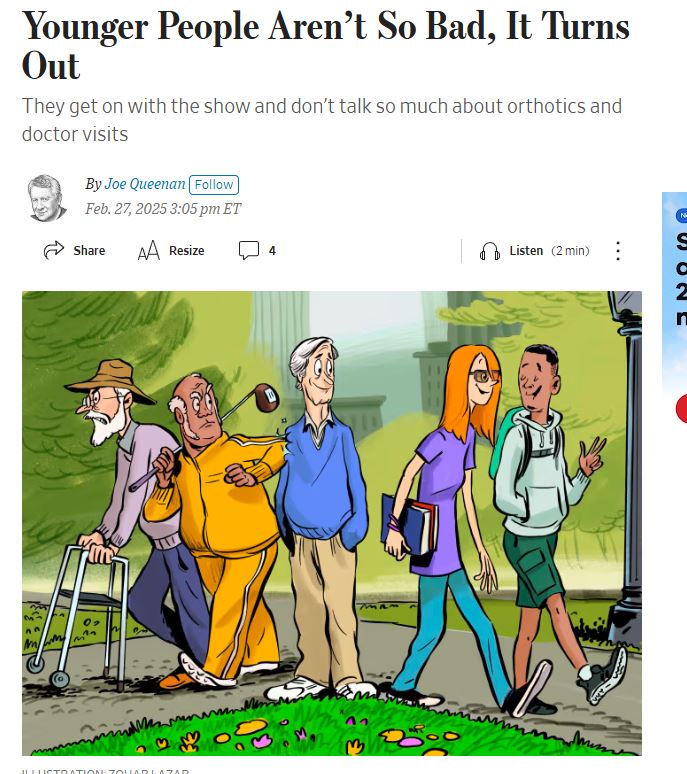
It may be hard to get past the paywall for this Wall Street Journal celebration of theater by Joe Queenan, my old friend and collaborator on four plays — Alms, Grudges, Genealogy, and The Oracle, but it’s well worth the effort. Joe enthuses (a rare occurrence) about putting on a play right now with a young cast and director and felt rejuvenated by people “who were still excited about their futures” and didn’t talk about their orthotics. 🙂
And, yes, of course, I am the old friend referenced in the first paragraph (who wears orthotics and has talked about them — they’re great and with that battered body of Joe’s from our basketball days Queenan should get some.)
Joe on the far right looking scheming how to turn this photo into one of his WSJ columns Photo Bill Wadman
I owe my 2018 return to theater after over thirty years away in large measure to Joe Queenan and I’m glad to see him succeeding with his latest effort The Counterfeit Moron, which only has one more performance left at 2 PM on March 2 at The Chain Theater as part of their Winter One Act Festival. I’m not sure if it’s sold out — the first 3 shows were — but The Chain often has last-minute walk-up tickets usually if you happen by 36 Street and 8th Avenue on Sunday. Terrific performances by friends and colleagues Ed Altman and Jasmine Dorothy Haefner as well as newcomer and star of Joe’s upcoming film Top Hate Tut Gregory Go Joe!
Chord: A straight line that connects the two ends of an arc
Many playwrights interested in self producing do not have the resources to avoid also holding down what people in the theater refer to as ‘straight job’. The phrase betrays a mindset that we also encounter; our theater work deviates from the straight and narrow, an ancient but still heard phrase indicating what the community deems as “the honest and moral or law-abiding way of life or … the correct and acceptable way of doing something.” Working in theater around the time that the phrase straight and narrow first appears — 1546, and very much in a religious context — was definitely not seen as a straight job. The Elizabethan era ‘Acte for the punishment of Vacabondes’ declared actors “vagabonds and masterless men and hence were subject to arrest and imprisonment.”) Today, the connotations of work as a playwright, actor, or producer lack that level of unsavoriness, but a straight job is still seen as something different: 9 to 5, regular, paying, maybe even benefits. It’s what many have to do in order to then squeeze into what hours and minutes remain their heartfelt desire of making theater live, to ascend the arc of a creative career.
Straight jobs are not just a reality for those in the theater. Recently, the New York Times published an inspiring obituary of Frank Auerbach, the great British painter that carried passages that many a theater person would recognize and admire.
Unable to earn a living solely through his paintings until the late 1960s, he taught, worked at a frame maker, took a job at the Kossoff family bakery in East London and at one point sold ice cream on Wimbledon Common.
Auerbach’s patience and ingenuity marks the self-producing artist. He believed not only in his ability to create something worthwhile but the necessity of his doing so even though initial circumstances didn’t favor such a pursuit. Isn’t that the case with so many creators who persisted until that effort changed the circumstances?
The same tenacity is true of Swedish master painter Harald Sandberg as noted in a wonderful study of his life and work by son Hans Sandberg. Harald’s own notes describe his difficult circumstances:
“One could say that not many people who survived to tell have been as sick and sick as often as I. My entire upbringing was one large suffering. I was condemned by 3 doctors when I was 5 years old. I had a double-sided pneumonia and my fever reached Fahrenheit 107.6 (42 C) …They said that there was no hope at all. Well, I fooled them, as I often did later in life.”
Harald with his lifelong heart condition decided to be a painter, but in order to support his wife and himself took the ‘straight job’ of hairdresser and opened his own salon. Speaking of that necessity, he wrote in his diary:
“to paint … seems to be the job that I should have gone for, but I did unfortunately not have the economic means for it. I cannot, with my health, starve and fare ill because I am unfortunately extremely frail. That’s why I have tried right from start to find a way to make a decent amount of money so that I would at least be able to paint a few months of the year at a minimum.”
And there are so many other stories of straight jobs that extended to allow and even buttress the arc of creation for writers, actors, painters and other artists. The medium of expression differs but the common element is persistence. Chekhov was a doctor, O’Neill spent several years at sea, David Mamet was a busboy and a cabdriver. In this American Theater article, several contemporary playwrights talk about the reality, frustrations, and even advantage of a straight job. The author of the article, Kari Bentley-Quinn, herself a playwright holding a straight job as well, aptly makes the argument for her other dual focus colleagues :
“A lot of us work 90 hours a week or more balancing our money job with our playwriting job. What is more evidence of commitment than working so many hours and being tired all the time? If you can do that, it is because you truly believe in and love what you are doing. You are willing to do what it takes.”
What comes across again and again in such accounts is the necessity for persistence toward the goal of making theater to avoid the gravitational pull of making that straight job your only occupation. Persistence is even more critical to achieving your goals of self-producing your work.
That’s not just my opinion. One of the great advantages of my straight job arose from almost twenty years of close association with scientists studying those attributes that make us successful in any endeavor. Two of them, Ralf Schulze and Rich Roberts, demonstrated that persistence and conscientiousness were more important factors in attaining success than even intelligence. Looking at the psychological definition of conscientiousness, several of its facets will seem familiar to any veteran of working a straight job while also maintaining your creative efforts: Industriousness, Procrastination Refrainment, Task Planning, and Perseverance.
As cautioned, these valuable traits of persistence and conscientiousness in self-producers can be a double edged sword. John Dos Passos splendidly describes one difficulty that arises from applying ourselves to the straight job: that career then encompasses us. The controls of tasks and schedules, meetings and commutes control and contain while within them we display extraordinary competence. Why extraordinary? (yes, there are straight jobs through which we might sleepwalk or worse.) Artists offer the extraordinary in performance because Unlike characters in the TV show Severance, we do not shut off the other parts of our minds and spirits when we walk into the office or restaurant. We come possessing conscientiousness and, of course, creativity.
That latter quality, which includes the propensity to see connections, open-mindedness and centeredness, imagination, invention, and originality, also will surface in those workplaces often leading to requests to do more there for greater rewards. The stages of life are not inevitable, but they often involve increased expenses as we willingly take on responsibilities of partnership, marriage, and parenthood. Those needs tip our time/space scale toward the activity that is going to solve the problem of finding a bigger place to live or a better means of transport or making sure the kids are well-fed. That’s likely to be the straight job and since our resources especially our time remain finite such a calculation may reduce the amount of time available to make our art. If we add to the required hours to write a play, the additional blocks of time to self-produce the resulting work the squeeze becomes evident, even palpable. The situation tests us. The good news is that like Frank Auerbach we can prep for and pass that test.
Head of E.O.W. fair use Frank Auerbach Estate
Self-producing as test with straight job for extra stress credit
Yes, I think of the experience of holding a straight job and also working to self-produce a play as a test. Given my own straight job at Educational Testing Service (ETS) that I should propose this as one way of looking at life — and before people freak out I am stating plainly that it is only ONE way of looking at life — should not surprise anyone. Much to the consternation of even members of my family, I have long held that a viable and useful way of viewing our existence is as either a series of tests or just one long test. Obviously, I don’t consider a test to be inherently a bad thing.
Consider this definition of a test: “a procedure intended to establish the quality, performance, or reliability of something, especially before it is taken into widespread use.”
We are testing ourselves all the time as to whether we can do something, whether it is going to work out, whether its output is sustainable. That’s what Frank Auerbach did. He was testing his ability to keep up what mattered to him most, his daily painting, despite circumstances that might have thwarted another artist. Obviously, he passed with flying colors as they say. Requiem in pace, Frank.
Certainly, many people find tests of any kind stressful. Stress results when the perceived demands of a situation exceed our perception of our abilities. The stress of bending the arc of creativity to meet the straight line of the job that pays the rent can be of all varieties acute, event-based, daily, and chronic. The following very apt description by Peter James from his insightful blog Diary of a Failed Comedian fits what many creators (definitely playwrights and actors) decry, but undertake anyway because they believe (perhaps realistically) that their goals require this regimen.
“I’m glad I no longer have to be out at all hours of the night, riding the subway to different shows and open mics, attempting to grow and network my way into a functional career. I’m glad to be rid of the constant nagging sense of disappointment that comes with falling short of your goals. I’m glad I no longer have to shamelessly promote myself on social media, dying a little inside every time I press the “Share” button.”
When fatigue and disillusion take hold, creators have several choices including abandoning such pursuits all together, pausing to recharge their batteries, and/or shifting their goals to another type of creativity that has less soul killing side effects. Good for Peter James for choosing the latter and subsequently giving us his takes on that world in essay form. That reality is why this guide to the self producing experience in theater emphasizes the cost — not just financial — of such an endeavor.
The warp meets the woof
“None Can say here Nature ends, and Art begins But mixt like th’ Elements, and borne like twins, So interweav’d, so like, so much the same.” — J. Denham
Playwrighting bears similarities to the ancient art of weaving. The woof are “the threads that cross from side to side of a web, at right angles to the warp.” Walter Benjamin noted the similarity: “Work on a good piece of writing proceeds on three levels: a musical one, where it is composed; an architectural one, where it is constructed; and finally, a textile one, where it is woven.” The architectural dimension of building a play was noted by Richard Schechner who wrote that we should think of “The playwright as wright — the play being wrought from the interrelationships among all the artists.” For me with a maternal grandfather who was listed on his Irish army pension papers as a cartwright, a carpenter who makes carts and my other grandfather a mechanic who ended up running the NYC Sanitation Department’s 125th Street garage fixing garbage trucks and snowplows, thinking of the playwright as wright is personally meaningful. Playwrighting and self-producing are about building and constructing. Doing so while also working a straight job add another dimension to that enterprise.
But compartmentalizing the areas may mislead. In none of these pursuits can we focus only on the parts or the elements. We must admit to their interconnectedness: how they fit and influence each other The whole of self-producing life is not only greater than the sum of its parts, but insistent that we attend to it as a unity. All of the aspects of self-producing interweave. Breaking the experience into 13 Ways for this book is both useful and artificial. Dealing with the situation of the straight job is an example of how the totality of the experience, which as noted can be overwhelming, sends us back to employing several of the 13 Ways: self-reflection, self-care, self-esteem — yes, lots of self in self-producing. And it’s not for everyone every time. We may move in and out of that mode depending upon our circumstances.
The good news arising from our exploration of self-producing playwrights is that with the application of that critical conscientiousness they make theater. The straight job sustains and supports their creative arc. It is possible to make theater live while also making a living in other ways. What might be impossible just trying to understand everything that is going on while you are self producing. That act (like the act of its preliminary actually writing something worth producing) evokes the description of James Salter “You never know what you’re really doing. Like a spider, you are in the middle of your own web.” That means we must keep spinning and see what emerges.
Lucian Freud’s portrait of Frank Auerbach; Patron Saint of the Artist with Straight Job
In our first installment of 13 Ways Of Looking At Self Producing (following up on our introduction to this series, we focused on desire and need as essential prerequisites to a success in such an effort. There’s little sense in pursuing a self-production of your playwrighting work unless you have some measure of those two elements. But the need to self-produce continues to grow, which may turn even more playwrights and actors to self-production. The Dramatists Guild of America states that the organization has over 8000 members and not all writers of plays belonged to the Guild — although they should IMHO. Conversely, the number of theaters available to stage plays continues to wane as the New York Times reported last July. Emailing the theaters registered in the Guild’s resource directory last year recently saw a bounce back of more than one out of every five emails because those companies listed no longer existed. (Community theaters have proved hardier in that there are still 6000 of them according to AACT. While they tend to mount productions of already legitimately presented plays, you should check out their new play festival that will start to accept the next wave of script submissions on May 1st 2024.)
Gotta fill those seats to have theatre
Theatre has always been as Tom Stoppard pronounced “a series of insurmountable obstacles on the road to imminent disaster” but having less stages than ever is an obstacle on an entirely different level; we can’t even find that road to disaster. When Michael Paulson of the New York Times declares in the above linked article that “There is less theater in America these days. Fewer venues. Fewer productions…” this choice to self-produce seems not so much brave as obligatory; “All theater is sharing…”, Michael Hordern argued, “You share with the audience.”. As Simon Callow wrote of Michael Chekhov, “It was vital, he said, to engage with what he called ‘the will of the auditorium’, to reach out to each member of the audience and share the creative act with him or her.” Part of what is being self-produced is an audience to share in this co-creation. No audience, no sharing, and no theater.
Examples of playwrights and colleagues who felt this imperative to self-produce abound in the recent Gothamist article: they’re using basements. dining rooms, and restaurant patios. There are tips on how to produce in spaces such as outside venues and as Sebastiano Spinella of HowlRound noted, “Historically, the time in which performances took place in real theatrical buildings is relatively limited compared to the phases where the stage space was an open space: a market, a fair, a square, a street, or a churchyard.” (Even distinguished performers such as LaChanze felt the need to become a producer although she isn’t forced to resort to “loft theater” to get her show up.) In our case at Knowledge Workings Theater, self-producing though arduous at times accomplished all of our objectives starting with an enormous assist from Orietta Crispino at TheaterLab by placing our first show in TLab Shares. That meant we got to: 1) Create a new piece of theater — #maketheaterlive 2) Provide well-paying work for talented actors and craftpersons 3) Raise the profile of that same group through publicity and social media efforts so they can continue to #maketheaterlive
In Way # 3, we’ll deal with another aspect: the fear that self-produced means self-centered, but until then PLEASE comment, criticize, and/or collaborate with your own take on self-producing.
Jasmine Dorothy Haefner, T.J. Elliott, Gifford Elliott, Kat Reeve, Daniel Thompson, Jeremiah Alexander, Marjorie Phillips Elliott at the January 16th, 2025 reading of RETROSPECTIVE at TheaterLab