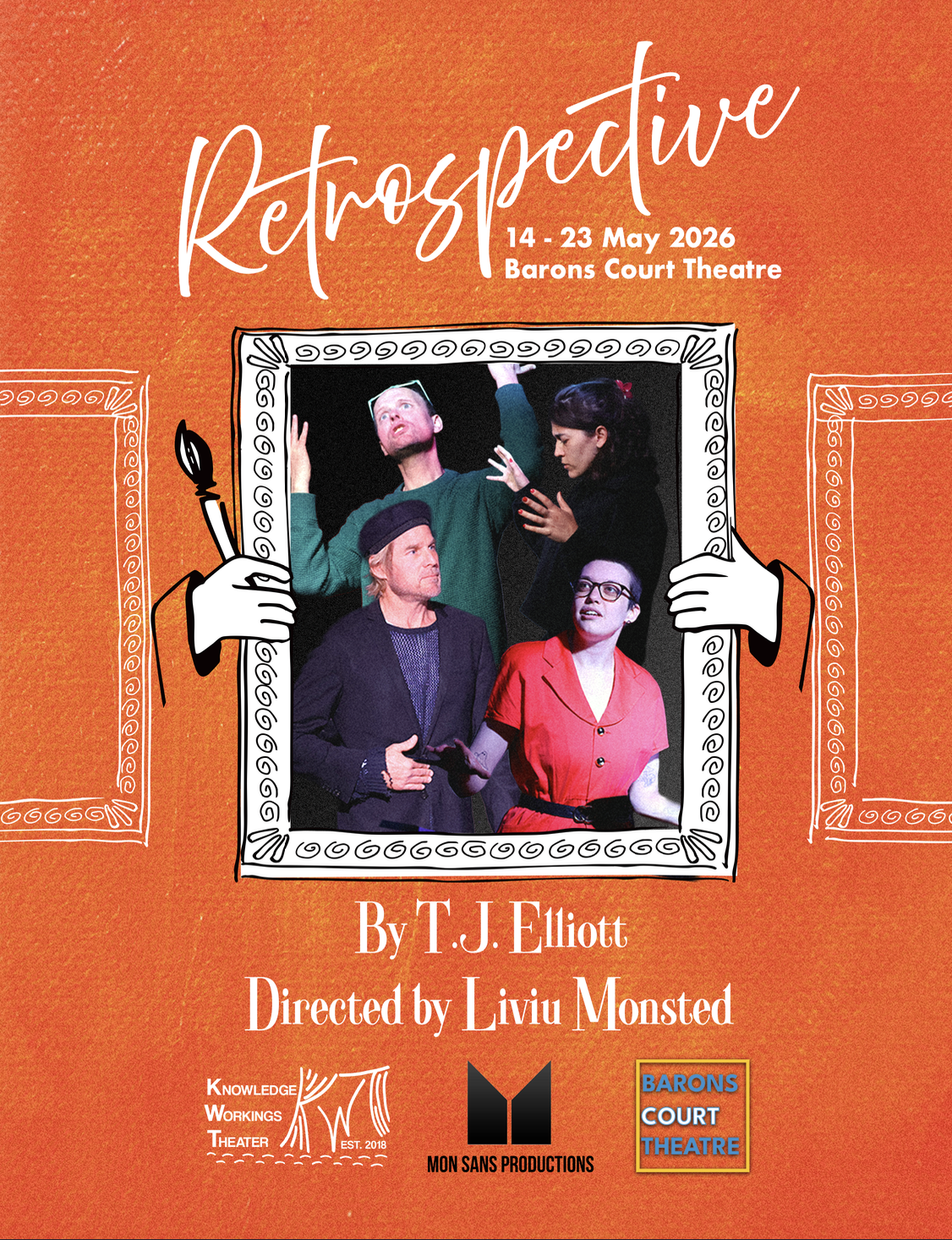
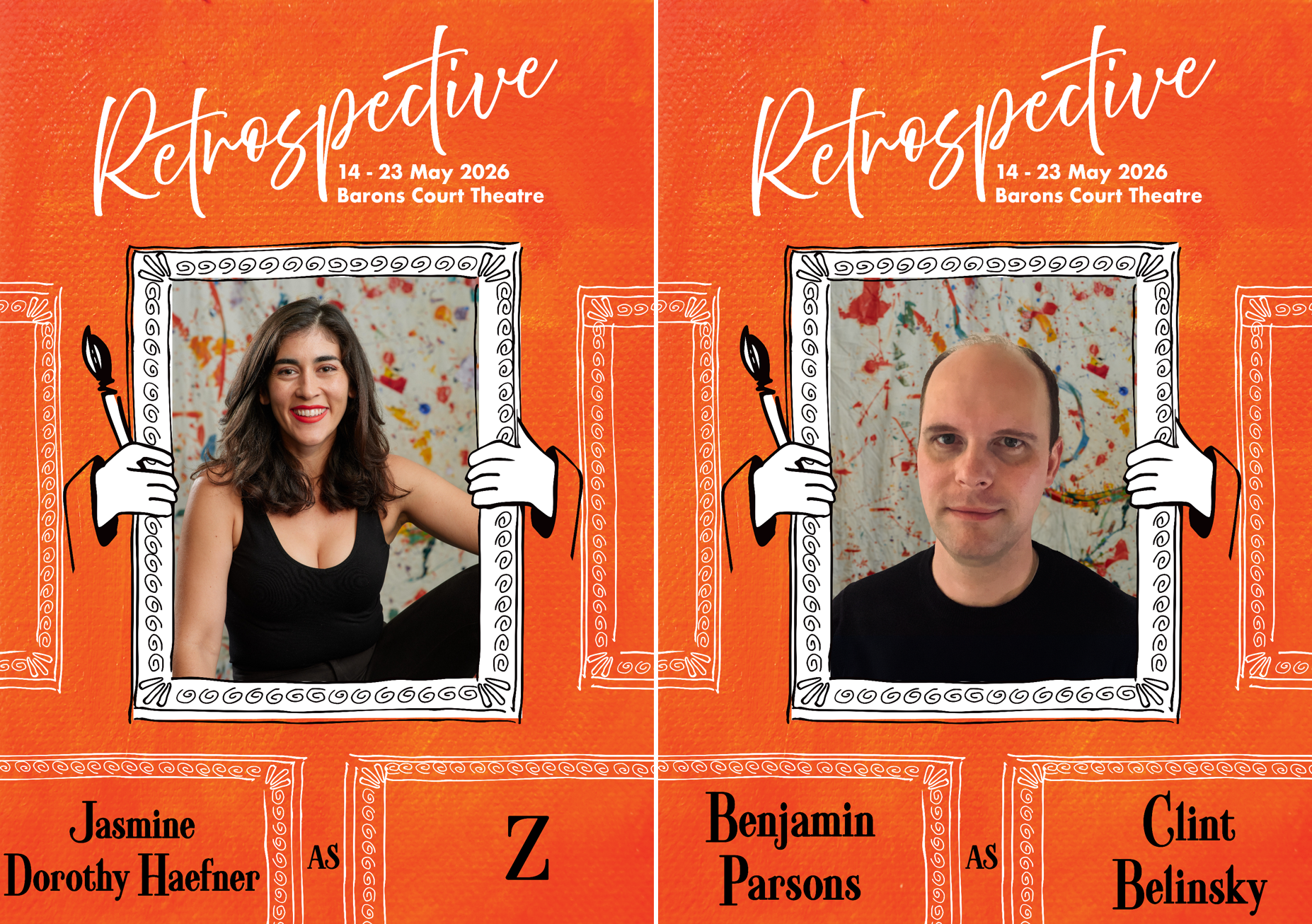
Lucky to have this pair making theater live in the UK premiere of RETROSPECTIVE
Here’s what our Jasmine Dorothy Haefner(Z) & Benjamin Parsons(Clint Belinsky) said
How lucky are we to have in the cast for our upcoming UK production of RETROSPECTIVE, friends and colleagues, old and new, who want to make theatre live. Jasmine Dorothy Haefner who plays Z, an acerbic critic, in this magical mystery tour of a comedy first worked with KWT in 2020. Here’s why Jasmine makes theatre:
Why make theatre? Because it’s fun!
We only met Benjamin Parsons at casting for this production, and yet already feel we have gained a stalwart companion and kindred spirit as he becomes Clint Belinsky, the rogue painter and laid-back lover in RETROSPECTIVE’s ‘menage a quatre‘. Here’s his thoughtful take on why making theatre matters to him:
Benji like many of us in theatre is there for the storytelling
In our previous post featuring the other half of this quirky quartet, Noah Huntley and Sarah Pearcy, we shared how the pandemic’s shuttering of theaters stirred our commitment at Knowledge Workings Theater company to #maketheatrelive. We needed that rush of creation and power of performance even if the work went into pixels before it got to people. Felicitously, many theatre artists joined that cause first in our Zoom productions Grudges in that crazy Spring of 2020 followed that autumn by Within The Context Of No Context by George W S Trow, and the Swedish screwball comedy, Keeping Right.
Happily and gratefully, thanks to a co-production with the pioneering and innovative Broom Street Theater in Madison WI in November 2021, we got back to making theater on an actual stage with our third play, Genealogy before a live, laughing, sighing, and physically present right before us audience . This ‘making’ then continued through our Off-Broadway productions of The Oracle (2022) at THEATRE FOR THE NEW CITY, The Jester’s Wife (2023) at The Chain Theatre, HONOR (2024) at Gene Frankel Theatre, and now Retrospective, which debuted at the Broadway Bound Theatre festival at the AMT Theatre on West 45th St. in Manhattan August 2025.
Now UK theater lovers can enjoy Jasmine and Benji along with Sarah and Noah in the shadowy bantering world of RETROSPECTIVE at Barons Court Theatre May 14-23 by clicking on the button below
Want to know more about the comedy that New York critics called “ more complicated and more multidirectional than one first assumes“? Click here for deets and treats
Nine years ago, this community embraced me for the last time as their colleague and so-called leader. (Anyone who knows this group realizes that they often did the leading) For 17 years, the energy, intelligence, and compassion of these people — and many not pictured — not only made positive differences in that organization but formed the most satisfying experience of my ‘straight job’ years. I was so darn lucky. Sadly, some of these folks are gone. Happily, many are making a difference in new communities. Blessedly, more than a few in their ‘post straight job’ days now can follow paths to creativity and satisfaction in other ways. Here’s wishing good times, good luck, and good health to those of us still making things happen each in our own way.
Luck is the residue of design as Branch Rickey wisely opined. And our co-founder, T.J. Elliott, had the good luck to plan his visit to Portland to be at the opening of Claire Elliott’s show at One Grand gallery of her paintings AND his grandson’s magnificent Paw Patrol themed fifth birthday party just as POTUS designated that city to be a ‘hellhole’ in need of military intervention. His journalistic work ended up on the Jimmy Kimmel show — go to 7:07 at this link — and garnered 54,000 views on YouTube. Knowledge Workings is proud of this daring reporting by such an old man.
Jeremiah Alexander smiling because he knows how much audiences will love his portrayal of Clint Photo Bill Wadman
For playwright, T.J. Elliott, and actor, Jeremiah Alexander, this collaboration stems from September of 1978. Alan Brody as the male leads in a regional production of George Bernard Shaw’s The Devil’s Disciple. First, they were fellow actors, then for a time roommates, and later, and always, friends as both moved to NYC to pursue careers in theater. They both studied with acting teacher legend Terry Schreiber and appeared on stages that happened to be in cellars, barrooms, lofts, and even occasionally a real theatre.
A pledge was made by T.J. once he turned to playwrighting in the early 1980s that one day he would work with Jeremiah and benefit from his chum’s comedic talent, irrepressible energy, and unique intuition. Necessarily working straight jobs and happily raising a family with wife and now Executive Producer, Marjorie Phillips, however, kept that rendezvous from happening until now, but the result is worth the wait. Jere enchants and entertains with the antics of Clint Belinsky, described in the script of RETROSPECTIVE as “late 60s, looks even younger, artist & enjoyer of life.” The last part is an understatement; Clint is a painter who admits, “Art was cool but some days I just heaved the paint up there and hoped for the best.” This so-called ‘seminal figure in the Soho crowd‘ concedes his “talent lay in a different direction” than his fellow painter and our protagonist, Rory McGrory (Mark Thomas McKenna), and apparently that direction took him into the arms of both Rory’s wife, Pippa LeFebvre (Adara Totino) and her best friend/his worst enemy, the ferocious critic, Z (Jasmine Dorothy Haefner). Rehearsals run long because we can’t stop laughing at Jere’s sparkling, loopy creation of this one of a kind character.
Jeremiah’s return to the stage comes after a long career in film, television, & commercials. Television credits include Mozart in the Jungle, Howl, All My Children, One Life to Live, & The Guiding Light. On film, Jere can be seen in Unfaithful, Inside Man, Goosed, &Half Baked. But where you really must see him to enjoy up close the laughter and charm he brings to his work is in RETROSPECTIVE. Get your tix today at this link or on TDF
“The play does not exist in the theater as a written text until it has been absorbed in the process of production. Drama is ‘translated’ or transformed into the person of the actor — “the body of the art of the theater”, as Stark Young put it.“ Harold Clurman, On Directing
‘The body of the art of the theater‘: Watching Mark Thomas McKenna* in rehearsal for RETROSPECTIVE, this quote came to mind. These words suggest one of the most important truths for any playwright or director: it’s mostly about the actor in theater that matters, theatre that moves us. Actors may not be everything in theatre but they form the essence of what we want to see on stage. Alan Ayckbourn, one of our greatest living playwrights and the clearest explainer of playwrighting, agrees; “Theatre is not about the writing, it’s not about the directing. It is about that, but in the end it’s really about the actors and the audience and most audiences – aside from the cognoscenti who sit there being experts – come to watch a bit of acting.”
Mark brings to this work (with our three other stellar actors featured on this page) more than 35 years of experience acting, devising, teaching, producing, and presenting ensemble created work for the stage. He blends the mimodynamics of two years at Ecole Jacques Lecoq in Paris with improv training from Second City. He incorporates insights gained at HB Studios with the great Herbert Berghof right alongside the clowning technique gained from studying with the great vaudevillean Avner Eisenberg better known as Avner the Eccentric. The latter skill showed up big time in his portrayal of Don Quixote.
But fundamentally Mark brings himself to the play, a grand artist who never stops learning while sharing his talent. Clarity of utterance, agility of movement, depth of feeling, generosity of spirit, and quickness of thought characterize his work. Make sure you see him as RORY in one of our three performances in RETROSPECTIVE
Clockwise from Bottom Left: Jasmine Dorothy Haefner, Jeremiah Alexander, Mark Thomas McKenna, Adara Totino [Cast photos by Bill Wadman]
Short Part #1: If you — like famous painter Rory McGrory — suddenly found yourself in a curious art gallery with nothing but empty frames only to be greeted by your dead ex-wife and two other old ‘frenemies’, would you think you were dreaming or were… you know.
That’s the quandary at the heart of RETROSPECTIVE where these past lives form a manic menage a trois plus one in this new comedy about art, attachments, and eternity.
Even Shorter Part #2: Buy tix here and feel free to forward, repost, and otherwise spread the word. Theater is nothing without an audience. Thank you!
It may be hard to get past the paywall for this Wall Street Journal celebration of theater by Joe Queenan, my old friend and collaborator on four plays — Alms, Grudges, Genealogy, and The Oracle, but it’s well worth the effort. Joe enthuses (a rare occurrence) about putting on a play right now with a young cast and director and felt rejuvenated by people “who were still excited about their futures” and didn’t talk about their orthotics. 🙂
And, yes, of course, I am the old friend referenced in the first paragraph (who wears orthotics and has talked about them — they’re great and with that battered body of Joe’s from our basketball days Queenan should get some.)
Joe on the far right looking scheming how to turn this photo into one of his WSJ columns Photo Bill Wadman
I owe my 2018 return to theater after over thirty years away in large measure to Joe Queenan and I’m glad to see him succeeding with his latest effort The Counterfeit Moron, which only has one more performance left at 2 PM on March 2 at The Chain Theater as part of their Winter One Act Festival. I’m not sure if it’s sold out — the first 3 shows were — but The Chain often has last-minute walk-up tickets usually if you happen by 36 Street and 8th Avenue on Sunday. Terrific performances by friends and colleagues Ed Altman and Jasmine Dorothy Haefner as well as newcomer and star of Joe’s upcoming film Top Hate Tut Gregory Go Joe!
You did it! The house opened, the seats filled, lights dimmed, and then rose again in the proper pattern to illuminate your story and the marvelous set constructed for this occasion. The actors costumed brilliantly moved and spoke as you imagined. Well, mostly as you imagined because the direction and their own imagination have brought new layers to the work. And now if you have done the job of publicity successfully, you’ll get to read some reviews. Don’t let them affect you too much.
(While the initial premise of this series — 13 Ways of Looking at Self-Producing — limited the observations about the experience of playwrights putting on their own work to thirteen perspectives, we only mentioned reviews glancingly in that sequence, and their rigors, realities, and ramifications deserve more attention. This post — a Bakers Dozen plus one — corrects that omission.)
Why do I offer that advice? Foundationally, I agree with the great poet and essayist Louise Gluck about what it takes to be a writer, which she described in a somewhat negative way explaining why her own father did not become a writer:
“…my father wanted to be a writer. But he lacked certain qualities: lacked the adamant need which makes it possible to endure every form of failure; the humiliation of being overlooked, the humiliation of being found moderately interesting, the unanswerable fear of doing work that, in the end, really isn’t more than moderately interesting, the discrepancy, which even the great writers live with (unless, possibly, they attain great age) between the dream and the evidence.”
Louise Gluck
In order to read the reviews usefully, you need those qualities even the best player in the best production is going to be viewed by someone out there with access to a website as a critic as having failed or only been found moderately interesting. It is highly likely that the ‘evidence’ of the review will be discrepant with whatever you and your team held as the ‘dream’.
DISCLAIMER: my relationship with feedback on plays resides in the eccentric column. I’m not looking for opinions about the work in the same way that many of my colleagues do. It just wouldn’t work for me. Jean Cocteau offers advice that makes sense to me: “Listen carefully to first criticisms made of your work. Note just what it is about your work that critics don’t like — then cultivate it. That’s the only part of your work that’s individual and worth keeping.” My process of writing and rewriting and then rewriting again depends almost exclusively upon my ‘familiars’: team members who have been with me from even before the eight productions of Knowledge Workings Theater, actors that I know trust, and a few other friends whose taste matters to me. So, the disclaimer is that I start off differently in my encounters with reviews than many other playwrights.
But there is a significant difference between getting feedback in forms like this one or NPS and getting a review. The wisdom of Edna St. Vincent Millay comes to mind “A person who publishes a book willfully appears before the populace with his pants down. If it is a good book nothing can hurt him. If it is a bad book nothing can help him.” And that’s just a book that might not even have your picture on the inside flap. In the case of the self-production of a play, the situation seems to be more full frontal nudity instead of just ‘depantsing’.
Previously in this series, we cited David Mamet’s assertion that “the correct study of the dramatist was neither his own feelings, nor those of the actors, but the attention of the audience.” Reviewers are certainly part of the audience, but I believe they need a different framing in considerations of self-producing. When we heed icons like Sarah Bernhardt stating that “The theatre is the involuntary reflex of the ideas of the crowd”, we should acknowledge that there is a segmenting in the crowd. Audience members do not all come with the same mindset. There are those who know our work and have returned, there are those who only know us and finally have decided to see one of our plays, there are those with whom we are unacquainted who have come to this particular play based upon some recommendation or report, there are those who came because it was a free ticket because as a producer you are wisely papering the house in preview week, and there are reviewers. We can roughly categorize each of those groups as arriving with a different mindset and even individual peculiarities, but the reviewer’s disposition merits a more specific examination. So, scroll a little further.
Your reviews aren’t all going to be like these.
Like any other member of the audience, a reviewer is going to project their own lives and experiences onto what you have written. And unless your play is Our Town, its content likely focuses on a particular dimension: families, workplaces, wars, etc. how will that work appear to audiences that have different experiences and perhaps no familiarity at all with the world of your story? Although you would already have these concerns as a playwright, you as the producer also have additional worries as to how viewers react to their work. After the first week, word-of-mouth especially in its contemporary version of posts and comments on social media platforms assumes a criticality in attracting audiences. And people do read reviews. There are dozens of little websites in the New York City metropolitan area for example that publish reviews of plays. Some of them have a specific theatrical emphasis and others or more general appealing to senior citizens or residents of a particular neighborhood. Getting reviews means getting attention, credibility, notice. But what you do with reviews is important not only for your success but also for your sanity. (Especially true for the actors reading this as Tom Briggs suggests here.)
Why impose this qualification? Because not all of the people writing reviews have a background in theater, dramaturgy, or even entertainment. Your reviewer might have spent their whole life as a dancer and political activist and your play is about the corporate world. That likely will result in a different sort of review than if your reviewer had to deal with bureaucracies because of their straight job or even just because their host organization is large enough to have such structures. Similarly, if your reviewer has spent most of their career as a financial analyst then you’re going to have that worldview seep into their opinions about your play.
Will this appearance of reviewers with limited or stilted experience matter in every situation? Probably not. Our first production, alms, which we unwisely mounted without any PR, publicity, or marketing advice didn’t get any reviews even though it sold out all of its performances. We learned from that circumstance and budgeted for the kind of consultation that does get you reviews. And in some cases, they have been uniformly positive. We still think it’s important not to pay to much attention to them.
But what if the reviews are missing the point? Our approach is simple: the only thing Iwant from a review is a pull quote. It doesn’t matter whether they like what I have written or hate it or misunderstand it. The job of a self-producing playwright is to find the most positive phrase you can and use that in your advertising. This is a long-standing practice of producers in movies and theater; check out this 1987 LA Times piece on the ploy. In fact, there was once a controversy in which the New York Times complained that quotes were being taken out of context.. (For more on David Merrick including his scheme to find people with the same names as prominent reviewers to offer their positive opinions, scroll down within this article and this one that are very good surveys of the effect of reviewers upon audience size.)
DISCLAIMER #2: I have practiced the art of the selective pull quote. (Apparently, this is not a good idea to do if your play is opening in the EU according to this 16-year-old Guardian article.) At the end of our week run, we received a review that was… less than affirming. We weren’t going to use it in marketing anyway because all of our ad and publicity budget was gone, but we did use it in a post. Nothing in the review seemed usable, but our wonderful PR guy Ron Lasko at Spin Cycle disagreed when I told him that. Here’s the review and here’s what Ron selected:
“Compelling… The strengths of the play lie in its situation, its embrace of ambiguity, and its recognition that people are, well, people.“
Show Showdown
Pretty nifty. And anyone who wants to read the entire review from that source can certainly get the catalogue of weaknesses that were identified. I offer this additional way of looking at self-producing in the same spirit that informed the original compilation of thirteen: we need to make theater live. That takes talent and guts. There may be reviews that are negative and yet in some way accurate, and we will learn from those along the way. But not while we’re in the process of trying to put audiences in front of our actors and vice versa. We all would to our team to do the best we can and then absorb the learnings as to how we can do better.
Practice the art of the pull-quote with your reviews and don’t let them pull you down. But do let us know what you think as a self-producing or other kind of playwright. We’d love to hear and read your considerations on this subject.
PS Here’s what ChatGPT said about our play; AI is more sophisticated than I imagined considering they didn’t actually pay for a ticket or show up even to claim a comp.
Ronnee (Alinca Hamilton) turns the tables on Don (Ed Altman) in HONOR
FULL ADVANTAGE!
“Alinca Hamilton takes full advantage of this space and, acting with her body and face as well as with her words, letting the audience see her reactions, is quite funny…, showing us the ridiculousness of the situation.”
Roberta Pikser, Theater-Wire.Net
We knew that about Alinca as Ronnee Emerson but seeing Roberta Pikser’s review of HONOR in Theater-Wire.Net proved a gratifying confirmation and commendation of our colleague’s superb talent. Come to the Gene Frankel Theatre in lively NoHo neighborhood of Manhattan and see for yourself but you’ll have to do so before October 6th when this run where Alinca is joined by her two partners in corporate comedy, John Blaylock and Ed Altman ends.
“The play suggests that such a thing as honor is all but impossible, at least in a corporate setting, or perhaps that the concept is totally subjective, that no one really knows what it is. White male privilege is touched upon as one aspect of the elusiveness of the concept. Perhaps, as suggested by the insistence of the two men not to listen to each other, but to try to prevail, the idea of honor comes down to dominance. “
You have to see HONOR the play that Andrew Cortes of