Richard Schechner influentially described “The playwright as wright — the play being wrought from the interrelationships among all the artists.” Wright is a very old word in the English language signifying an artificer, a creator, a joiner as in cart-wright or ship-wright. I like the building aspect of being a playwright, the joining together of different parts; perhaps my favoring the word is because one of my grandfathers was a wainwright in Ireland, a wagon builder. We build our plays hoping to convey the audience somewhere interesting so I claim a kinship of craft with Grandfather Conn Connaghan whom I never got to meet.
That description of being a ‘wright’ influenced me as well when Schechner in his experimental work emphasized how “‘Performance’ ties together the performer, director, designer, and audience.” And the Assistant Director – the person upon whom the entire ensemble depends for so many things as these disparate elements join together.
When we did our initial Zoom reading of Genealogy in preparation for its opening this Friday night, November 5, at Broom Street Theater in Madison Wisconsin, the script was a mere frame upon which the reading allowed us to see how all of these other people could construct a meaningful and entertaining performance. But first we needed their opinions as to where we should shave and where we should extend this frame. And the opinion expressed by Martha White, now Genealogy’s Assistant Director, mattered a great deal to me. She told me critical feedback and then concluded our call by stating that if this play moved forward that she wanted to be involved. From the little bit that I knew Martha at that point, her expression of commitment to our play meant a great deal. Encouragement matters a great deal to the builder.
Besides being our Assistant Director, Martha is an actor who has appeared recently in Alice Childress’s classic play “Trouble in Mind” and Jan Levine Thal‘s “Fake Mom”, both with Krass Theatre in Madison. Martha has hosted several television shows, including the Emmy Award-winning “Cultural Horizons of Wisconsin” for Wisconsin Public Television [which is now called PBS Wisconsin]. We are so grateful that along with the authors, cast, crew and audience she is helping to #maketheaterlive.
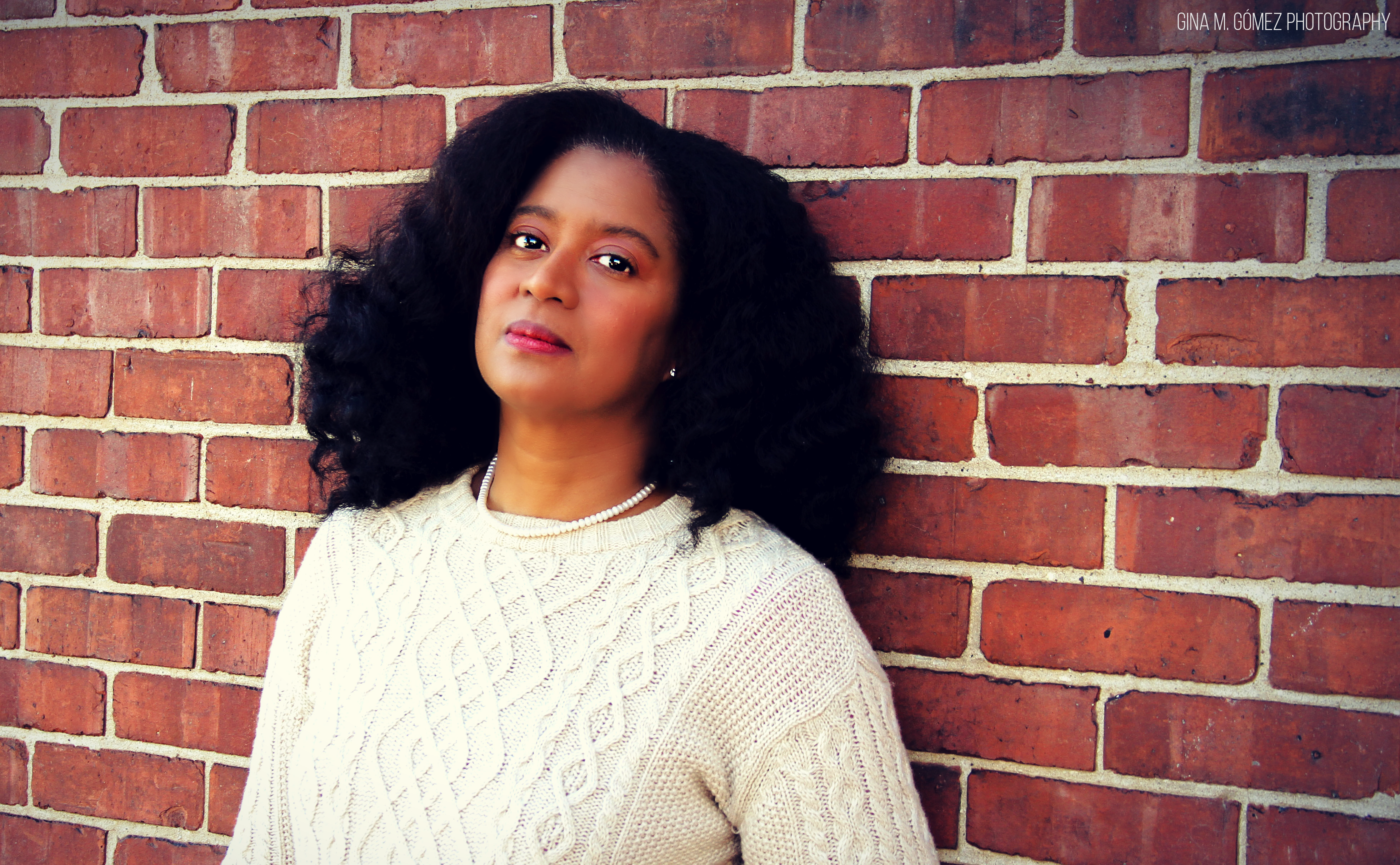
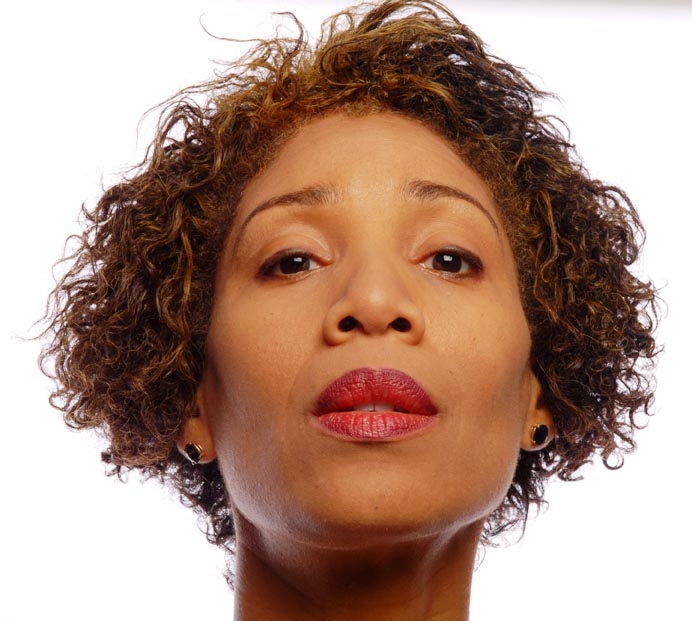
(l-r) Top Row: Atticus Cain, T.J. Elliott, Dana Pellebon, Jamie England, Martha E. White Seated: Quanda Johnson, Donavon Armbruster, Jackson Rosenberry photo by Karl Reinhardt
The combination of the lingering effects of the pandemic and the distance to Madison, Wisconsin from our homes in the New York City area meant that Joe Queenan and I did not meet many of the actors in our Genealogy cast in person when we had our Zoom table reading a few months ago. And then when we were auditioning several actors for the part of Glenn Weber, the former MTV personality now hosting what another character in the play describes as the “tabloid version” of ancestry podcasts, watching applicants on video was the only method available to us. Jackson Rosenberry stood out even on that colder medium for his energy and inventiveness.
Thus, I wasn’t surprised when we asked for his bio after he was chosen for the role to read its very first sentence: “Jackson Rosenberry is very excited to work on this production.” Finally meeting him a few weeks ago in person and watching his work in the first two rehearsals, I realized that this was something of an understatement. Jackson plunged dynamically into the role and I found myself cracking up at the ingenuities of his interpretations. He also read the script so carefully that he caught a mistake we had made in describing someone’s ancestor. I don’t think I will ever get over the sensation of gratification that comes from recognizing someone has read our words very carefully.
As I learned more about Jackson’s work in the theater, I understood the strong foundation that he brings to our work. Since moving to Madison in 2017, Jackson has been involved in multiple productions around Madison including Henry IV Part 2 and The Merry Wives of Windsor, both produced by the Madison Shakespeare Company. He has also been involved with several productions at Broom Street Theater, including Lysistrata, and Hamilton: The Original 1917 Broadway Smash Hit. Having an opportunity to grab a drink at the Weary Traveler after one of the rehearsals with Jackson, it was very clear how very happy he is to return to Broom Street once again to bring the love of theater back to Madison after such a long time. And that long time is now less than a week before Genealogy directed by Dana Pellebon opens at Broom Street Theater Our live stream on the Broom Street YouTube channel will be on November 19 and we are very happy that Jackson Rosenberry will be part of our fine cast.
In my own biography, allusions to 35 years away from active work in the theater receive comic treatment: “In those lost years, T.J. produced, directed, and performed among casts of thousands in a mélange of corporate telenovelas and tragic, comic, melodramatic, and semi-absurd organizational performance art.” But as Sigmund Freud pointed out jokes even self-deprecating ones like the above example can camouflage what is very serious in our lives. Freud noted in what had to be one of his lighter moments that “our enjoyment of a joke is based on a combined impression of its substance and of its effectiveness as a joke.” The effectiveness is not just getting people to laugh, but also at times a way for handling something that was uncomfortable or even painful.
In my case, I missed theater terribly, and explaining more than three decades away from it remains slightly difficult. The good news is that all of that earlier theatrical career — writing, performing, producing, directing, pitching, — proved enormously useful in my succession of straight jobs. In a wonderful example of consilience, a concept first introduced to me by EO Wilson of Harvard, a great deal of what I learned in those years of ‘semi-absurd organizational performance art’ enriched my subsequent playwrighting and indeed my understanding (limited though it remains) of how the world works.
I read and learned a great deal about the way the world works: everything from adult development to adult learning, from knowledge management to project management, from leadership to followership, from neural networks to social networks. From that latter domain, academic papers like this one about the concept known as the Strength of Weak Ties introduced by Mark Granovetter proved useful in those corporations and they prove useful today in trying to #maketheaterlive, which is our motto at Knowledge Workings.
Atticus Cain, who plays Mosiah Wilson in our upcoming production of Genealogy at Broom Street Theater opening next Friday, November 5, could serve as a textbook illustration of Granovetter’s points about how the weak ties in our network, the friends of friends offriends if you will, may prove more valuable to us than our immediate circle in many circumstances.
Ed Altman, who first worked with Knowledge Workings in Grudges when that Queenan-Elliott drama went up live on Zoom in May through July 2020, was in another streamed theater piece that summer, The Statement, hosted by Theater for the New City. Ed invited me to see the piece and that was where I first viewed Atticus. Thus, when I was casting my solo playwrighting effort, Keeping Right, for its live Zoom performances in December, Ed recommended Atticus to me for the part of Sven McManus. Perfect. This kind of connection happens all the time in every type of work, but in theater where the usual structures of workplaces are not available or do not apply being introduced to a powerful actor whom you otherwise would not know is a kind of mighty grace. You’re not sure how it works, but you’re awfully glad that it does work is often as evidenced. As Jeffrey Rush famously pronounced in Shakespeare In Love, “It’s a mystery.”
And while we are offering quotes, this one that appeared at the end of Atticus’ bio seems also apt: “I am a series of small victories and large defeats and I am as amazed as any other that I have gotten from there to here” – Charles Bukowski. We are amazed as well and feeling very lucky yet again.
And as to the getting “from there to here”: Atticus Cain was born in Memphis, Tennessee, raised in part in Kalamazoo, Michigan, with his loving grandparents. Atticus lived in a total of thirty-five states while growing up. When he was recruited to substitute for a fellow student in a play, acting arrived in his life. After graduating, he advanced to local theater, appearing in plays ranging from Shakespeare to Guare until he moved to Pittsburgh in 1995. Cain resumed acting with a cameo role on the CBS series The Guardian (2002). Since then, he has performed stage and screen roles in multiple cities, including Chicago, Pittsburgh, and New York, Productions include the aforementioned Keeping Right (2020), Wrong Number (2003), and The Stranger (2004) and his own self-written short feature, Opposition. Some of his favorite roles are Sgt. Waters in A Soldier’s Play by Charles Fuller, Dr. George Washington Carver, in Carver at Tuskegee by Kyle Bass, Alan Beaumont in Deadline, and Dr. Jacob Carter in the original web series Dark Therapy, the story of a therapist who treats supernatural monsters…and a few human ones too. Atticus completed conservatory training in July 2017 at the acclaimed Atlantic Acting school.
Very soon, we will post the link to the November 19th live YouTube stream of Genealogy benefitting Broom Street Theater. With that welcome addition, everyone will get to see how strong our weak ties can be.
When Joe Queenan and I first created the character of famous lawyer Hamilton Hunt in Genealogy, our problem comedy in which “a shocking ancestral connection revealed during the taping of a reality podcast incites a series of surprising negotiations and unanticipated antics among its participants”, we drew for that figure upon attorneys we knew personally as well as famous attorneys whom many of us have viewed on television over the last few decades. While we didn’t seek to imitate any of those individuals, they served as useful reference points while we wrote and rewrote and rethought and revised and finally reached the finish line for the text, which is our third work to receive a production. In a Zoom table reading last April, I got to meet Donavon Armbruster and he did what good actors do: he brought the character of Hamilton Hunt alive in ways that neither Joe nor I had imagined but that make the story unfolding in our play compelling, comedic, and true. The last part is the most difficult and this cast including Donavon together with our director Dana Pellebon, assistant director, Martha E. White, and stage manager Karl Reinhardt astonished me in the two rehearsals I was able to see as they immediately made the story real in a way I could only hope would happen.
Donavon enjoys great familiarity with the process of taking a playwright’s text and making it real. He has been acting for over 45 years, both professionally and non-professionally, appearing in well over 100 productions When he starred in the film, The Evangelist, he talked in this interview about his 45 years of acting work. It’s well worth the read and I will let him speak for himself through that piece. Speaking for myself, I feel that luck mentioned in an earlier blog post as I get to enjoy having Donavon play this famous lawyer who ends up in a podcast not realizing how his life is about to get turned upside down.
We are grateful that he is playing Ham Hunt in Genealogy either live November 5, 6, 11-13, 18-20 or via our streaming performance on that final weekend. For those of you who can travel to Madison, you can purchase tickets at this link. We should have more details on our live streamed format soon; it will air on the last weekend of our run at Broom Street. Stay tuned for Donavon Armbruster as Hamilton Hunt in Genealogy!
While my co-playwright, Joe Queenan, was writing a dozen books and thousands of columns over several decades, my life required me to take several steps back from direct activity in the theater. That did not mean I stopped writing or thinking about plays; it just meant that I had to concentrate on my straight job because I was just not talented enough to dance that corporate tango and stage plays. But those moments in which I could consider theater yielded results that continue to be important now when I’m back full-time in this world. Several large drawers overflow with notes from that earlier era that may yet find their way onto the stage as plays and a few well-worn books that inspired me then persist still in nourishing my theatrical interests.
One of those books is by the playwright Alan Ayckbourn. The Crafty Art of Playmaking became one of the books of my ‘Bible’ guiding me in playwrighting. Perhaps counterintuitively, one of the most important messages Ayckbourn conveys emphasizes an element other than the writing: “Theatre is not about the writing, it’s not about the directing. It is about that, but in the end it’s really about the actors and the audience and most audiences – aside from the cognoscenti who sit there being experts – come to watch a bit of acting. … Stephen Joseph always taught me that you serve that wonderful moment between actor and audience. And that is the precious moment that live theatre has that no other media has quite to that extent and that is why I stick to theatre.”
I agree wholeheartedly with Ayckbourn’s sentiment and that is why meeting and then working with Jamie England who plays Muggs Moriarty in Genealogy, which opens in just a dozen days from now at Broom Street Theater in Madison Wisconsin, elated me so powerfully. Having an actress like Jamie who was not only capable of creating that “wonderful moment between actor and audience”, but also possessed such imagination and curiosity made me certain that a character that enchanted Joe and I as she came into being on the page would now be even more compelling on the stage.
That Jamie owns such talent is no surprise to those who have seen her act in Madison or elsewhere. After all, Jamie has been acting since fourth grade, when she gave a rousing, critically-acclaimed performance as the narrator in Cinderella. Here in Madison, Jamie most recently appeared onstage as Judy in Madison Theatre Guild’s 2019 production of Small Mouth Sounds. Other favorite local acting experiences include turns as Joyce in Body Awareness, Mattie Fae in August: Osage County, Nightshade LaVixen in Sweet William,Linda Loman in Death of a Salesman, JoAnn in Company, the unsinkable Narrator in You’ve Ruined a Perfectly Good Mystery, Lisa in Cancer Stories, Margaret Hughes in The Compleat Female Stage Beauty, Liz Morden in Our Country’s Good, and Arsinoe’ in The Misanthrope. We are very fortunate that she has taken on our Muggs as her next role and for those of you who will see Genealogy either live November 5, 6, 11-13, 18-20 or via our streaming performance will be fortunate to see her performance. For those of you who can travel to Madison, you can purchase tickets at this link. We should have more details on our live streamed formants, which will air on the last weekend of our run at Broom Street. Stay tuned and don’t miss Jamie!
Luck is the residue of design. That’s a saying by Branch Rickey whose fame as being the first courageous general manager of a Major League baseball team in the 1940s to integrate the game through the addition of Jackie Robinson to the Brooklyn Dodgers squad of 1947. Many other figures of that day are forgotten but Rickey persists in the popular imagination to this day as an example to all of us to have the courage to lead change, to design our lives so that we will have the luck we need. My luck is very much in my friends. And the design that produces that luck of companions may seem inconsequential until we have the opportunity of retrospective. We meet a lot of people when we are young, but choosing with whom we continue to be friends represents a channels of choices, choices that we made. Who we have as friends is not accidental, the way in which we continue to stay in touch with them, to attend to those relationships, to be a giver and not just a taker, is a kind of design.
The linkages among friends accounts for how we now enjoy the extraordinary good fortune to have Dana Pellebon as Director and Co-producer of Genealogy nearing its opening on November 5 at Broom Street Theater in Madison Wisconsin. How so? Through a lineage of friendships that stretches back half a century. I first met John Clay over 50 years ago in the Players at Manhattan College in the Bronx where John was a few years ahead of me and an outstanding actor and director. Our friendship continued through lots of changes in our lives so that when Joe Queenan and I wanted a director for Alms, our first Equity showcase production at TheaterLab in May, 2018. John was the obvious and… lucky choice.
That meant that when I decided to stage a reading of Within the Context of No Context, the seminal 1980 New Yorker essay by George WS Trow, I asked John not only to be part of that cast but also to suggest other actors. He introduced me to Quanda Johnson. My connection to Quanda was so immediate and rich that I dared to ask her to read our play Genealogy and consider playing the part of Aaliyah. She said yes and when I told her I really needed to find a director who could help us to bring this work alive in a dynamic but sensitive fashion she introduced me to Dana Pellebon, whom she described in our first joint email as “a force to be reckoned with in the world of Madison theater.” Understatement alert!
The design part of this luck is putting myself in a place where I get to meet wonderful artists and establish links to their lives and work. The luck part is Genealogy gaining the perfect director for this play where secrets in family trees surprise two couples appearing on a ‘reality’ ancestry podcast. Again and again since that first email introduction, I’ve had the opportunity to thank my blessings in gaining Dana as a collaborator for a ‘problem comedy’ in which the characters manage audaciously to conjure a few shocks for each other and their host while also confronting some key culpabilities in our country’s heritage.
One bio describes Dana as “a Madison, WI based activist, artist, and educator.” Even with my acquaintance being fairly recent, I find this description insufficient. Her work in Madison is already legendary including such important innovations as helping to make a Black Theater Festival happen there. The breadth of her work encompasses achievements such as directing the powerful Dominique Morisseau play ‘Detroit ‘67 ‘ and being part of the Peach Pies Caburlesque group. She has been a regular director and producer with StageQ and other local theater companies including our wonderful host theater for this production Broom Street. Dana acts sometimes, too, as in in StageQ’s 2018 production of “A Lady and a Woman,” about two Black women who fall into a romantic relationship in a small, late-1800s town.
More recently Dana was one of the organizers of the Loud ‘n Unchained Black Theater Festival. She has served as Chair of the 2020 Magic Pride Festival planning committee and a member of the Outreach board. I have to stop and just say luck is the residue of design and we can’t believe how lucky we are to have Dana Pellebon not only as director but as co-producer of Genealogy. Another piece of luck that we recently heard from Doug Reed , Artistic Director of Broom Street, that we will be able to have a live streamed performance of genealogy available to people all over the country and indeed all over the world as was the case with earlier Knowledge Workings Theater productions. That means everybody else will get to see how lucky we are to have followed the connections to Dana Pellebon.
There are three women without whom this play, Genealogy, doesn’t happen. Joe Queenan and T.J. Elliott had worked on Genealogy for well over a year, but as one of their relatives had opined, “What are two white men doing writing a play about race, slavery, and reparations?”
Indeed. We had the same nervous thought occasionally and wanted to reach out to others we respected to get the opinion of those whose heritage IS the major subject of this work. Cheryl Aaron , a dear friend and former colleague, was the first reader to encourage us to keep on going, and that allowed us to believe in our own work in a different way. Then Quanda Johnson, who first connected with Knowledge Workings Theater in the Zoom production of within the context of no context by the late George W.S. Trow in November 2020, read the script and encouraged us to mount a production of Genealogy. One of our heroes, Seamus Heaney wrote of writers that “we must teach ourselves to walk on air against our better judgment.” But when someone like Quanda emboldens us with her support, that walking on air comes more easily.
Anyone looking even casually at all of the superb things that Quanda has done and accomplished will understand the joy that we felt at her acceptance of our work. (The third woman giving us courage, of course, was our marvelous director and co-producer Dana Pellebon to whom Quanda introduced us, but more about Dana in the next post in this series.)
Quanda is a Fulbright Scholar and a current doctoral student in Interdisciplinary Theatre Studies at UW – Madison, pursuing a doctoral minor in Afro-American Studies. She is now at the dissertator phase. As a Dean’s Graduate Scholar at New York University’s Gallatin School (MA 2017), she presented her work, In Search of Negroland: a different study of the negro race and The Ballad of Anthony Crawford: a love letter to americaat the Gallatin Art Festivals 2016 and 2017.
From Broadway to grand opera, Quanda seeks ways to utilize performance to disrupt and consequently alter entrenched, cyclical conversations about Blackness and the African Diaspora. Awarded the Fulbright Community Leadership Program Grant, she wrote, edited, and directed Beyond the Veil of the Sorrow Songs, which examined the Underground Railroad related to Atlantic Canada, Quebec, and current Maritime racial issues. Performed in the spring of 2014 at Nova Scotia’s Dalhousie Arts Center (Halifax) and Alderney Landing Theatre (Dartmouth), it was welcomed at New York University (February 2018) at the Skirball Center for the Performing Arts.
Quanda earned a MFA in Acting from New School University and a Master of Music degree from the Conservatory of Music at Brooklyn College. An AUDELCO Award nominee for her portrayal of Marian Anderson, she appeared in Broadway’s Tony award winning Ragtime and made her New York City Opera debut in The Mother of Us All with Lauren Flanigan.
Her work is dedicated to the memory of the first artist in her life, her mother, Vernetta. We hope that many of you will get to see Quanda as Aaliyah Levin-Wilson in Genealogy November 5th through November 20th at Broom Street Theater or (as we are working to arrange) in a live stream of one of these performances. She brings to life with passion and intelligence a woman intent on gaining for her people what they deserve. Tickets are available for purchase here.
Broom Street Theater and Knowledge Workings present A Satire of Inconvenient Family Ties:
“Genealogy”
by T.J. Elliott & Joe Queenan
Directed & Co-Produced by Dana Pellebon
Presented live at Broom Street Theater, Madison, WI
November 5 – November 21, 2021
[Madison, WI — October 18, 2021] Broom Street Theater and Knowledge Workings present a new play by T.J. Elliott and Joe Queenan. The playwriting team’s third and latest effort, Genealogy, explores how a shocking ancestral connection revealed during the taping of a reality podcast which incites a series of surprising negotiations and unanticipated antics among its participants. The host of “Chasing the Dead” is Glenn Weber, a former “influencer” and erstwhile MTV emcee who attempts to finesse his guests – two high-profile, straight married couples, one black and one white – while wrestling with the demands of unseen supervisors in the Control Room. When Mosiah Wilson, a former all-star pro football player and his wife, professor and activist Aaliyah Levin-Wilson, meet home-maker and former prosecutor, ‘Muggs’ Moriarty Hunt and her husband, Hamilton Hunt, a high-profile lawyer whose presumably illustrious family tree is under scrutiny, a power struggle ensues. Individual allegiances seem to sway and shift over culpability for the legacy of slavery and the debate over reparations. For Director and Co-producer, Dana Pellebon, “The play, while a comedy, doesn’t shy away from issues of history, trauma, and paths moving forward. We need more conversations on reparations. We need to voice the pain caused by slavery and how to repair the enormous damage of the current and past history of white supremacy. Art is an important outlet to start conversations. Genealogy does just that.” Genealogy stars Donavon Armbruster, Atticus Cain, Jamie England, Quanda Johnson, and Jackson Rosenberry. Genealogy runs for three consecutive weekends: November 5, 6, 7 November 12, 13, 14 November 19, 20, 21 Tickets available at this site: /
Audience members will be required to show proof of Covid-19 vaccination at the door and remain masked at all times while in the building.repair the enormous damage of the current and past history of white supremacy. Art is an important outlet to start conversations. Genealogy does just that.” Genealogy stars Donavon Armbruster, Atticus Cain, Jamie England, Quanda Johnson, and Jackson Rosenberry. Genealogy runs for three consecutive weekends: November 5, 6, 7 November 12, 13, 14 November 19, 20, 21 Tickets available at: https://genealogy.brownpapertickets.com/ More information at http://www.knowledgeworkings.com and https://bstonline.org Audience members will be required to show proof of Covid-19 vaccination at the door and remain masked at all times while in the building. Dana Pellebon has acted, directed, written, and produced for a variety of community and professional theatrical troupes in the Madison area since 2001. She performs in/produces the Madison-based Caburlesque troupe, Foxy Veronica’s Peach Pies. She also produced three shows for the New York International Fringe Festival and is a co-founder of the Loud ‘N Unchained (LNU) Black Theater Festival. In 2021, she co-founded LNU Black Theater Festival and directed Good Bad People for LNU Black Theater Festival, directed 2 pieces in “Network Playwright 10 Play Festival” for Chicago Dramatists, and directed in Forward Theater’s Monologue Festival “Within These Walls”. She produces LGBTQ+ events for OutReach and other local not for profits. This is Dana’s first show with Knowledge Working Theater Company.
While Theatre isn’t just about words, those things that characters say usually matter a great deal both to the group presenting them and to the audience experiencing them. Unsurprisingly, a theater company with the name of Knowledge Workings does pay special attention to the words of others. Hence this post including a link to our commonplace book, a rather extensive list of quotations. T.J. Elliott began this commonplace book in 1990 and continues to add to its quotations as of August 2025. (He also collects quotes to read while playwrighting and you can read those in the Word doc at this link.)
What is a commonplace book? According to the Oxford English dictionary, it is “a book in which ‘commonplaces’ or passages important for reference were collected, usually under general heads; hence, a book in which one records passages or matters to be especially remembered or referred to, with or without arrangement”. The one by W.H. Auden is a good example of sententiae or wise sayings that are more idiosyncratic than still treasured quotation collections such as Bartlett’s or Oxford and the very political collection by George Seldes.
Wonderfully wise and droll
The version of our commonplace book that you have through this linkis on OneDrive. If you are looking for that killer saying or just ‘le mot juste’, perhaps you will find this collection, which generally captures quotes that are not found in the usual collections, to be of some value. To draw upon just one of our thousands of quotes in the word document, Sextus Empiricus in Fragment 2, as quoted in Against the Mathematicians reminds us that, “Though wisdom is common, yet the many live as if they had a wisdom of their own.”
A commonplace book acknowledges that wisdom is common if we only take the time to look to those who offered it in the past and even those sharing it in our present. For for those of us at Knowledge Workings Theater, our work begins with the text, but there is no illusion that whatever text we create is completely original, lacks connections to all of the many texts we have read and heard. One way into the creation of theater is to swim in the words of others, refreshed and challenged, submerged and afloat, until you reach your own spot, your own place where what you think and feel merges with what others have offered. As Tom Stoppard once wrote, “Words are sacred. They deserve respect. If you get the right ones, in the right order, you can nudge the world a little.”
On March 12 of 2020, Knowledge Workings Theater had scheduled auditions at the studios of Alliance of Resident Theaters in Manhattan for a staged reading of Grudges. Joe Queenan and I exulted at the prospect of hearing many talented actors read our work in the second of our ‘problem comedies’. (Our first was Alms, which as an Equity Showcase off-Broadway at TheaterLab, enjoyed a sold-out run in May 2019) We were ready to start the collaborative journey to get our new play upon the stage by early summer. We were psyched
You should have no difficulty guessing what happened.
Grudges did make it out to the world via Zoom as that staged reading in May and subsequently as a full production live but digital last July. Our company also managed in November a staged reading of George WS Trow’s seminal 1980 essay Within the Context of No Context on the occasion of the 40th anniversary of its publication in the New Yorker. Then in December, we had a rollicking good time debuting to delighted audiences Keeping Right, the mostly phony Swedish screwball comedy. Obviously, that play had to be performed on Zoom as well, but it helped us live up to our motto #maketheaterlive.
But before we did any of these productions, we celebrated St. Patrick’s Day virtually by getting friends and acquaintances to sing and recite pieces that evoked the warmth and fun and lyricism of that day. The Elliotts have hosted St. Patrick’s Day parties for well over three decades starting with a kind of seisun in Irene Elliott’s one-room apartment on W. 10th St. right next to the Sixth Precinct in 1987. Knowledge Workings Theater couldn’t let St. Patrick’s Day move by silently.
Those 27 videos from last year are still up for viewing on our YouTube channel here and we decided to repeat the experience this year only grander and gaudier. We hope never to repeat the experience of celebrating St. Patrick’s Day online for the rest of our lives, but as Spring approaches and many of us think that we can make out the outlines of that proverbial corner that we all hope to be turning celebration seems an apt activity.
How will this virtual Saint Patrick’s Day fest work?
You don’t have to be a professional singer; just listen to the guy in the video to the left for verification of that statement
Videotape yourself and/or others singing a St. Patrick’s Day song or reciting an Irish poem. (You don’t have to be on screen if that makes you uncomfortable; you can have the camera looking out the window or some other image.)
Just send us one video, please. We want to involve as many people as possible and there are only so many hours in St. Patrick’s Day.
We will post it on this YouTube channel so that they are all in one place
Oh, and that hashtag…Nowadays everything virtual has to have a hashtag and I’m proposing #virtualpaddysongs for this campaign. Again.
By now, some of you may be asking what’s the catch? There must be a price tag to participate. Not at all. We just crave your company for the celebration.
However… If you’re looking for a good cause on this day of Celtic heritage make a donation of whatever amount to Irish Rep. Buy a ticket to one of their online shows, drop a few bucks in their general fund, or donate to the capital fund for the refurbishment of their 22nd Street stages where we all hope to be very soon again sharing the superb dramas and comedies they produce. Their work during the last year entertained and edified so many of us. Our own motto is #maketheaterlive and Irish Rep did that splendidly. (We have no connection to Irish Rep whatsoever; we don’t even know the good folks except by their work. We just think it’s a good thing to give them money on St. Patrick’s Day.)