“The play does not exist in the theater as a written text until it has been absorbed in the process of production. Drama is ‘translated’ or transformed into the person of the actor — “the body of the art of the theater”, as Stark Young put it.“ Harold Clurman, On Directing
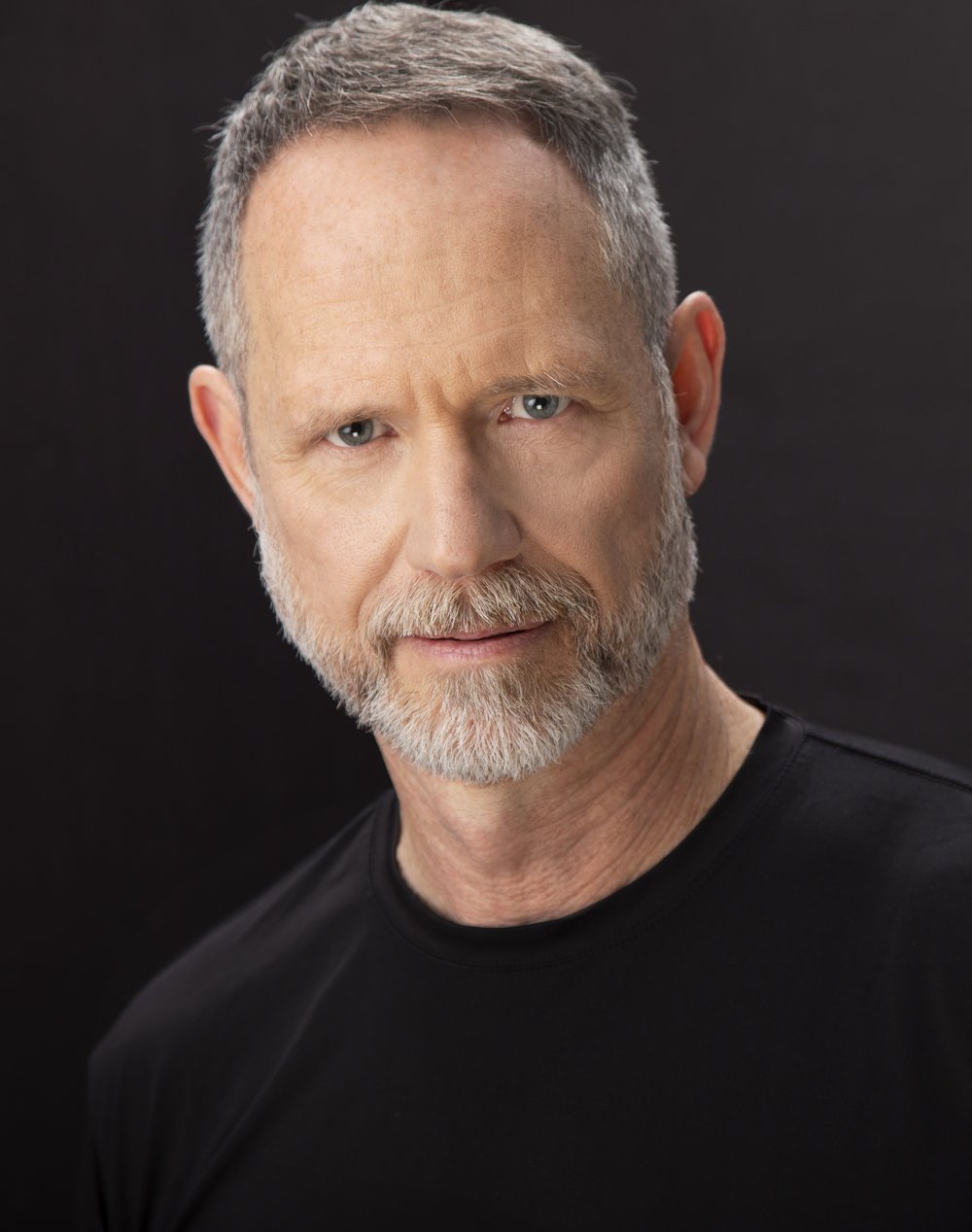
‘The body of the art of the theater‘: Watching Mark Thomas McKenna* in rehearsal for RETROSPECTIVE, this quote came to mind. These words suggest one of the most important truths for any playwright or director: it’s mostly about the actor in theater that matters, theatre that moves us. Actors may not be everything in theatre but they form the essence of what we want to see on stage. Alan Ayckbourn, one of our greatest living playwrights and the clearest explainer of playwrighting, agrees; “Theatre is not about the writing, it’s not about the directing. It is about that, but in the end it’s really about the actors and the audience and most audiences – aside from the cognoscenti who sit there being experts – come to watch a bit of acting.”
Mark brings to this work (with our three other stellar actors featured on this page) more than 35 years of experience acting, devising, teaching, producing, and presenting ensemble created work for the stage. He blends the mimodynamics of two years at Ecole Jacques Lecoq in Paris with improv training from Second City. He incorporates insights gained at HB Studios with the great Herbert Berghof right alongside the clowning technique gained from studying with the great vaudevillean Avner Eisenberg better known as Avner the Eccentric. The latter skill showed up big time in his portrayal of Don Quixote.
But fundamentally Mark brings himself to the play, a grand artist who never stops learning while sharing his talent. Clarity of utterance, agility of movement, depth of feeling, generosity of spirit, and quickness of thought characterize his work. Make sure you see him as RORY in one of our three performances in RETROSPECTIVE
Clockwise from Bottom Left: Jasmine Dorothy Haefner, Jeremiah Alexander, Mark Thomas McKenna, Adara Totino [Cast photos by Bill Wadman]
Adara Totino is PIPPA in RETROSPECTIVE Photo Credits — Bill Wadman
“Fine acting always hits an audience with the force and oneness of the well made bomb — one is only aware of the blast or series of blasts at the time–afterwards you can study the devastation or think about how a bomb is made.“ Alan Rickman
Adara Totino detonates delightfully as PIPPA in the new play RETROSPECTIVE in the leading comedy performance of the summer. (Don’t miss the glorious burst of energy that is her performance; buy your tix nowfor 08/13-08/16 for BBTF at AMT Theatre 354 West 54th St. )
Adara (PIPPA) and Jasmine Dorothy Haefner (Z) take in the action in the afterlife
Born and raised in Brooklyn, NY, Adara attended the Actor’s Studio MFA Program, studying under luminaries such as Elizabeth Kemp, Susan Aston and Louis Colaianni. You may have been fortunate enough to see Adara in Edward Allan Baker’s DOLORES (ASDS Repertory) or Cyn Cooper’s I WAS A STRANGER TOO produced by Remember the Women Institute. To see Adara on stage is to cherish and never forget her ability to create a character so real and engaging that her story draws you willingly, bewitchingly into another world.
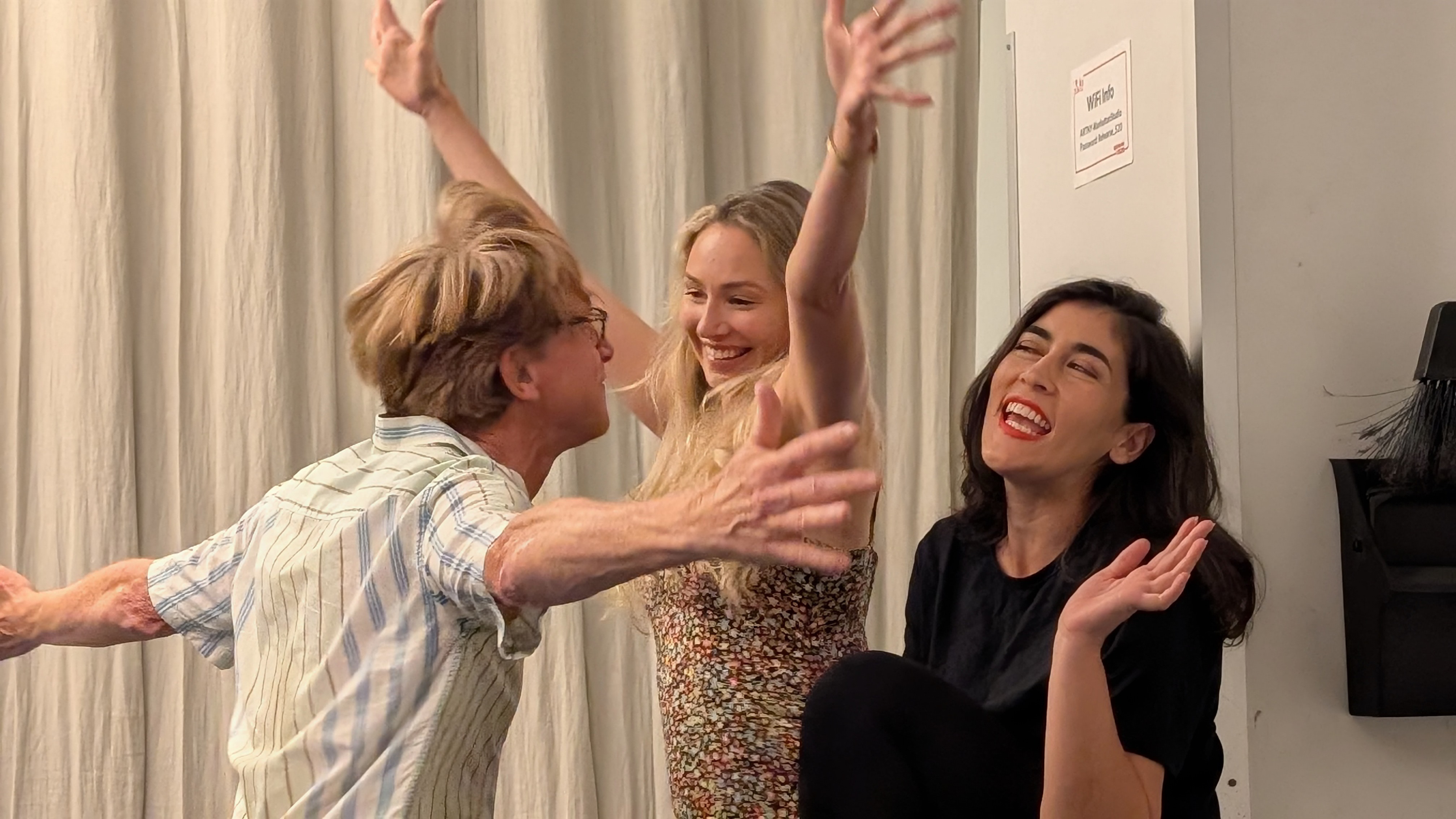
Air hugs for everyone: Jeremiah Alexander (CLINT), Adara (PIPPA) and Jasmine (Z) are into it
“The theatre is the place where extraordinary things happen, where you see people behaving, not as they do on the street, but as they might do in your dreams. Or your nightmares.” Simon Callow
Who is Pippa the character that Adara embodies in RETROSPECTIVE?
Dead poet, deep-rooted rapturous rhymer
Tour guide to the afterlife
Feltering (look it up) ex-wife of Rory McGrory, acclaimed painter
Putative, but disputed, muse of Rory, now warily encountering her
Unclogger of earthly attachments and schmutz
Rory thinks (and hopes) he’s dreaming; Pippa says he’s dead. To find out who’s right and see Adara Totino in her captivating turn on the Off-Broadway stage come see RETROSPECTIVE
Clockwise from bottom left” Jasmine Dorothy Haefner, Jeremiah Alexander, Mark Thomas McKenna, Adara Totino, our fab cast for RETROSPECTIVE at Broadway Bound Theatre Festival
Clockwise From Top Left: Adara Totino, Jeremiah Alexander, Jasmine Dorothy Haefner, Mark Thomas McKenna
In mid-July, our cast gathered for their “etudes,” a time for the actors to dig into their characters. Edward Albee, one of the greatest English language playwrights once said that “Every good actor does two things: He does exactly what the author intended and he does it his own way.” Etudes are a way of actors figuring out what that way is. The actors with our director, Gifford Elliott, are shaping now during our last week of rehearsals what the world of this play will be with the text as a foundation. Here’s a look at their adventures:
The words of the play describe how famous painter, Rory McGrory, finding himself in a gallery with empty canvases puzzles over whether he is asleep or… in the afterlife? There, Rory encounters his first wife and two other frenemies from his past. This mischievous menage a trois claims they just want to help him get to next while he just wants to wake up. These fine actors create a world out of these words with work that start this week, which we will be documenting here.
Come enter that world August 13th (8PM), August 13th (5PM), August 13th (2PM). Tickets for our performances at AMT theater 354 West 45th Street in Manhattan as part of the Broadway Bound Theatre Festival are available at this link.
RETROSPECTIVE is our tenth production since slip-sliding back into theatre again in 2018, and with Gifford Elliott directing this marvelous cast we think it’s going to be our best yet. So, get your tickets today by clicking this link
Cast of RETROSPECTIVE, clockwise from Center: Adara Totino (PIPPA), Mark Thomas McKenna (RORY), Jasmine Dorothy Haefner (Z), Jeremiah Alexander (Clint)
Mark, actor/teaching artist, was an ensemble member at Touchstone Theater (PA) for over 23 years, specializing in devised and community-based work. He also served as producing/artistic director for half of his tenure. Most recently, he played Jim in the NY premier of A House Divided by Joshua Crone at The NuBox/Night Cook Studios. Select highlights: Steelbound dir., Bill Rauch; Los Locos del Pueblo (the Fools) dir., Chris Bayes; Candide, adapted from Voltaire, with Bill Pope L. and dir., Jim Calder; Frankenstein, in collaboration with The Independent Eye (Philadelphia), adapted/directed by Conrad Bishop. Other roles: Charlie, Stones in his Pockets; Estragon, Waiting for Godot; Sir Toby Belch, Twelfth Night; Weston, Curse of the Starving Class. Film includes: The Forest Hills (Dreznick/Goldberg Productions), AWAKE! (FusionBox Films). As a teaching artist, Mark recently worked two years in residence at Penn State Hershey Medical Center helping healthcare workers build community and listening skills. Training: Graduate, L’École Internationale de Théâtre Jacques Lecoq, Paris; TA Certification, UARTS Philadelphia; HB Studios, Second City (NYC). AEA/SAG-AFTRA
PLAYWRIGHT’S NOTE:Evidence of our luck shows up in the way our director Gifford Elliott (with the help of Jasmine and Adara ) read six superb actors for the lead role of Rory McGrory. That array of talented NYC artists made for a tough choice, but there was no doubt in our minds that Mark Thomas McKenna would be the force needed for that performance as the famous painter who has to deal with a weird reunion with an ex-wife and two frenemies. Call it a ménage à trois with a plus-one
Adara Totino (Pippa)
Adara Totino
Adara Totino is so excited to be a part of the Broadway Bound Theatre Festival and working with Knowledge Workings Theater! Adara attended the Actor’s Studio MFA program, studying under luminaries such as Elizabeth Kemp, Susan Aston and Louis Colaianni. Career highlights include: working with playwright Edward Allan Baker on his DOLORES (ASDS Repertory) and Cyn Cooper’s I WAS A STRANGER TOO (finalist: The Jewish Plays Project 2022, produced by Remember the Women Institute). She can be seen in the upcoming short SLEEPING MOTHER which will screen at LCT in the fall of 2025. For my Mama, Carol, my grandma, Sophie, and also- for Elizabeth. @adaratotino http://www.adaratotino.com
PLAYWRIGHT’S NOTE:Jasmine introduced us to Adara Totino who will be playing Pippa in this production’s Festival performances on August 13th, August 15th, and August 16th (Yes, tickets are available at this link. Go buy a few!) That feeling when you are wowed by the way someone makes your text come alive and your character more real than you even dreamed? That’s what Adara did when we first met with her. Her scintillating creativity and deep skill astonished us.
Jasmine Dorothy Haefner (Z)
Jasmine Dorothy Haefner
Jasmine Dorothy Haefner is an internationally performing comedic actress, writer, and producer for stage and screen based in NYC — and frankly, you should be ashamed you haven’t heard of her. She even has a credit on SNL! That’s right, WHAT a comedy credit… as Kim Kardashian’s photo double. (You have got to stop telling people that part, DAMMIT!) Her work is fast-paced, madcap, heightened, and usually funny on purpose. She’s currently developing the TV series NOT DEAD, a genre-bending mockumentary loosely based on her life with Crohn’s Disease. Her one-act play 2-Faces premiered at the Edinburgh Festival Fringe after a London preview, and earned great reviews (“If you fancy a dose of what the Fringe is really about, get really drunk and go see this show…”) and crowds six times larger than the festival average. Her film 28 is Great — a meta-mockumentary short about a film crew rife with chaos, which she wrote, directed, produced, and starred in, playing all five roles — won or received nominations for multiple film festival awards, including Best Solo Performance, Best Actress, Best Comedy, and Overall Audience Awards. After working in the entertainment industry for 10 years, she’s done just about every job except lighting fire to the hoop the lion jumps through, and if you come see her work you’re guaranteed “…eccentric and arguably refreshing new writing,” “…multiple characters with wit and physical energy,” and stories that are “…thrilling and provocative.” Her last short film The Counterfeit Moron (co-director, producer, actress) is a 19 minute true one-shot, for which they shot a standard-version and mockumentary version, and just screened at Lighthouse International Film Festival. Next performing: Retrospective (actor) at Broadway Bound Theatre Festival (August.)
PLAYWRIGHT’S NOTE:Some people are lucky charms because they introduce you to other good people. Meeting Jasmine Dorothy Haefner happened because she knew Aaron Long, one of the actors in Alms, the very first play that Joe Queenan and T.J. wrote in in 2018. Jasmine not only came to see the play but told us she wanted to be in one of our plays. Well, Jasmine has now been in three Knowledge Workings Theater productions: GRUDGES, THE ORACLE, and now dazzling as Z in RETROSPECTIVE. Again we’re lucky.
Jasmine appropriately shooting a skeptic stare at Patrick Smith in The Oracle in 2022 at TNC
Jeremiah Alexander (Clint)
Jeremiah Alexander
Jeremiah is delighted to return to the stage after a long career in film, television, and commercials. Select television credits include Mozart in the Jungle, Howl, All My Children, One Life to Live, and The Guiding Light. Film appearances include Inside Man, Goosed, Half Baked, and Unfaithful. A few favorite New York stage credits are Enter a Free Man, Lone Star, and Gentile of the Top Percentile. Jeremiah is thrilled to be working with such a “heavenly” gang! Many thanks to T.J. and Knowledge Workings Theater.
PLAYWRIGHT’S NOTE:T.J. created the character of Clint Belinsky in RETROSPECTIVE with Jeremiah in mind because “his timing and verve make the laughs flow and the truths resound.”They first worked together in 1978 as the leads in a regional production of The Devil’s Disciplein Saratoga Springs, New York. Talk about ‘luck as the residue of design’: how about this reunion 47 years later from a feeling that T.J. had back then about wanting to see Jere work in one of his plays. Their connection is one of the very special aspects of this production
PLAYWRIGHT’S NOTE:Of course, the evidence for luck being in our corner is best exemplified by Gifford Elliott as director who got to make these casting decisions along with Marjorie Phillips Elliott who is both producer AND production designer on this show.
Gifford Elliott (Director)
Photo by Bill Wadman
Besides serving as Director, Co-Producer, and/or Technical Manager for many of Knowledge Workings Theater’s plays since 2018, Gifford has played many other parts in their eight productions: maker of publicity Instagram reels, mover of massive sets, magician with sound design, and mender of props. This stack of work led to his co-authoring with T.J. Elliott 13 Ways of Looking at Self-Producing
Besides this wide and wizardly work, Giff served in recent years as a post-production coordinator on such hit series as Bupkis (the Pete Davidson comedy), The Best Man — The Final Chapters, Queens Gambit, and Divorce (Season 3). Prior to those assignments, he was a manager at LightIron, one of the premier firms in the movie and television industry specializing in post-production workflows. A graduate of the Cal Arts acting program, Gifford is also a director of a variety of theatrical events including Srivia, the weekly fun trivia extravaganza at Singers in Brooklyn.
Marjorie Phillips Elliott (Production Design)
Marjorie’s work as Executive Producer & Co-founder of Knowledge Workings Theater arises from deep roots in the arts. Having studied theater at Skidmore College and photography at the Fashion Institute of Technology, Marjorie brings to her role at Knowledge Workings a wide array of talents and experiences including her work in the film industry for New Line Cinema in the 1980s. Her support of our productions ranges from strategy to prop design to photo retouching to publicity consultation and beyond. Marjorie is also the former Chair of the Board of Chamiza Foundation, a nonprofit helping to ensure the continuity & living preservation of Pueblo Indian culture and traditions, and on the Members Committee of the Phillips Collection in Washington, DC.
Myles Platt (Stage Manager)
Myles Platt is an artist from Rockford, Michigan. He is thrilled to be welcomed back to stage management after his retirement in 2017. Myles has a bachelor’s in arts from Wayne State University where he studied literature. He has appeared in and produced various independent films and productions over the last 12 years. And he is honored to join in sharing the sacred winds of “Retrospective” with its audiences.
Kaye Loggins (Lighting Design)
Kaye Loggins is a New York multi-instrumentalist, producer, filmmaker & actress. Her compositions as Time Wharp cover the range of ambient jazz, kosmische, dance music, and minimalist composition. She produces the internet broadcast project New York Television and hosts the bizarro multimedia talk show KAYE NITE LIVE. . More info is at her LinkTree
Jonathan Leonard (Choreographer/Movement Coach)
Jonathan’s background in professional theatre spans over a decade in repertory dance. He is a classically trained dancer who started in the Joffrey Ballet School Trainee Program, a scholarship awardee. Upon graduating, he immediately thrusted himself into the professional sphere, starting small in the studio companies of both The Sarasota Ballet (FL) and Ballet Hispanico (New York City). His breakthrough was at New York Theatre Ballet, where the marriage of dance and theatre was paramount. Under the esteemed direction of Diana Byer, Jonathan worked meticulously in a rare syllabus form of the Cecchetti Method which highlights gesture, musicality, and theatricality. With careful guidance, he rose to principal dancer, dancing some of the finest works of 20th century masters including Jerome Robbins, Antony Tudor, Jose Limon, Merce Cunningham and Agnes de Mille. His focus shifted to coaching later on, leading to his promotion to rehearsal master of NYTB. He helped stage some of the major ballets in the company’s repertoire including The Firebird and The Nutcracker. Now retired from performing, Jonathan is excited to devote more of his time to expanding his reach as a dance instructor, movement coach, and repetiteur.
Short Part #1: If you — like famous painter Rory McGrory — suddenly found yourself in a curious art gallery with nothing but empty frames only to be greeted by your dead ex-wife and two other old ‘frenemies’, would you think you were dreaming or were… you know.
That’s the quandary at the heart of RETROSPECTIVE where these past lives form a manic menage a trois plus one in this new comedy about art, attachments, and eternity.
Even Shorter Part #2: Buy tix here and feel free to forward, repost, and otherwise spread the word. Theater is nothing without an audience. Thank you!
Here’s a synopsis of our new work for those who were not at our January 16th reading:
Famous painter Rory McGrory thinks it must be a dream. Why else would he find himself transported to a large space filled with blank frames and his dead ex-wife, poet Pippa LeFebvre? As she engages him in conversations about the tumultuous end to their marriage and narrates the paintings of his career retrospective she claims hangs in those frames, he is bemused — until Pippa states that he is not asleep but dead. Dismay and denial deepen as further witnesses from his past appear attesting that he is now resident in the first stop of the afterlife, evidently a place where detaching from past resentments is a prerequisite to moving to ‘next’, whatever ‘next’ turns out to be. But who is still ‘malattached’ to whom — and why — becomes the question all members of this mixed-up merry ménage à quatre must try to solve.
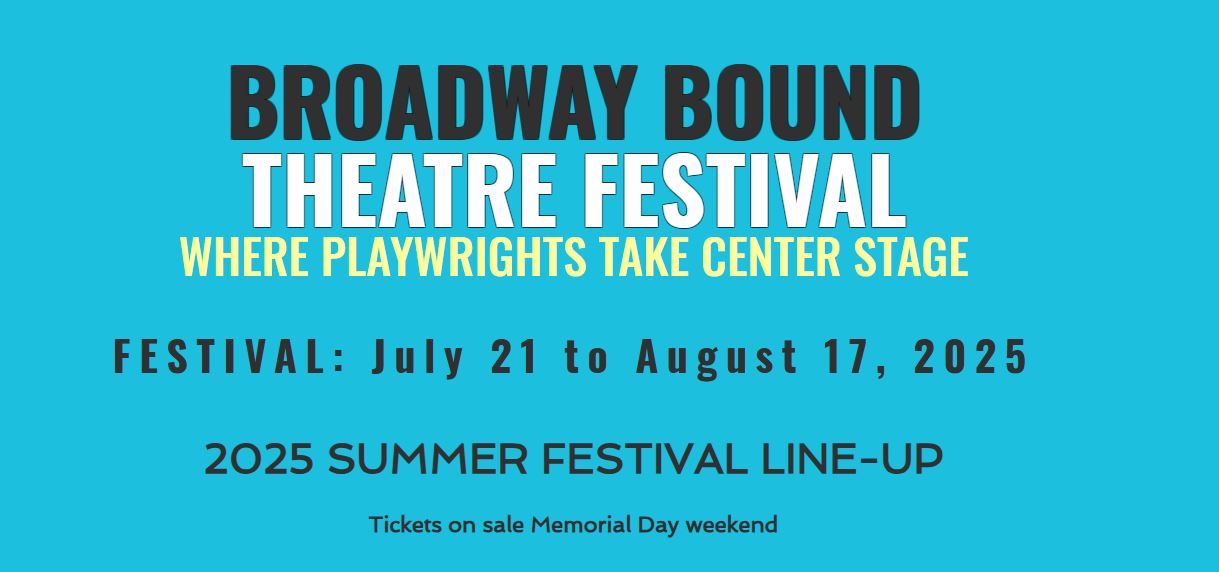
BBTF “is a boutique festival of live theatre that focuses on developing playwrights into self–producers. BBTF has an unwavering commitment to professionally producing new works, working hands-on with playwrights to make producing their own work a fulfilling and successful experience. And presenting these works to a theatre-savvy community. Since our inception in 2016 in New York City, we’ve been devoted to the evolution of our artists and their work to create great theatrical experiences that continue to live long after their premieres. “
We are thrilled and grateful that they chose our play, which will have three performances:
Our artistic director Gifford Elliott looks at recent writing that rang true to us about the state of theater making and the rewards of self-producing.
Brownlow-Calkin’s article takes a look at the corner that academic institutions has backed themselves into when preparing students for a ‘constantly changing industry.’ She asks what would be most helpful for students making the jump from school to career. As a holder of a BFA in acting, I particularly enjoyed the beginning allusion of a ‘professional preparedness’ talk to actors resembling a high school Sex-Ed talk. It took me back to my last year of school where some talks of the outside world felt more like, lovingly, a waiving of liability. There was much emphasis in the curriculum on a bottom line that your career “is what YOU make of it.
That was in 2015 and it saddened me a bit reading that not much has changed in the past decade. (Give the article a read to hear from recent grads and teachers who bring hope to the discussion but also harsh realities.) One suggestion in the article, strength in community, was an impetus to making this post as it overlaps with our writing about self-producing: Network to net resources: The Strength Of Weak Connections which is also Way #5 in our new book 13 Ways of Looking at Self-Producing.
A letter response from Scott Walters, Emeritus Professor of Drama at University of North Carolina Asheville expands on the article in a way that rang true to our collective experience as a theater company in the contemporary world of theater. His words are what my fellow grads and I have been shouting since we graduated:
The prescription—that students ought to be taught things like “how to shoot a self-tape or build a website” and how much rents are in NYC—fails to acknowledge that the system itself is dysfunctional and exploitative. Anyone who spends even a few minutes with the employment numbers published by Actors Equity should be deeply disturbed that more than half of Equity members don’t make a dime from working in theatre. And of those that do make any money, the average annual income is less than six months of rent. Saying “life in the business will be tough” isn’t just an understatement, it is malpractice.“
You can teach a theater artist as many tools as possible to operate within the current boundaries of the industry but teaching them the foundation blocks of self-producing and encouraging them to find their audience and community, wherever that may be, is imperative. Today, many of fellow graduates still working in the performing arts have relocated or found troupes outside of the bicoastal trappings of NY and LA.
If interested more in words and reflections on Self-Producing then we’d love for you to check out 13 Ways of Looking at Self-Producing. As a company that has put on our own shows, we’d love for anyone interested to learn from our successes (and mistakes).
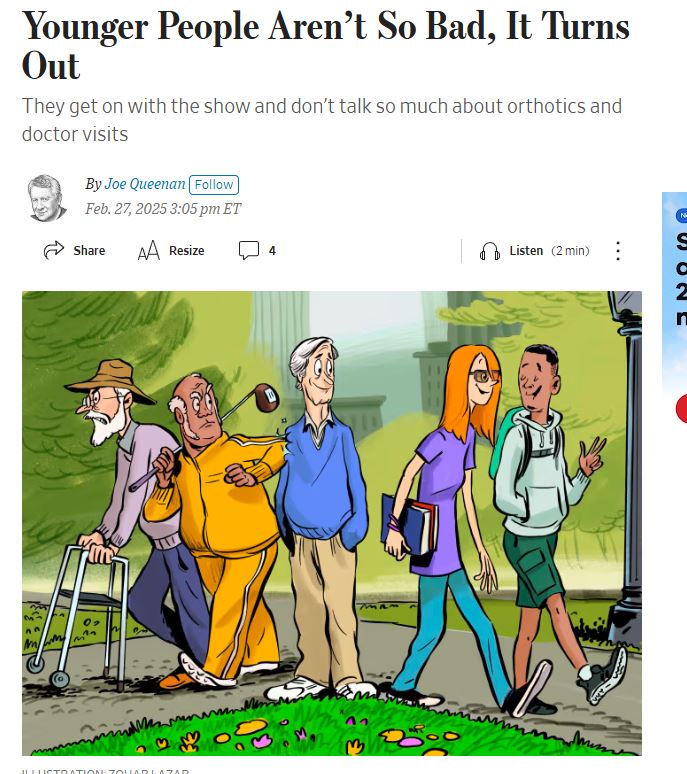
It may be hard to get past the paywall for this Wall Street Journal celebration of theater by Joe Queenan, my old friend and collaborator on four plays — Alms, Grudges, Genealogy, and The Oracle, but it’s well worth the effort. Joe enthuses (a rare occurrence) about putting on a play right now with a young cast and director and felt rejuvenated by people “who were still excited about their futures” and didn’t talk about their orthotics. 🙂
And, yes, of course, I am the old friend referenced in the first paragraph (who wears orthotics and has talked about them — they’re great and with that battered body of Joe’s from our basketball days Queenan should get some.)
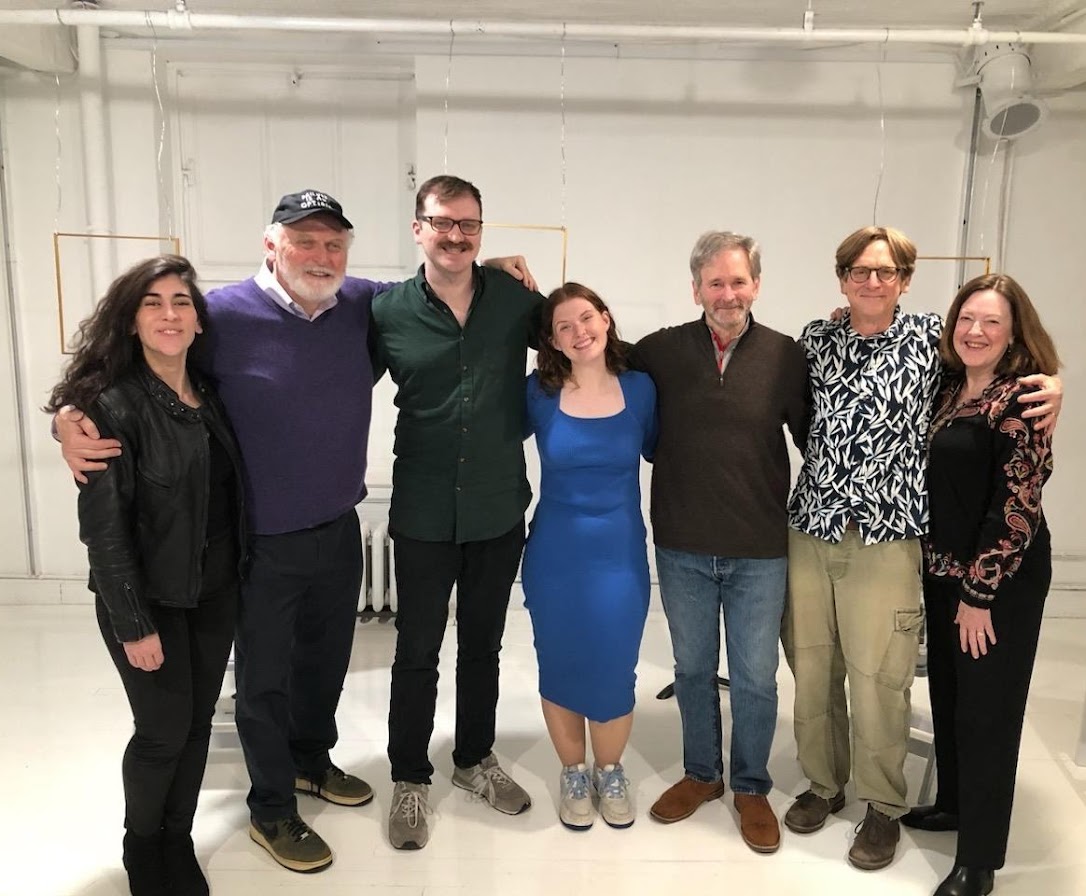
Joe on the far right looking scheming how to turn this photo into one of his WSJ columns Photo Bill Wadman
I owe my 2018 return to theater after over thirty years away in large measure to Joe Queenan and I’m glad to see him succeeding with his latest effort The Counterfeit Moron, which only has one more performance left at 2 PM on March 2 at The Chain Theater as part of their Winter One Act Festival. I’m not sure if it’s sold out — the first 3 shows were — but The Chain often has last-minute walk-up tickets usually if you happen by 36 Street and 8th Avenue on Sunday. Terrific performances by friends and colleagues Ed Altman and Jasmine Dorothy Haefner as well as newcomer and star of Joe’s upcoming film Top Hate Tut Gregory Go Joe!
Retrospective, a new comedy, by T.J. Elliottintroduced at a January 16th reading at TheaterLab
“I can’t understand how anyone can write without rewriting everything over and over again.“ Leo Tolstoy
Readings help rewritings. The generous adventurous people who come to the reading of a new play help to shape its next iteration through both their reactions in the moment — laughs, gasps, silences, even groans sometimes — and what they were willing to tell afterwards. But even before the audience steps into your reading room, the actors and the director have animated the characters in such a way that the idea of the play can never be quite the same as it appeared on the page beforehand. Both groups — creators and observers — prove critical at this stage of making theater live.
At the reading of our new comedy, RETROSPECTIVE, we received a great deal of valuable feedback. At the gathering after the reading, I like to say that I consumed 3 beers and 33 opinions. The play provides an example of the role of readings and rewriting in self-producing a play. I cannot imagine any play that does not benefit from rewriting. But how does that happen in the self-producing process? I’ll show you an example at the bottom of this chapter.
“I am the kind of writer who rewrites and rewrites. I am very eager to correct everything.”
Kenzaburo Oe
This pdf at the end of this post constitutes the thirteenth draft of our latest play, which counting the film we made of scenes for our first play Alms is our tenth production since reentering theater in 2018. And rewriting played an important role in each of those instances, but that’s nothing unusual or new in this field.
In fact, Quote Investigator led me to one of the earliest proponents of rewriting plays: Steele MacKaye, who was a highly popular U.S. playwright and actor of the 19th Century. In July 1889, MacKaye published in several newspapers a piece titled “How Plays Are Written: They Are the Product of Study and Patient Toil”. The first line presented his thesis. Emphasis added:[1]
Plays are not written—they are rewritten. In this lies the advantage of the creative, as distinct from the critical, literature of the stage.
This is not Steele MacKaye
One more time: “Plays are not written—they are rewritten”
QI goes on to note that “by 1894 the saying had been reassigned to the Irish actor and playwright Dion Boucicault, and by 1903 W. S. Gilbert had been assigned a variant referring to comic operas. Yet, the earliest evidence currently points to Steele MacKaye as crafter of the statement.” Of course, others would take credit for this wisdom, which also serves as a caution to beginner playwrights: don’t think this process is like a 100 yard dash. Getting a play into its produceable form is more like an ultramarathon relay race in which you must keep passing the baton to yourself, but there are bathroom breaks.
Let’s trim that quote of MacKaye a little; Plays Are the Product of Study and Patient Toil. This is especially true for self-produced plays, and the rewriting of such enterprises differs from other development schemes for plays. As a bonus way of looking at self-producing, I argue that such work provides more opportunities for a playwright to refine their text through rewriting.
This not to demean the many opportunities to help a playwright revise their new script outside of self-producing: dramaturgs, workshops, New Play Exchange, etc. But when you are the producer of the play, your contact with others is perhaps wider and richer than it would be as someone who luckily has had a submitted script accepted for the next stage of development.
Being the self-producer in my experience rendered me more open to suggestions from actors. Why? Self-producing means self-interest squared. The calculus of how the play can be successful necessitates a collaboration that is authentic. The self-producing playwright may have even greater motivation to have each one of the actors be fully engaged. I don’t think that happens unless the collaboration is sincere, and that means the listening to, exploring of, and responding to comments and suggestions about the play must be real, true, not feigned or pretended.
Our Team: Jasmine Dorothy Haefner, T.J. Elliott, Gifford Elliott, Kat Reeve, Daniel Thompson, Jeremiah Alexander, Marjorie Phillips Elliott
That doesn’t mean that you, the playwright, will take every suggestion; that would be madness and an abdication of the duty to be the final judge of the text. But it does mean that you are in dialogue with these other artists and in doing so learning from their questions and even their complaints. Of course, one of their complaints with me is why do you write so many words? And I always say, I’m just imitating my favorite playwrights like Shaw and Shakespeare and Stoppard. I’m not pretending that I’m as good as they are, but part of what that imitation allows is the courage to let my characters run on, to luxuriate in language, maneuver in making arguments with quality and quantity. And since I have confidence in the eventual audiences that will see the finished product, I’m not afraid of all these things that are said about attention span. I’m willing to hazard that possibility. It drives me to tell a better story, one that will hold each person because they want to know what happens next. But I would be a fool not to ask others what they think about all of this.
Lucas Hnath is a massive rewriter. As D.T. Max observed in a New Yorker piece: “He can sound mystical about his creative process. At workshops, I’ve heard him say many times, ‘This line hasn’t figured out yet what it wants to become.; But he can also be stringently analytical. Playwright’s Input A should result in Audience Output B. … I asked him what he’d be looking out for that evening [of a preview], and he said that it was important that he not look for anything. He wanted to experience the play as if he’d never seen it. This, he emphasized, would be just the start of his process. “You have to watch several performances. Then take a step back and try to understand, on average, how the play works. It’s what remains consistent across many performances that tells me something useful. Tonight is one single data point.” He hoped to next time find “a better spot” in the theatre. Another night found him in the stage manager’s office, listening to the actors on a monitor. He was rewriting their parts as they spoke.”
There are three aspects of rewriting in that story: the intuitive (This line hasn’t figured out yet what it wants to become), the analytical in checking off whether a particular line or passage elicited the desired reaction; e.g., an expected laugh, a thoughtful frown. Isaac Bashevis Singer, a paragon of effective and glorious storytelling, once said: “There’s no great art in confusing the reader.” That holds true for the audience member as well, and that’s the third aspect evident in the passage on Hnath above; he is rewriting in the booth as the actors speak their lines because he is sensing where the audience is finding meaning or getting lost, which is different than the analytical look in which he keeps score of whether the reactions were what he planned. This third look arise from his wanting “to experience the play as if he’d never seen it.”
At least, that’s my take. The next time (first time!) I run into Lucas I’ll factcheck my interpretation and let you know.
“Frankly, I also don’t want to have to listen to everybody’s views since, based on an ignorance of the overall text, they are only going to be prejudices anyway. Of which, with this subject, there are too many already.” David Hare, Acting Up
Before I move on to the planning and unfolding of the reading that will lead to this rewriting, we should hear another take that of David Hare whose book Acting Up is one of my holy texts about how theater and specifically performance really work. From the above quote, you might get the sense that David doesn’t use as many people as aids in his rewriting as we did in this reading. (I do not know Hare either, but I consult his book so often it seems like we would be mates over a pint.) But in that same book, he tells a story about how Louis Malle influenced his playwrighting that describes ne way of rewriting that offers many advantages:
“Louis (Malle) shared my fascination with techniques of storytelling. Once, we were meant to be working together on Damage, the film of Josephine Hart’s novel. But I came into the restaurant for supper usually dissatisfied with that morning’s readthrough of the play of mine called Murmuring Judges. ‘It ought to bloody work,’ I said, ‘and it doesn’t.’ At once Louis asked me to tell him the story of the play. Together we sat for three hours, refining the narrative. Louis isolated every component of the story, and then put them all back together again in the right order. It was like watching a great car mechanic lay out the pieces of an engine on a clean white cloth before reassembling them. He did it for the sheer intellectual pleasure.… (After writing the synopsis of Damage) Every morning he would make me sit down under the vines and go back to the beginning of the story. He did it so many times that I thought I was going to go mad.”
That’s a rewriting occasion at the synopsis stage! You’ll figure out your own way, but if you’re self-producing starting with a reading makes sense for at least four reasons:
$$$
Marketing
Shaping the play
Exploring the acting
$$$: Attendees at a reading might be backers. Such a strategy requires a whole separate chapter.
Marketing: Readings aid this phase of self-producing because through that event you get photo ops, the start of word of mouth, and possible blurbs (e.g., “this is the best work yet from this playwright“; yes, someone said that at our last reading, which made me wonder what was lacking with the earlier plays). Reading attendees may be your repeat customers; If they liked it at the reading they will often be curious enough to return for the full production.
Given the theme of this chapter, the focus here is on the last two items on the list: Shaping and Exploring. We quote Hilton Als all the time to distinguish between the text and the play:
The reading represents the first chance to see what happens when actors speak that text in front of an audience. You realize what’s too long, too short, really funny, really NOT funny. You get the idea. Singer’s dictum becomes critical: is the audience confused; you can tell a lot by looking at faces and listening to breathing. Allan Gurganus notes that, “A crucial verb for writers is revise. Which means, of course, to re-see.” The re-seeing that happens here is quite different than the first seeing that spun out in your mind’s eye. As you re-see, you begin to reshape: lines bend, passages disappear, images appear or disappear.
To re-see, you must engage a director actors who will bring your text to its best possible life at this point. You connect to a director who can make the storytelling consistent and as potent as one can manage in front of music stands with no set. This exploration requires actors who have ideas based upon your primary text, notions about their character’s backstory, relationships with other characters, even the cadence of the language that you gave to them. Their questions about moments that are unclear to them or ways in which the structure seems not to work given their new understanding of the story.
Even before these conversations or rehearsals occur with the actors and your director, other preparations for the reading happen: getting a space, sending out scripts, etc. But the most important of these preparations is to gather an audience that likes theater. To paraphrase Singer; there is no great benefit in torturing yourself by inviting to your Chekhovian comedy an audience of people whose usual entertainment diet is thirty second TikTok parodies.
There is the usual housekeeping to address: pick a time that is convenient, send invites that are inviting and grateful, offer directions and cautions if your venue happens to be down a flight of crumbling steps or has a funky buzzer system to get in the front door. Make sure there are enough chairs and music stands. Be prepared to find the bathroom key and make sure there are paper towels there. Every detail increases the comfort of this audience and you want them in a good mood to focus on your play.
We recommend a place for an after-reading gathering. Make it comfortable and convivial. Work that room to get reactions and note them in your phone or on paper. Then consider them in the next few days because not all of them will be useful. After all, this is still your play and you need to decide which of those comments and reactions will help the story versus what will harm it or make it a totally different work.
And then…
The Fruits of Your Labor: A Rewritten Play
“Everything is there in the sauce; it just needs to simmer.”
B. Huvane
The forty people who DID come to the reading only had this context about the subject of the play:
Retrospective concerns a famous painter who may or may not be dreaming of an encounter with his first wife amidst a retrospective of his work and the appearances of others from his past.
With that sparse framework, the rest of this chapter will offer examples of the rewriting. Knowing the whole play is not necessary to appreciate the learnings that the reading produced for us.
If you have the luck to persuade some people with experience in the theater as producers to attend your reading, then you are very lucky indeed. And I must claim humbly that status as at each of my readings experienced Off-Broadway, Broadway, and West End hands have attended and offered substantial constructive reactions. But I’ve also gained critical ideas from causal theatergoers who wanted to see what a new play reading was like. Having this variety is an advantage: listen to everyone. That’s particularly important for self-producers as we need all the support we can muster.
One of those old hands was lavish in his praise of RETROSPECTIVE based on the reading, but wondered what it would be like if the main female character addressed some of her bouts of confusion directly to the audience. I found this compelling and thus our opening notes reflected this change. Will it stick as the play moves to production? Impossible to tell, but whoever reads it next will have the advantage of this context.
Having sat in on the three pre-reading rehearsals, I didn’t need anybody to tell me that the play was too long, but several people did so anyway. You have to develop listening skills; hold the play at arms length for good perusal, don’t let the play hold you. Don’t take criticism personally. A common theme ran through those kind but ‘cutting’ comments: get the secondary female character on to that stage sooner. In fact, one of the people who told me that was the actress who played the secondary female character who is also a collaborator with two of our previous plays. Trusting her, we realized that there was too much business around the beginning and as you can see from the image below of the first page we cut, cut, cut as if this was a slasher movie.
And cut some more…
Rewriting is not just about cutting. Paying attention to the audience lets you know that their attention flags at times. One cause of this is excessive wordplay. In the change pictured below, the shift to emphasize one character’s discomfort with his reflexive taunting of the other combines with her need for ‘the right word’ as a poet. We are still establishing their identities and relationship, but that must happen economically.
Some of the many changes made are like Hnath’s analytical takes described above: Input A (a joke in this case) did not get Output B (a laugh from the audience). So we swapped in other repartee that should work better.
Our goal became losing ten minutes of runtime, which with this 14 point font means ten pages. One way to do that is to look scrupulously at how you can have more show and less tell in the exchanges and action. The cuts below resulted form that feedback.
A pleasant surprise from the audience reactions in the reading was the enjoyment expressed for the poems written and read by the main female character, Pippa. In this case, rather than cutting, we decided to expand one of her poems a little bit. This had the dual advantage of clarifying her personality through her poetry and also allowing the audience more chuckles at these rhymes. Nothing wrong with chuckles in this play.
Two motives manifest in this next illustration of rewriting. The first one is familiar to any writer and was initially offered by a literary savant with a wonderful name for a comic character: Arthur Quiller-Couch. In his still highly relevant book, On The Art of Writing, Q, as he was known, advised, “Whenever you feel an impulse to perpetrate a piece of exceptionally fine writing, obey it—whole-heartedly—and delete it before sending your manuscript to press. Murder your darlings.” Rewriting may involve multiple murders. The one below was justified because a) we need to cut 10 minutes and b) it’s a clever digression that the character, the acerbic critic self-named Z, doesn’t need as by this point everyone knows she is devilishly clever .
One last example of the changes made is a confession to a weakness. I think most playwrights have conversations with their characters or at least become eavesdroppers on such dialogue. In a first draft, the talk goes on and amuses the playwright. But a reading reveals the prosaic nature of some of those exchanges. Cutting them makes things move and that is necessary to have your audience be moved. That’s what happened here.
And with decisions like that, we cut our ten minutes. The process isn’t over, but the shape of the play satisfies, and its overall idea now has passed a test. Self-producing gave us both additional input and added urgency for our rewrite. Want to see for yourself how it turned out? Click on the PDF below and read through the current version.
And, yes, we’re always interested in having talks with folks who want to be producers or co-producers or investors helpng Knowledge Workings Theater get this play out in front of more audiences. The reading? The rewrites? The capturing of the lessons from self-producing? It’s all about pursuing our impulse, following our motto: make theater live.
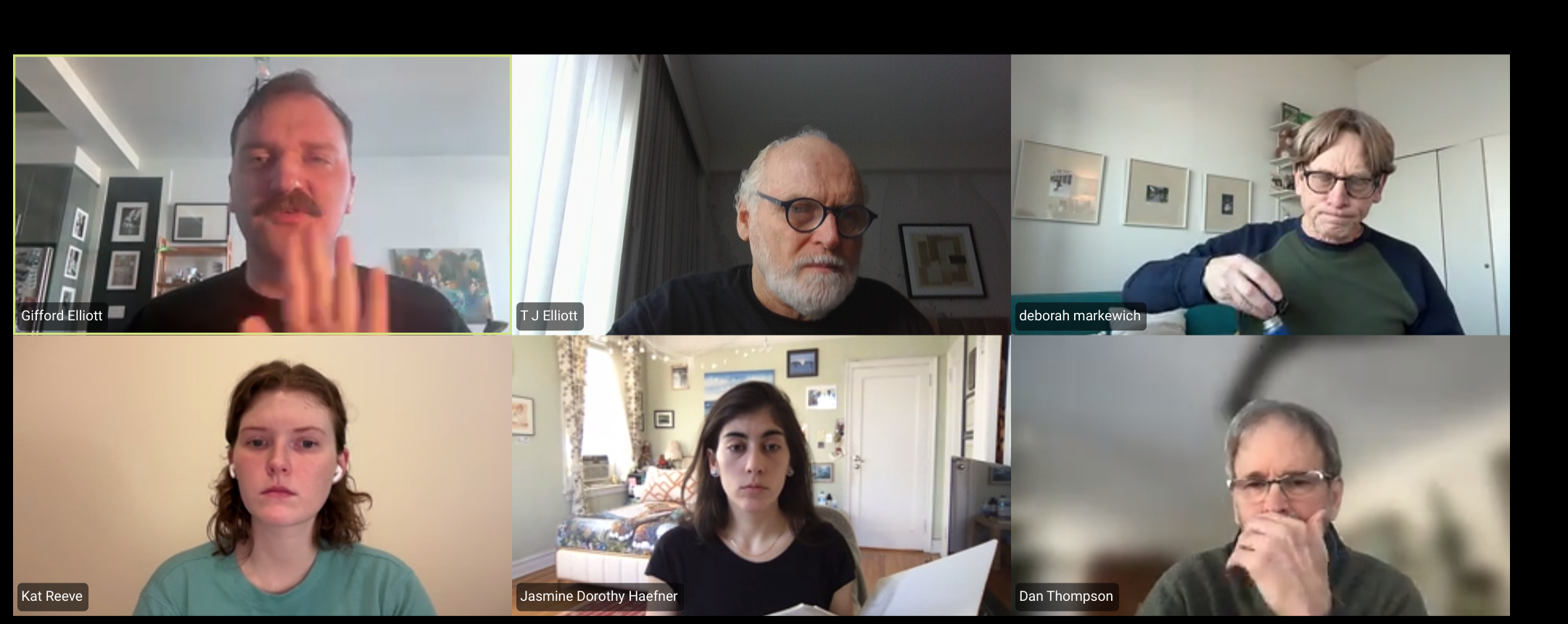
Top (l-r) Gifford Elliott [Director], T.J. Elliott [Playwright], Jeremiah Alexander [Clint]
Bottom (l-r) Kat Reeve [Pippa], Jasmine Dorothy Haefner [Z], Daniel Thompson [Rory]
And so it begins: fine actors working with an astute director starting the transformation of text to performance, figuring out how to make theater live. The Hilton Als quote about theater seems both instructive and inspiring:
We have a new play, Retrospective, but at this moment it’s still that primary text and even that continues to shift. After our first rehearsal yesterday, January 12th for its first public reading that will take place on January 16th 2025 at 7PM in Manhattan, our playwright, T. J. Elliott spent several hours in his hotel room in midtown Manhattan trimming and altering that text. The after effect of the reading will likely be even more editing and tightening. Past happy experiences have taught us that the quality of the audience at a first reading provides significant and actionable insights into the further development of a play. If you’d like to be part of that audience, just ping us at knowledgeworkings@elliotttj
Retrospective concerns a famous painter who may or may not be dreaming of an encounter with his first wife amidst a retrospective of his work and the appearances of others from his past. We are lucky and gratified to have Gifford Elliott directing our cast of Daniel Thompson, Kat Reeve, Jasmine Dorothy Haefner, and Jeremiah Alexander. (Jerry and I first worked together as actors in 1978; Dan and I met in theatre in 1979!)
If you would like to attend what will be about a ninety minute reading, then just email knowledgeworkings@gmail.com and we will send you a Google calendar invite. If you attend, you will part of the process of production as noted in another essential quote below:
“The play does not exist in the theater as a written text until it has been absorbed in the process of production. Drama is ‘translated’ or transformed into the person of the actor — “the body of the art of the theater”, as Stark Young put it.”