Our artistic director Gifford Elliott looks at recent writing that rang true to us about the state of theater making and the rewards of self-producing.
Brownlow-Calkin’s article takes a look at the corner that academic institutions has backed themselves into when preparing students for a ‘constantly changing industry.’ She asks what would be most helpful for students making the jump from school to career. As a holder of a BFA in acting, I particularly enjoyed the beginning allusion of a ‘professional preparedness’ talk to actors resembling a high school Sex-Ed talk. It took me back to my last year of school where some talks of the outside world felt more like, lovingly, a waiving of liability. There was much emphasis in the curriculum on a bottom line that your career “is what YOU make of it.
That was in 2015 and it saddened me a bit reading that not much has changed in the past decade. (Give the article a read to hear from recent grads and teachers who bring hope to the discussion but also harsh realities.) One suggestion in the article, strength in community, was an impetus to making this post as it overlaps with our writing about self-producing: Network to net resources: The Strength Of Weak Connections which is also Way #5 in our new book 13 Ways of Looking at Self-Producing.
A letter response from Scott Walters, Emeritus Professor of Drama at University of North Carolina Asheville expands on the article in a way that rang true to our collective experience as a theater company in the contemporary world of theater. His words are what my fellow grads and I have been shouting since we graduated:
The prescription—that students ought to be taught things like “how to shoot a self-tape or build a website” and how much rents are in NYC—fails to acknowledge that the system itself is dysfunctional and exploitative. Anyone who spends even a few minutes with the employment numbers published by Actors Equity should be deeply disturbed that more than half of Equity members don’t make a dime from working in theatre. And of those that do make any money, the average annual income is less than six months of rent. Saying “life in the business will be tough” isn’t just an understatement, it is malpractice.“
You can teach a theater artist as many tools as possible to operate within the current boundaries of the industry but teaching them the foundation blocks of self-producing and encouraging them to find their audience and community, wherever that may be, is imperative. Today, many of fellow graduates still working in the performing arts have relocated or found troupes outside of the bicoastal trappings of NY and LA.
If interested more in words and reflections on Self-Producing then we’d love for you to check out 13 Ways of Looking at Self-Producing. As a company that has put on our own shows, we’d love for anyone interested to learn from our successes (and mistakes).
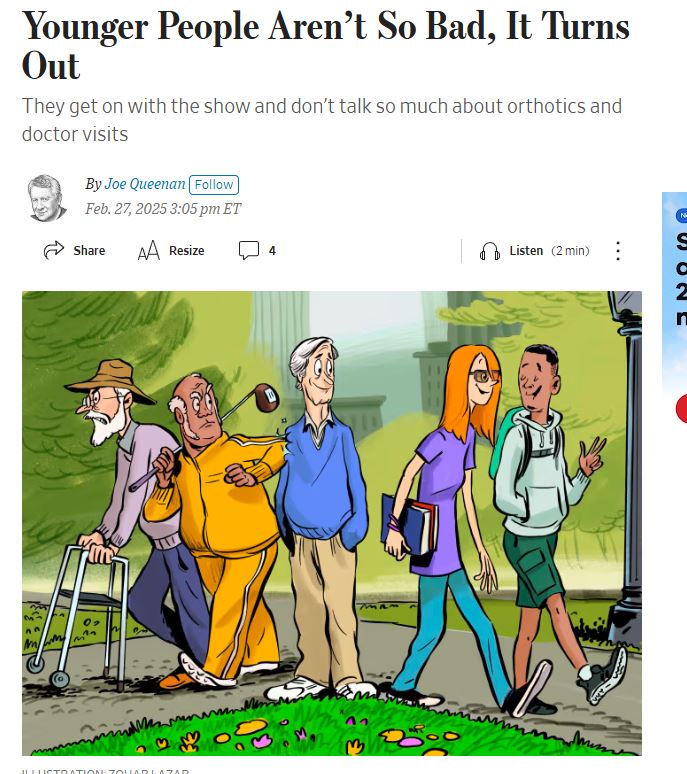
It may be hard to get past the paywall for this Wall Street Journal celebration of theater by Joe Queenan, my old friend and collaborator on four plays — Alms, Grudges, Genealogy, and The Oracle, but it’s well worth the effort. Joe enthuses (a rare occurrence) about putting on a play right now with a young cast and director and felt rejuvenated by people “who were still excited about their futures” and didn’t talk about their orthotics. 🙂
And, yes, of course, I am the old friend referenced in the first paragraph (who wears orthotics and has talked about them — they’re great and with that battered body of Joe’s from our basketball days Queenan should get some.)
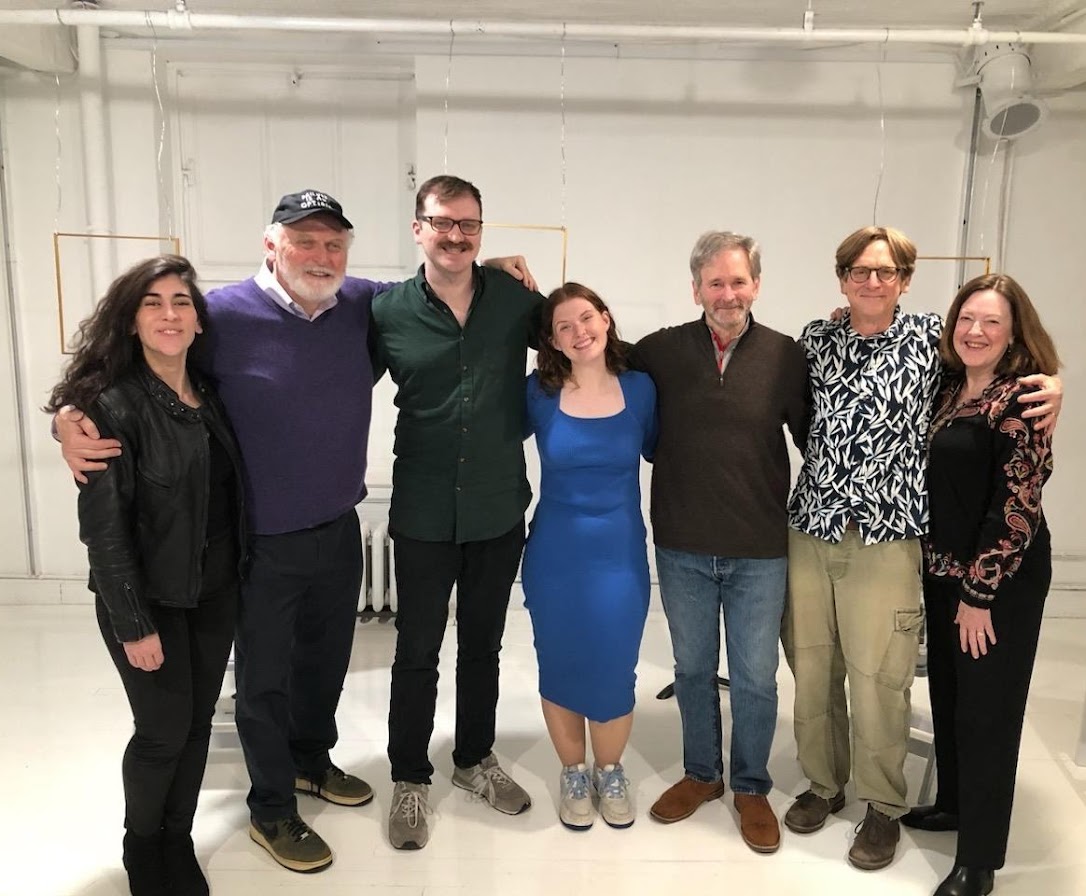
Joe on the far right looking scheming how to turn this photo into one of his WSJ columns Photo Bill Wadman
I owe my 2018 return to theater after over thirty years away in large measure to Joe Queenan and I’m glad to see him succeeding with his latest effort The Counterfeit Moron, which only has one more performance left at 2 PM on March 2 at The Chain Theater as part of their Winter One Act Festival. I’m not sure if it’s sold out — the first 3 shows were — but The Chain often has last-minute walk-up tickets usually if you happen by 36 Street and 8th Avenue on Sunday. Terrific performances by friends and colleagues Ed Altman and Jasmine Dorothy Haefner as well as newcomer and star of Joe’s upcoming film Top Hate Tut Gregory Go Joe!
Retrospective, a new comedy, by T.J. Elliottintroduced at a January 16th reading at TheaterLab
“I can’t understand how anyone can write without rewriting everything over and over again.“ Leo Tolstoy
Readings help rewritings. The generous adventurous people who come to the reading of a new play help to shape its next iteration through both their reactions in the moment — laughs, gasps, silences, even groans sometimes — and what they were willing to tell afterwards. But even before the audience steps into your reading room, the actors and the director have animated the characters in such a way that the idea of the play can never be quite the same as it appeared on the page beforehand. Both groups — creators and observers — prove critical at this stage of making theater live.
At the reading of our new comedy, RETROSPECTIVE, we received a great deal of valuable feedback. At the gathering after the reading, I like to say that I consumed 3 beers and 33 opinions. The play provides an example of the role of readings and rewriting in self-producing a play. I cannot imagine any play that does not benefit from rewriting. But how does that happen in the self-producing process? I’ll show you an example at the bottom of this chapter.
“I am the kind of writer who rewrites and rewrites. I am very eager to correct everything.”
Kenzaburo Oe
This pdf at the end of this post constitutes the thirteenth draft of our latest play, which counting the film we made of scenes for our first play Alms is our tenth production since reentering theater in 2018. And rewriting played an important role in each of those instances, but that’s nothing unusual or new in this field.
In fact, Quote Investigator led me to one of the earliest proponents of rewriting plays: Steele MacKaye, who was a highly popular U.S. playwright and actor of the 19th Century. In July 1889, MacKaye published in several newspapers a piece titled “How Plays Are Written: They Are the Product of Study and Patient Toil”. The first line presented his thesis. Emphasis added:[1]
Plays are not written—they are rewritten. In this lies the advantage of the creative, as distinct from the critical, literature of the stage.
This is not Steele MacKaye
One more time: “Plays are not written—they are rewritten”
QI goes on to note that “by 1894 the saying had been reassigned to the Irish actor and playwright Dion Boucicault, and by 1903 W. S. Gilbert had been assigned a variant referring to comic operas. Yet, the earliest evidence currently points to Steele MacKaye as crafter of the statement.” Of course, others would take credit for this wisdom, which also serves as a caution to beginner playwrights: don’t think this process is like a 100 yard dash. Getting a play into its produceable form is more like an ultramarathon relay race in which you must keep passing the baton to yourself, but there are bathroom breaks.
Let’s trim that quote of MacKaye a little; Plays Are the Product of Study and Patient Toil. This is especially true for self-produced plays, and the rewriting of such enterprises differs from other development schemes for plays. As a bonus way of looking at self-producing, I argue that such work provides more opportunities for a playwright to refine their text through rewriting.
This not to demean the many opportunities to help a playwright revise their new script outside of self-producing: dramaturgs, workshops, New Play Exchange, etc. But when you are the producer of the play, your contact with others is perhaps wider and richer than it would be as someone who luckily has had a submitted script accepted for the next stage of development.
Being the self-producer in my experience rendered me more open to suggestions from actors. Why? Self-producing means self-interest squared. The calculus of how the play can be successful necessitates a collaboration that is authentic. The self-producing playwright may have even greater motivation to have each one of the actors be fully engaged. I don’t think that happens unless the collaboration is sincere, and that means the listening to, exploring of, and responding to comments and suggestions about the play must be real, true, not feigned or pretended.
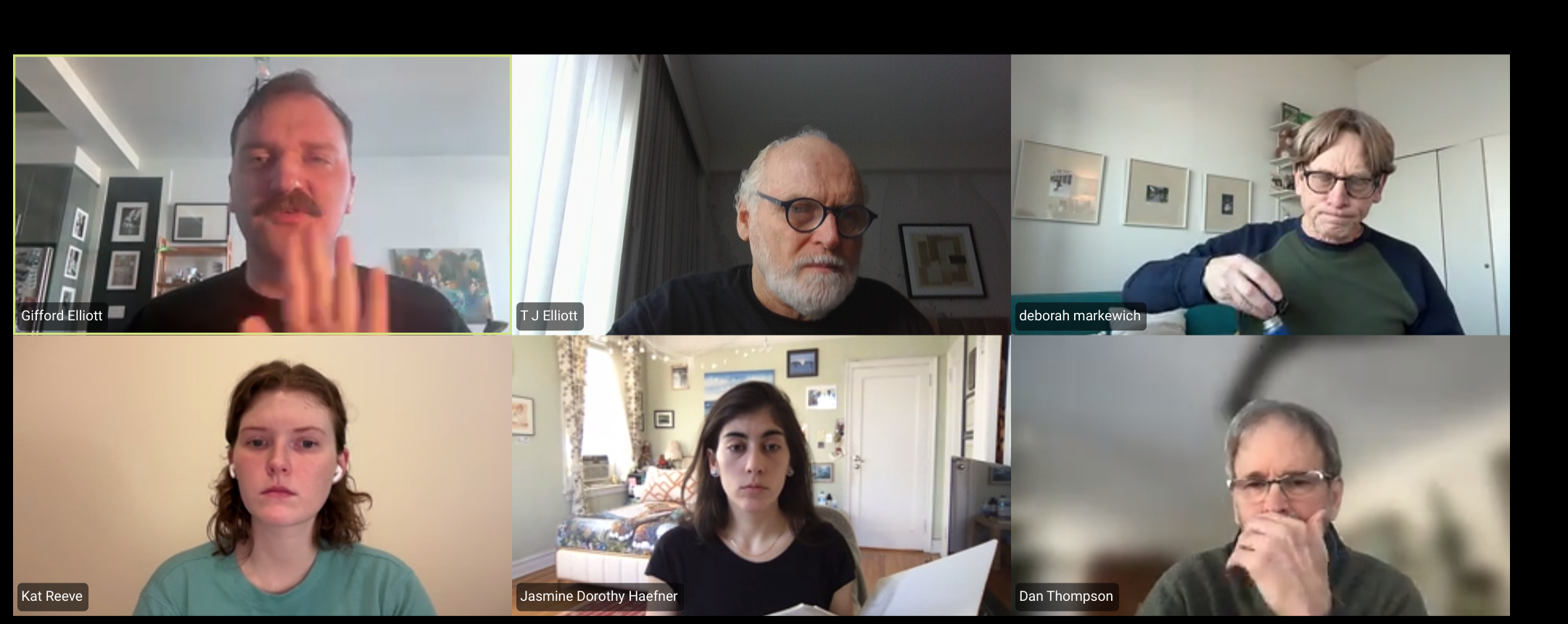
Our Team: Jasmine Dorothy Haefner, T.J. Elliott, Gifford Elliott, Kat Reeve, Daniel Thompson, Jeremiah Alexander, Marjorie Phillips Elliott
That doesn’t mean that you, the playwright, will take every suggestion; that would be madness and an abdication of the duty to be the final judge of the text. But it does mean that you are in dialogue with these other artists and in doing so learning from their questions and even their complaints. Of course, one of their complaints with me is why do you write so many words? And I always say, I’m just imitating my favorite playwrights like Shaw and Shakespeare and Stoppard. I’m not pretending that I’m as good as they are, but part of what that imitation allows is the courage to let my characters run on, to luxuriate in language, maneuver in making arguments with quality and quantity. And since I have confidence in the eventual audiences that will see the finished product, I’m not afraid of all these things that are said about attention span. I’m willing to hazard that possibility. It drives me to tell a better story, one that will hold each person because they want to know what happens next. But I would be a fool not to ask others what they think about all of this.
Lucas Hnath is a massive rewriter. As D.T. Max observed in a New Yorker piece: “He can sound mystical about his creative process. At workshops, I’ve heard him say many times, ‘This line hasn’t figured out yet what it wants to become.; But he can also be stringently analytical. Playwright’s Input A should result in Audience Output B. … I asked him what he’d be looking out for that evening [of a preview], and he said that it was important that he not look for anything. He wanted to experience the play as if he’d never seen it. This, he emphasized, would be just the start of his process. “You have to watch several performances. Then take a step back and try to understand, on average, how the play works. It’s what remains consistent across many performances that tells me something useful. Tonight is one single data point.” He hoped to next time find “a better spot” in the theatre. Another night found him in the stage manager’s office, listening to the actors on a monitor. He was rewriting their parts as they spoke.”
There are three aspects of rewriting in that story: the intuitive (This line hasn’t figured out yet what it wants to become), the analytical in checking off whether a particular line or passage elicited the desired reaction; e.g., an expected laugh, a thoughtful frown. Isaac Bashevis Singer, a paragon of effective and glorious storytelling, once said: “There’s no great art in confusing the reader.” That holds true for the audience member as well, and that’s the third aspect evident in the passage on Hnath above; he is rewriting in the booth as the actors speak their lines because he is sensing where the audience is finding meaning or getting lost, which is different than the analytical look in which he keeps score of whether the reactions were what he planned. This third look arise from his wanting “to experience the play as if he’d never seen it.”
At least, that’s my take. The next time (first time!) I run into Lucas I’ll factcheck my interpretation and let you know.
“Frankly, I also don’t want to have to listen to everybody’s views since, based on an ignorance of the overall text, they are only going to be prejudices anyway. Of which, with this subject, there are too many already.” David Hare, Acting Up
Before I move on to the planning and unfolding of the reading that will lead to this rewriting, we should hear another take that of David Hare whose book Acting Up is one of my holy texts about how theater and specifically performance really work. From the above quote, you might get the sense that David doesn’t use as many people as aids in his rewriting as we did in this reading. (I do not know Hare either, but I consult his book so often it seems like we would be mates over a pint.) But in that same book, he tells a story about how Louis Malle influenced his playwrighting that describes ne way of rewriting that offers many advantages:
“Louis (Malle) shared my fascination with techniques of storytelling. Once, we were meant to be working together on Damage, the film of Josephine Hart’s novel. But I came into the restaurant for supper usually dissatisfied with that morning’s readthrough of the play of mine called Murmuring Judges. ‘It ought to bloody work,’ I said, ‘and it doesn’t.’ At once Louis asked me to tell him the story of the play. Together we sat for three hours, refining the narrative. Louis isolated every component of the story, and then put them all back together again in the right order. It was like watching a great car mechanic lay out the pieces of an engine on a clean white cloth before reassembling them. He did it for the sheer intellectual pleasure.… (After writing the synopsis of Damage) Every morning he would make me sit down under the vines and go back to the beginning of the story. He did it so many times that I thought I was going to go mad.”
That’s a rewriting occasion at the synopsis stage! You’ll figure out your own way, but if you’re self-producing starting with a reading makes sense for at least four reasons:
$$$
Marketing
Shaping the play
Exploring the acting
$$$: Attendees at a reading might be backers. Such a strategy requires a whole separate chapter.
Marketing: Readings aid this phase of self-producing because through that event you get photo ops, the start of word of mouth, and possible blurbs (e.g., “this is the best work yet from this playwright“; yes, someone said that at our last reading, which made me wonder what was lacking with the earlier plays). Reading attendees may be your repeat customers; If they liked it at the reading they will often be curious enough to return for the full production.
Given the theme of this chapter, the focus here is on the last two items on the list: Shaping and Exploring. We quote Hilton Als all the time to distinguish between the text and the play:
The reading represents the first chance to see what happens when actors speak that text in front of an audience. You realize what’s too long, too short, really funny, really NOT funny. You get the idea. Singer’s dictum becomes critical: is the audience confused; you can tell a lot by looking at faces and listening to breathing. Allan Gurganus notes that, “A crucial verb for writers is revise. Which means, of course, to re-see.” The re-seeing that happens here is quite different than the first seeing that spun out in your mind’s eye. As you re-see, you begin to reshape: lines bend, passages disappear, images appear or disappear.
To re-see, you must engage a director actors who will bring your text to its best possible life at this point. You connect to a director who can make the storytelling consistent and as potent as one can manage in front of music stands with no set. This exploration requires actors who have ideas based upon your primary text, notions about their character’s backstory, relationships with other characters, even the cadence of the language that you gave to them. Their questions about moments that are unclear to them or ways in which the structure seems not to work given their new understanding of the story.
Even before these conversations or rehearsals occur with the actors and your director, other preparations for the reading happen: getting a space, sending out scripts, etc. But the most important of these preparations is to gather an audience that likes theater. To paraphrase Singer; there is no great benefit in torturing yourself by inviting to your Chekhovian comedy an audience of people whose usual entertainment diet is thirty second TikTok parodies.
There is the usual housekeeping to address: pick a time that is convenient, send invites that are inviting and grateful, offer directions and cautions if your venue happens to be down a flight of crumbling steps or has a funky buzzer system to get in the front door. Make sure there are enough chairs and music stands. Be prepared to find the bathroom key and make sure there are paper towels there. Every detail increases the comfort of this audience and you want them in a good mood to focus on your play.
We recommend a place for an after-reading gathering. Make it comfortable and convivial. Work that room to get reactions and note them in your phone or on paper. Then consider them in the next few days because not all of them will be useful. After all, this is still your play and you need to decide which of those comments and reactions will help the story versus what will harm it or make it a totally different work.
And then…
The Fruits of Your Labor: A Rewritten Play
“Everything is there in the sauce; it just needs to simmer.”
B. Huvane
The forty people who DID come to the reading only had this context about the subject of the play:
Retrospective concerns a famous painter who may or may not be dreaming of an encounter with his first wife amidst a retrospective of his work and the appearances of others from his past.
With that sparse framework, the rest of this chapter will offer examples of the rewriting. Knowing the whole play is not necessary to appreciate the learnings that the reading produced for us.
If you have the luck to persuade some people with experience in the theater as producers to attend your reading, then you are very lucky indeed. And I must claim humbly that status as at each of my readings experienced Off-Broadway, Broadway, and West End hands have attended and offered substantial constructive reactions. But I’ve also gained critical ideas from causal theatergoers who wanted to see what a new play reading was like. Having this variety is an advantage: listen to everyone. That’s particularly important for self-producers as we need all the support we can muster.
One of those old hands was lavish in his praise of RETROSPECTIVE based on the reading, but wondered what it would be like if the main female character addressed some of her bouts of confusion directly to the audience. I found this compelling and thus our opening notes reflected this change. Will it stick as the play moves to production? Impossible to tell, but whoever reads it next will have the advantage of this context.
Having sat in on the three pre-reading rehearsals, I didn’t need anybody to tell me that the play was too long, but several people did so anyway. You have to develop listening skills; hold the play at arms length for good perusal, don’t let the play hold you. Don’t take criticism personally. A common theme ran through those kind but ‘cutting’ comments: get the secondary female character on to that stage sooner. In fact, one of the people who told me that was the actress who played the secondary female character who is also a collaborator with two of our previous plays. Trusting her, we realized that there was too much business around the beginning and as you can see from the image below of the first page we cut, cut, cut as if this was a slasher movie.
And cut some more…
Rewriting is not just about cutting. Paying attention to the audience lets you know that their attention flags at times. One cause of this is excessive wordplay. In the change pictured below, the shift to emphasize one character’s discomfort with his reflexive taunting of the other combines with her need for ‘the right word’ as a poet. We are still establishing their identities and relationship, but that must happen economically.
Some of the many changes made are like Hnath’s analytical takes described above: Input A (a joke in this case) did not get Output B (a laugh from the audience). So we swapped in other repartee that should work better.
Our goal became losing ten minutes of runtime, which with this 14 point font means ten pages. One way to do that is to look scrupulously at how you can have more show and less tell in the exchanges and action. The cuts below resulted form that feedback.
A pleasant surprise from the audience reactions in the reading was the enjoyment expressed for the poems written and read by the main female character, Pippa. In this case, rather than cutting, we decided to expand one of her poems a little bit. This had the dual advantage of clarifying her personality through her poetry and also allowing the audience more chuckles at these rhymes. Nothing wrong with chuckles in this play.
Two motives manifest in this next illustration of rewriting. The first one is familiar to any writer and was initially offered by a literary savant with a wonderful name for a comic character: Arthur Quiller-Couch. In his still highly relevant book, On The Art of Writing, Q, as he was known, advised, “Whenever you feel an impulse to perpetrate a piece of exceptionally fine writing, obey it—whole-heartedly—and delete it before sending your manuscript to press. Murder your darlings.” Rewriting may involve multiple murders. The one below was justified because a) we need to cut 10 minutes and b) it’s a clever digression that the character, the acerbic critic self-named Z, doesn’t need as by this point everyone knows she is devilishly clever .
One last example of the changes made is a confession to a weakness. I think most playwrights have conversations with their characters or at least become eavesdroppers on such dialogue. In a first draft, the talk goes on and amuses the playwright. But a reading reveals the prosaic nature of some of those exchanges. Cutting them makes things move and that is necessary to have your audience be moved. That’s what happened here.
And with decisions like that, we cut our ten minutes. The process isn’t over, but the shape of the play satisfies, and its overall idea now has passed a test. Self-producing gave us both additional input and added urgency for our rewrite. Want to see for yourself how it turned out? Click on the PDF below and read through the current version.
And, yes, we’re always interested in having talks with folks who want to be producers or co-producers or investors helpng Knowledge Workings Theater get this play out in front of more audiences. The reading? The rewrites? The capturing of the lessons from self-producing? It’s all about pursuing our impulse, following our motto: make theater live.
Top (l-r) Gifford Elliott [Director], T.J. Elliott [Playwright], Jeremiah Alexander [Clint]
Bottom (l-r) Kat Reeve [Pippa], Jasmine Dorothy Haefner [Z], Daniel Thompson [Rory]
And so it begins: fine actors working with an astute director starting the transformation of text to performance, figuring out how to make theater live. The Hilton Als quote about theater seems both instructive and inspiring:
We have a new play, Retrospective, but at this moment it’s still that primary text and even that continues to shift. After our first rehearsal yesterday, January 12th for its first public reading that will take place on January 16th 2025 at 7PM in Manhattan, our playwright, T. J. Elliott spent several hours in his hotel room in midtown Manhattan trimming and altering that text. The after effect of the reading will likely be even more editing and tightening. Past happy experiences have taught us that the quality of the audience at a first reading provides significant and actionable insights into the further development of a play. If you’d like to be part of that audience, just ping us at knowledgeworkings@elliotttj
Retrospective concerns a famous painter who may or may not be dreaming of an encounter with his first wife amidst a retrospective of his work and the appearances of others from his past. We are lucky and gratified to have Gifford Elliott directing our cast of Daniel Thompson, Kat Reeve, Jasmine Dorothy Haefner, and Jeremiah Alexander. (Jerry and I first worked together as actors in 1978; Dan and I met in theatre in 1979!)
If you would like to attend what will be about a ninety minute reading, then just email knowledgeworkings@gmail.com and we will send you a Google calendar invite. If you attend, you will part of the process of production as noted in another essential quote below:
“The play does not exist in the theater as a written text until it has been absorbed in the process of production. Drama is ‘translated’ or transformed into the person of the actor — “the body of the art of the theater”, as Stark Young put it.”
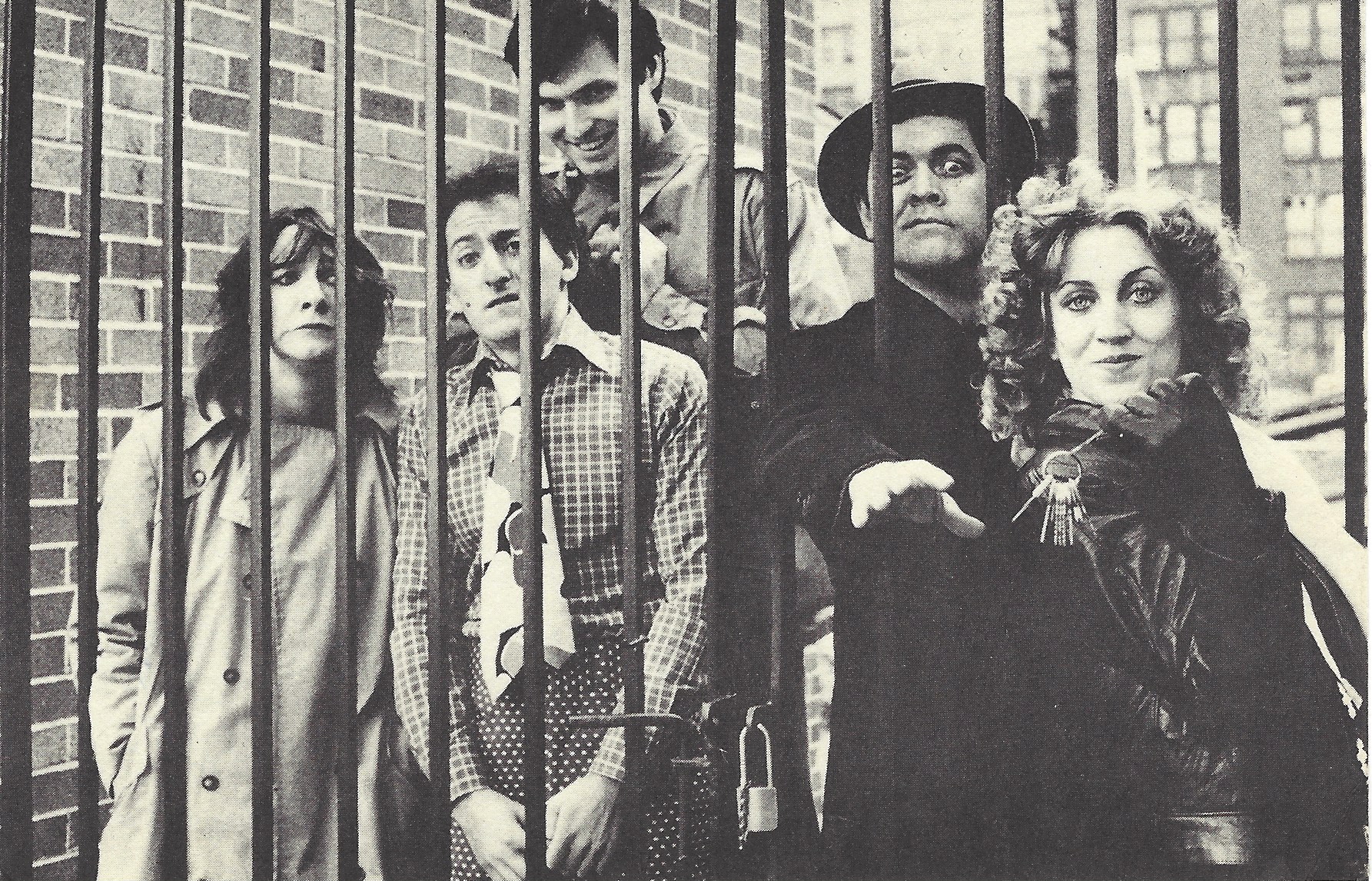
Captive Audiences 1982: (L-R) Beth Rake, Phil Ruskin, Brendan Elliott, John McCarthy, & Georgia Harrell.
Rem tene; verba sequentur. Grasp the subject, the words will follow. Cato the Elder
Cato the Elder, whose other notable quote is ‘Delenda est Carthago ‘or ‘Carthage must be destroyed!’, gives good advice for playwrights here: nail the story from spine to skeleton to full body and the dialogue will flow.
It’s appropriate guidance for a website makeover as well. The subject for us there is making theater live. And we promote that purpose through this website with its blog and other features. The new look to our website courtesy of the effort and skills of Gifford Elliott reminded us not only of all the KWT productions since 2018, but also of the story from over forty years ago that coursed through two of the KWT founders — Marjorie Phillips and T.J. Elliott — a passion to make theater live. We were lucky then to have such able collaborators and we are similarly fortunate now.
Our new design celebrates the work of our collaborators, and highlights some of our more recent moments of live theater via our YouTube channel. We hope you check out those videos and other stories as well as 13 Ways of Looking at Self-Producing, which will soon be available as an e-book on Amazon. Coming up in January: a staged reading of RETROSPECTIVE, a new play.
We seek producers for that play and other planned works, collaborators who wish to join us on this journey of theatre making. Interested? We’ll buy the beverage for an in-person discussion. Just email KWTto start the connection.
You did it! The house opened, the seats filled, lights dimmed, and then rose again in the proper pattern to illuminate your story and the marvelous set constructed for this occasion. The actors costumed brilliantly moved and spoke as you imagined. Well, mostly as you imagined because the direction and their own imagination have brought new layers to the work. And now if you have done the job of publicity successfully, you’ll get to read some reviews. Don’t let them affect you too much.
(While the initial premise of this series — 13 Ways of Looking at Self-Producing — limited the observations about the experience of playwrights putting on their own work to thirteen perspectives, we only mentioned reviews glancingly in that sequence, and their rigors, realities, and ramifications deserve more attention. This post — a Bakers Dozen plus one — corrects that omission.)
Why do I offer that advice? Foundationally, I agree with the great poet and essayist Louise Gluck about what it takes to be a writer, which she described in a somewhat negative way explaining why her own father did not become a writer:
“…my father wanted to be a writer. But he lacked certain qualities: lacked the adamant need which makes it possible to endure every form of failure; the humiliation of being overlooked, the humiliation of being found moderately interesting, the unanswerable fear of doing work that, in the end, really isn’t more than moderately interesting, the discrepancy, which even the great writers live with (unless, possibly, they attain great age) between the dream and the evidence.”
Louise Gluck
In order to read the reviews usefully, you need those qualities even the best player in the best production is going to be viewed by someone out there with access to a website as a critic as having failed or only been found moderately interesting. It is highly likely that the ‘evidence’ of the review will be discrepant with whatever you and your team held as the ‘dream’.
DISCLAIMER: my relationship with feedback on plays resides in the eccentric column. I’m not looking for opinions about the work in the same way that many of my colleagues do. It just wouldn’t work for me. Jean Cocteau offers advice that makes sense to me: “Listen carefully to first criticisms made of your work. Note just what it is about your work that critics don’t like — then cultivate it. That’s the only part of your work that’s individual and worth keeping.” My process of writing and rewriting and then rewriting again depends almost exclusively upon my ‘familiars’: team members who have been with me from even before the eight productions of Knowledge Workings Theater, actors that I know trust, and a few other friends whose taste matters to me. So, the disclaimer is that I start off differently in my encounters with reviews than many other playwrights.
But there is a significant difference between getting feedback in forms like this one or NPS and getting a review. The wisdom of Edna St. Vincent Millay comes to mind “A person who publishes a book willfully appears before the populace with his pants down. If it is a good book nothing can hurt him. If it is a bad book nothing can help him.” And that’s just a book that might not even have your picture on the inside flap. In the case of the self-production of a play, the situation seems to be more full frontal nudity instead of just ‘depantsing’.
Previously in this series, we cited David Mamet’s assertion that “the correct study of the dramatist was neither his own feelings, nor those of the actors, but the attention of the audience.” Reviewers are certainly part of the audience, but I believe they need a different framing in considerations of self-producing. When we heed icons like Sarah Bernhardt stating that “The theatre is the involuntary reflex of the ideas of the crowd”, we should acknowledge that there is a segmenting in the crowd. Audience members do not all come with the same mindset. There are those who know our work and have returned, there are those who only know us and finally have decided to see one of our plays, there are those with whom we are unacquainted who have come to this particular play based upon some recommendation or report, there are those who came because it was a free ticket because as a producer you are wisely papering the house in preview week, and there are reviewers. We can roughly categorize each of those groups as arriving with a different mindset and even individual peculiarities, but the reviewer’s disposition merits a more specific examination. So, scroll a little further.
Your reviews aren’t all going to be like these.
Like any other member of the audience, a reviewer is going to project their own lives and experiences onto what you have written. And unless your play is Our Town, its content likely focuses on a particular dimension: families, workplaces, wars, etc. how will that work appear to audiences that have different experiences and perhaps no familiarity at all with the world of your story? Although you would already have these concerns as a playwright, you as the producer also have additional worries as to how viewers react to their work. After the first week, word-of-mouth especially in its contemporary version of posts and comments on social media platforms assumes a criticality in attracting audiences. And people do read reviews. There are dozens of little websites in the New York City metropolitan area for example that publish reviews of plays. Some of them have a specific theatrical emphasis and others or more general appealing to senior citizens or residents of a particular neighborhood. Getting reviews means getting attention, credibility, notice. But what you do with reviews is important not only for your success but also for your sanity. (Especially true for the actors reading this as Tom Briggs suggests here.)
Why impose this qualification? Because not all of the people writing reviews have a background in theater, dramaturgy, or even entertainment. Your reviewer might have spent their whole life as a dancer and political activist and your play is about the corporate world. That likely will result in a different sort of review than if your reviewer had to deal with bureaucracies because of their straight job or even just because their host organization is large enough to have such structures. Similarly, if your reviewer has spent most of their career as a financial analyst then you’re going to have that worldview seep into their opinions about your play.
Will this appearance of reviewers with limited or stilted experience matter in every situation? Probably not. Our first production, alms, which we unwisely mounted without any PR, publicity, or marketing advice didn’t get any reviews even though it sold out all of its performances. We learned from that circumstance and budgeted for the kind of consultation that does get you reviews. And in some cases, they have been uniformly positive. We still think it’s important not to pay to much attention to them.
But what if the reviews are missing the point? Our approach is simple: the only thing Iwant from a review is a pull quote. It doesn’t matter whether they like what I have written or hate it or misunderstand it. The job of a self-producing playwright is to find the most positive phrase you can and use that in your advertising. This is a long-standing practice of producers in movies and theater; check out this 1987 LA Times piece on the ploy. In fact, there was once a controversy in which the New York Times complained that quotes were being taken out of context.. (For more on David Merrick including his scheme to find people with the same names as prominent reviewers to offer their positive opinions, scroll down within this article and this one that are very good surveys of the effect of reviewers upon audience size.)
DISCLAIMER #2: I have practiced the art of the selective pull quote. (Apparently, this is not a good idea to do if your play is opening in the EU according to this 16-year-old Guardian article.) At the end of our week run, we received a review that was… less than affirming. We weren’t going to use it in marketing anyway because all of our ad and publicity budget was gone, but we did use it in a post. Nothing in the review seemed usable, but our wonderful PR guy Ron Lasko at Spin Cycle disagreed when I told him that. Here’s the review and here’s what Ron selected:
“Compelling… The strengths of the play lie in its situation, its embrace of ambiguity, and its recognition that people are, well, people.“
Show Showdown
Pretty nifty. And anyone who wants to read the entire review from that source can certainly get the catalogue of weaknesses that were identified. I offer this additional way of looking at self-producing in the same spirit that informed the original compilation of thirteen: we need to make theater live. That takes talent and guts. There may be reviews that are negative and yet in some way accurate, and we will learn from those along the way. But not while we’re in the process of trying to put audiences in front of our actors and vice versa. We all would to our team to do the best we can and then absorb the learnings as to how we can do better.
Practice the art of the pull-quote with your reviews and don’t let them pull you down. But do let us know what you think as a self-producing or other kind of playwright. We’d love to hear and read your considerations on this subject.
PS Here’s what ChatGPT said about our play; AI is more sophisticated than I imagined considering they didn’t actually pay for a ticket or show up even to claim a comp.
What a great pleasure and privilege to talk to Madelyn Blair about reinvention on her intriguing and insightful video program, UNLOCKED (https://lnkd.in/eicbTx3K) . We ranged from our common interest in knowledge sharing to the ways in which any of us can create a new reality in our lives. And thanks to Madelyn for giving me another chance to talk about my latest play, HONOR, with just four performances left at the Gene Frankel Theatre in lower Manhattan: October 3-5 at 7 PM and Sunday, October 6th at 1 PM. Tix at our.show/honor The program is available now on YouTube https://lnkd.in/eMi4i6w9
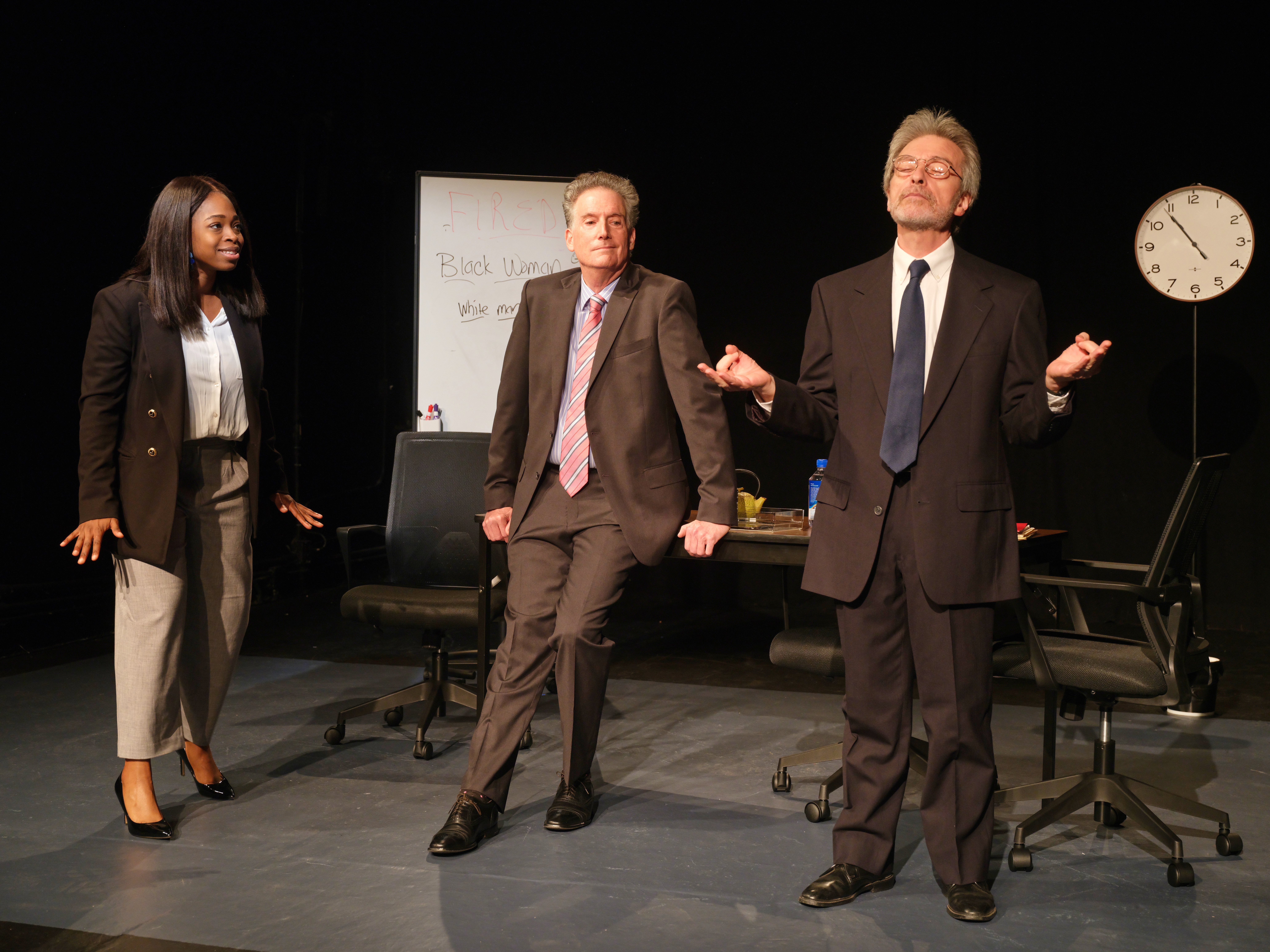
Photos by Bill Wadman: John Blaylock as Ludwig along with Alinca Hamilton as Ronnee and Ed Altman as Don
“Theatre isn’t real. It’s a refraction of reality, containing feelings and thoughts that are put forth, first, in a primary text, which the actor interprets—an interpretation that the director supports or edits, in an attempt to help build, in a made-up world, an atmosphere of verisimilitude.”
Hilton Als
Hilton Als, longtime critic at The New Yorker magazine, describes above the theatrical experience pithily and — to our thinking — near perfectly: he puts the actor at the heart of the creation. That centrality explains why we adore John Blaylock as Ludwig in HONOR. He built a character — the diligent, conservative General Counsel of a big company — from the foundation of the text giving him a reality that makes lawyers in our audience ask where John studied law. Spoiler: he didn’t. John is just a fine actor who loves to work so hard to put his person into a compelling story. He creates that ‘made-up world’, that atmosphere of verisimilitude. John makes you believe.
We are entering our final week of this run and tickets are available at our.show/honor If you’ve ever worked in a business, HONOR will speak to you as it presents the complexities and ambiguities of trying to do the right thing by each other in that world. Don’t miss John’s stirring electric performance and this story. See you at the Gene Frankel Theatre for seventy minutes of riveting theatre.
Don’t just take our word for it. Read what others have said:
“Honor, by , T.J. Elliott… If you’ve ever navigated the corporate world, you’ll immediately recognize the intricacies of the system – power dynamics, conflict, and behind-the-scenes negotiations that can lead to major frustrations. You might even spot a few familiar personalities from your own workplace! What stood out was the play’s comedic edge, using sharp humor to make the often stressful corporate environment feel both relatable and amusing (although, let’s be honest, it’s a lot less funny when you’re actually living it ). The play invites you to reflect on the nuances of leadership and influence, making you think about just how complex and layered these interactions truly are.”
“The play masterfully takes what appears to be an apparent disagreement over a value interpretation of an issue to a place that reveals the complexity of not only the interpretation of the issue but also each of the participant’s values. The ending provides an excellent explication of the complexity of human character in the interpretation of what constitutes personal honor, leaving one with intriguing ideas to contemplate.”
“Eloquently and dramatically skewers the current business culture… provocative entertainment.” “Elliott also directed and his physical staging is crisp, well-paced and contains momentum. The personable and talented cast of Ed Altman as Don, and Alinca Hamilton and John Blaylock, as the lawyers, all deliver energetic and authentic performances. This trio shines in the concluding sequence… “
Ronnee (Alinca Hamilton) turns the tables on Don (Ed Altman) in HONOR
FULL ADVANTAGE!
“Alinca Hamilton takes full advantage of this space and, acting with her body and face as well as with her words, letting the audience see her reactions, is quite funny…, showing us the ridiculousness of the situation.”
Roberta Pikser, Theater-Wire.Net
We knew that about Alinca as Ronnee Emerson but seeing Roberta Pikser’s review of HONOR in Theater-Wire.Net proved a gratifying confirmation and commendation of our colleague’s superb talent. Come to the Gene Frankel Theatre in lively NoHo neighborhood of Manhattan and see for yourself but you’ll have to do so before October 6th when this run where Alinca is joined by her two partners in corporate comedy, John Blaylock and Ed Altman ends.
“The play suggests that such a thing as honor is all but impossible, at least in a corporate setting, or perhaps that the concept is totally subjective, that no one really knows what it is. White male privilege is touched upon as one aspect of the elusiveness of the concept. Perhaps, as suggested by the insistence of the two men not to listen to each other, but to try to prevail, the idea of honor comes down to dominance. “
You have to see HONOR the play that Andrew Cortes of
Ed Altman, Alinca Hamilton, and John Blaylock make the story sizzle
Okay, one more plea to see HONOR at The Gene Frankel Theatre before it closes on October 6th, but this time the recommendation comes from reviews for which we are SOOOO grateful
1) “Written and superbly directed by T.J. Elliott…All of these actors are first-rate in their performances.”
2) “The play masterfully takes what appears to be an apparent disagreement over a value interpretation of an issue to a place that reveals the complexity of not only the interpretation of the issue but also each of the participant’s values. The ending provides an excellent explication of the complexity of human character in the interpretation of what constitutes personal honor, leaving one with intriguing ideas to contemplate.”from Scotty Bennett, TheaterScene.Net Did that work?
3) “Eloquently and dramatically skewers the current business culture… provocative entertainment.” “Elliott also directed and his physical staging is crisp, well-paced and contains momentum. The personable and talented cast of Ed Altman as Don, and Alinca Hamilton and John Blaylock,as the lawyers, all deliver energetic and authentic performances. This trio shines in the concluding sequence… “
4) “Technical and artistic director Gifford Elliott contributes smoothness to the production with balanced lighting and sound. The realistic,simple scenic design consists of a long table, wheelie chairs, a white board on an easel, and a large running wall clock which add a cool real-time dimension to the stated 45-minute proceeding.”from Darryl Reilly, Encore! Come on, you like theater and this is a well-reviewed relevant piece.
Click here for tickets to a show that is rollicking and relevant Not good enough? How about what…TimeOut says “In this dark corporate comedy by writer-director T.J. Elliott, three executives chew over—and perhaps spit out—the results of an investigation into a case of harassment that has been brought against by one of them. Alinca Hamilton, John Blaylock and Ed Altman play the compromised trio.”You need a night out so go to this link for those tickets 70 minutes of fast-paced fun that surfaces realities all too familiar for many of us in a grand historic theatre in the lively NoHo neighborhood at 7 PM (Sunday at 1 PM)