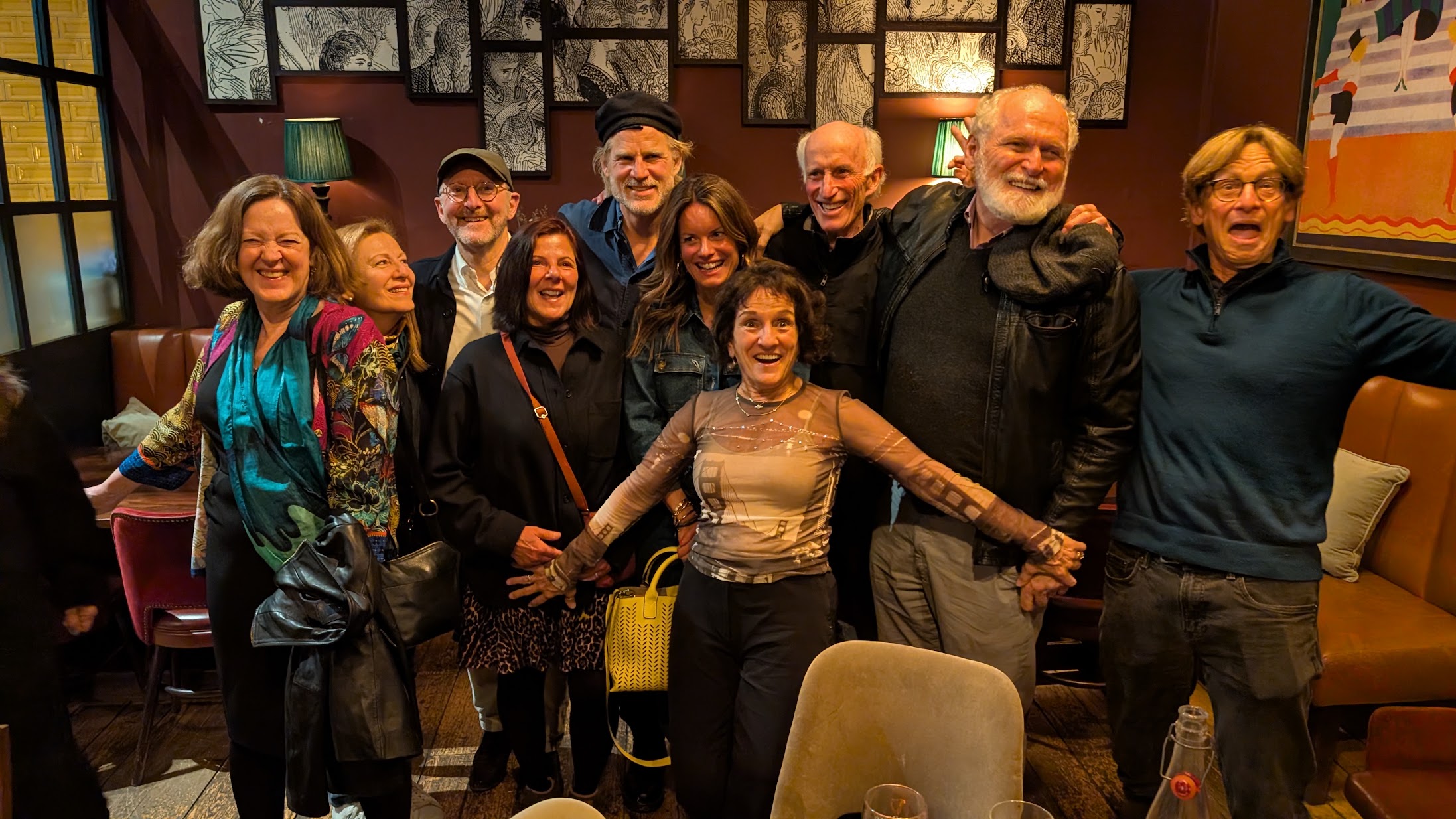
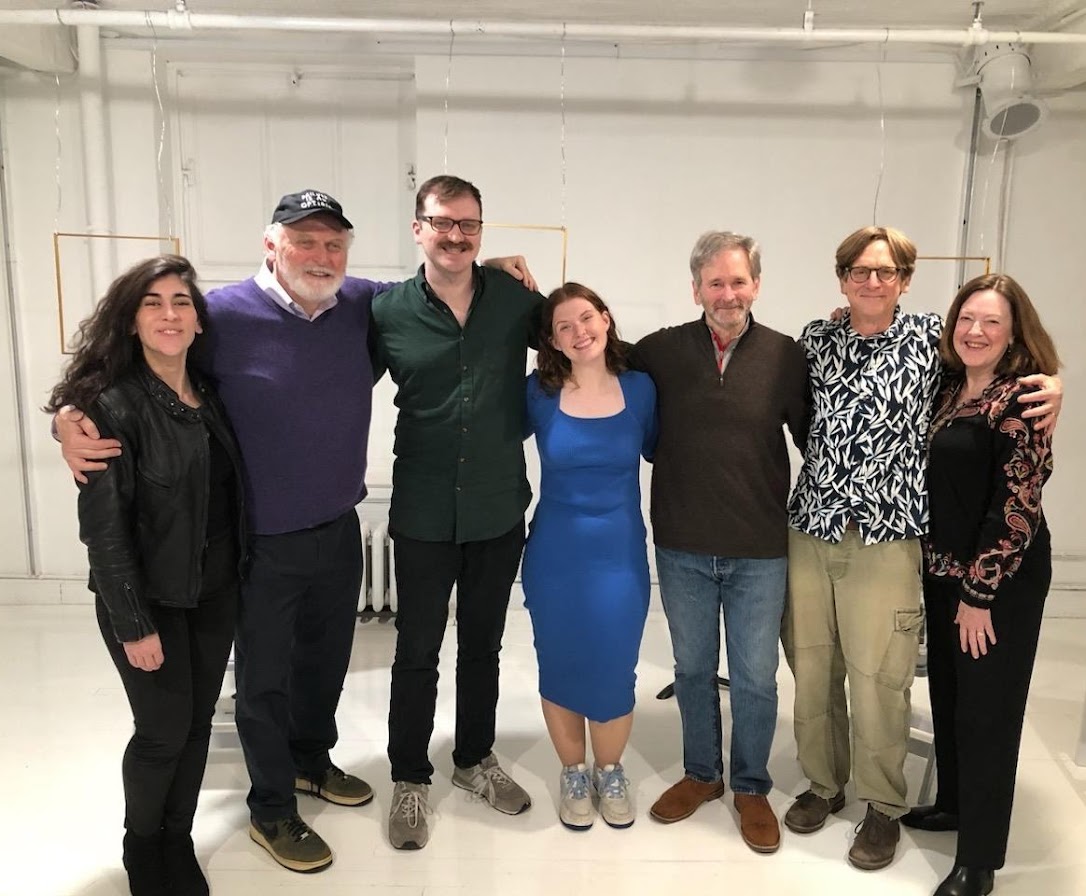
Some of our audience members showing how much they enjoyed RETROSPECTIVE in pub theatre
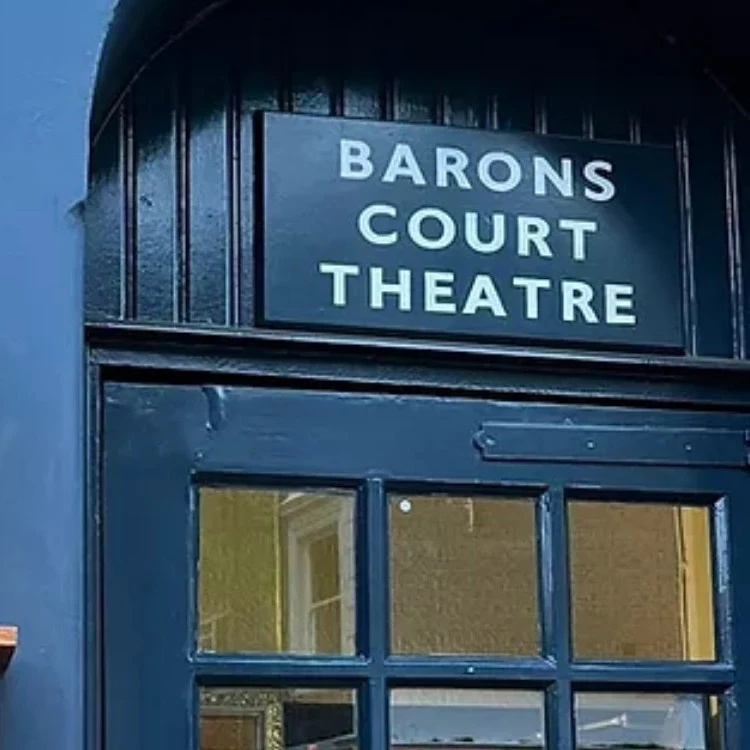
Maybe you already know this as someone who supports theater, but London’s pub theatre experience is unique. We found that out first hand this past May as Knowledge Workings Theater in collaboration with Mon Sans Productions produced the UK premiere of RETROSPECTIVE by T.J. Elliott . And thanks to award-winning filmmaker Louis Catliff, you can share that experience by watching a recording of our May 16th performance at Barons Court Theater .(Blessings on Leo Bacica who brought us to West Kensington.) Just click here to revel in some fanciful fun.
When you click on that link here and are asked to make a minor donation of your choosing to access the RETROSPECTIVE performance, know that you’re supporting making theater live. All proceeds received through this video presentation are split equally among our team of seven people: actors, director, playwright, and tech guru. And while you’re basking deservedly in the warmth of the goodness of your support, you’ll also get to feel what we experienced every night at the theater: audiences bringing powerful energy, a space inviting intimacy, and a nearby bar with alcoholic and non alcoholic encouragement for all concerned. OK, you can’t see the bar upstairs from our theater in the video, but the picture at the top of us with some of our audience at the Curtains Up pub gives an idea of the merriment that ensues.
A Typical Crowd at Curtains Up
So click on this link of our video of RETROSPECTIVE on the Ko-fi platform, you’ll enjoy the way in which Director Liviu Monsted dazzlingly brings to life this comedy about a famous painter, Rory McGrory, — who may or may not be dreaming — encountering his first wife and other hilariously haunting figures from his past amidst what they claim is a retrospective of his work. This mischievous ménage swear they just want to help him ’get to next ’ but Rory just wants to wake up from this dream.
Our theatergoers loved the story as presented so brilliantly by actors Noah Huntley, Sarah Louise Pearcy, Jasmine Dorothy Haefner, and Benjamin Parsons. Take a few secs to watch this clip of comments about the performance from audience members. And look below to see what reviewers had to say about RETROSPECTIVE: One critic actually called the play ‘thoroughly lovable’ and we haven’t been called that maybe… ever?!?
And while a retrospective implies looking back, we are looking forward to hearing what you think of this play. Follow us on Facebook or Instagram. And if you want to help us further, please forward this e-mail do your own friends and family. Then just click on the link, pour a pint of whatever suits you, and let London pub theatre play in your home. Thanks again for helping to #maketheaterlive
All Nine London Test Posts About RETROSPECTIVE’s UK Premiere
Obsessed with tests? Yes, but this post offers advice for all performing and presenting artists
The words test and toast qualify as etymological cousins. Language experts think that the former word meaning originally “a piece of burned brick, clay, or tile” derived from the Latin “tosta, from torreō (‘to burn, parch’).” That means our word ‘torrid’ is in this linguistic clan as well and London reached 100 degrees Fahrenheit as we departed yesterday after the conclusion of our run of RETROSPECTIVE. Torrid!
The other connection between TEST and TOAST is that after a theatrical experience like the just concluded run of RETROSPECTIVE — as depicted in our nine post series London Test — all participants including this playwright and his goddess of an Executive Producer wife are ‘toast’ as in the colloquial sense of burnt out, frazzled, exhausted. (Bonus phrase reference; the use of ‘toast’ in this way purportedly originates with words mostly written by Harold Ramis and dan Akroyd but spoken by Bill Murray as Venkman in Ghostbusters “as he prepares to fire a laser-type weapon … ‘This chick is toast’.” )
He changed the line from the script; of course, he did
Knowing that after such an adventure as RETROSPECTIVE , you’ll be the metaphorical equivalent of a word that originally denoted “A slice or piece of bread browned on both sides by exposure to an open fire, a grill, or other source of radiant heat (formerly often immersed in wine, water, or another beverage)” should prompt theatre makers and other artists to journal about their work while it’s unfolding. Creating performance or presentation involves activity (and often anxiety) on many different levels; the work is multi-faceted. It’s x-dimensional chess and you have to solve for chess just like in high school algebra.
This is not just about theatre; my good friend and sometime cast member, Patrick Smith, just published his first novel The Last Revision. The event extends beyond the writing to the revision, negotiation, promotion, and reflection of all of the material. Talking to him in London when he came to see RETROSPECTIVE provided a rich travelogue of that journey from the book being done to the author never being done. Well, it’s just that Patrick is not there yet. Waiting to capture the impressions and insights of your creating means you’ll miss a few. (Emily St. John Mandel, one of my favorite contemporary authors, seemed to turn her jottings from the experience of her hit novel Station Eleven into a whole other highly imaginative novel, Sea of Tranquility. So, there’s that possibility too from journaling during the work.)
Creation of ANY type is perplex. The wonderful Word Origins newsletter reminded me of one way of portraying the process: x-dimensional chess:
The earliest citation of three-dimensional chess in the Oxford English Dictionary is a literal one, found in H. J. R. Murray’s 1913 A History of Chess: The latest derivative game of chess is Schachraumspiel, or Three dimensional chess (see Dr. Ferd. Maach, Das Schachraumspiel, 1908). The German is literally chess-room-game or translated more idiomatically, spatial chess game Word origins is very cool
Joe Queenan and I when writing Grudges in 2019-20 took advantage of the pretentiousness of the ‘playing x-dimensional chess’ term to skewer a certain political figure whose cult members claim he’s operating on that level, but as Dr. Spock knew (but NOT Dr. Einstein apparently) chess like creating art tests not just our cognitive intelligence, but also the emotional type along with resilience and adaptability. In writing the nine posts about our LONDON TEST, some elements likely escaped that documentation, but the journaling helped me to understand what this thing called theatre and myself within it is all about
Here’s what our Noah Huntley(RORY McGRORY) & Sarah Louise Pearcy (PIPPA) said:
March 12th, 2020.
Do you remember where you were on that date? On March the 12th, 2020, my co-playwright, Joe Queenan, and I were set to audition actors for the staging of our second co-written play, Grudges. That’s the day the pandemic hit the fan in the USA with the NBA canceling its season, ERs overflowing, and travel of pretty much any kind cancelled, cancelled, cancelled. Theater also just stopped. Around the country, whether in Broadway palaces or school gyms, regional playhouses or East Village cabarets, theater just stopped. Every plan for a stage performance died.
Theatre is a series of insurmountable obstacles on the road to imminent disaster. Tom Stoppard
But along with a few others, our then still relatively new company, Knowledge Workings Theater, refused to give up the creation and unfolding of those moments that encompass actor and audience, that give life to the text of a playwright, the scheme of a director, the arts of scenic, lighting, and sound designers. What distinguishes theater is that process and product are about making something live in a way that can simultaneously resemble our lives and show us another world. That four-letter word — live — can be an action verb or a descriptive adjective; both signifying In theater the vivifying reality of stage performance. So hatched our tagline #maketheaterlive. And that’s why we asked our four fabulous actors in the UK premiere of our latest play Retrospective at Barons Court Theatre May 14th – May 23rd to share why they are passionate about making theater live. Noah Huntley and Sarah Louise Pearcy offered the first installment of those answers above.
Our making theater live in those dark days started in a compromise: the actors and performance were live, but the audience was spread somewhat to our surprise not only across North America but in Europe and Asia as well via Zoom. That’s the way in which we produced Grudges (which was our first time working with Jasmine Dorothy Haefner who plays Z in our upcoming UK production of RETROSPECTIVE—her third performance with KWT) followed by Within The Context Of No Context by George W S Trow, and the Swedish screwball comedy, Keeping Right. And through the generosity of these audiences to a GoFundMe, our actors got paid, which we think made them perhaps the best paid stage performers at that moment. Of course, that status derived from being were just about the ONLY stage performers due to the COVID restrictions, but a credit is a credit, right?
Here’s a thirty second promo for those Zoom showings featuring my friends and fine actors John Blaylock and Lynne Otis.
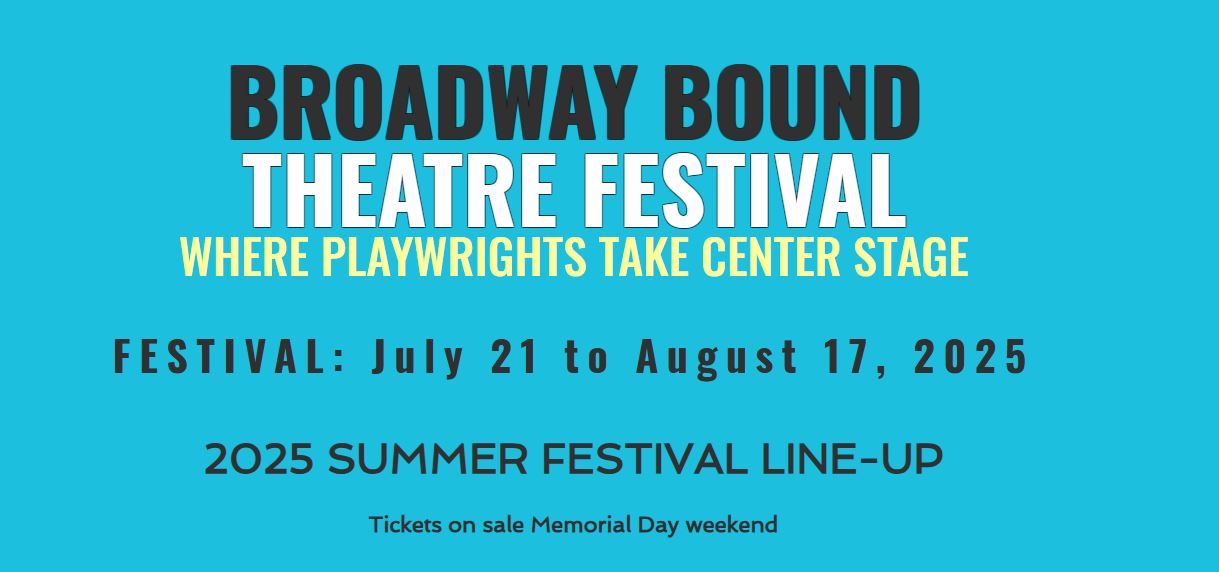
And then in 2021, we got to actually make theater live again through the gracious coproduction of our third play, Genealogy, at Broom Street Theater in Madison WI. Because that’s what’s important about theater: it’s live. You have to remember the lines right then. The lights have to go up at the right time and the sound effects have to go off at the right time. And the audience is right there. Happily for us at KWT, this ‘making’ continued through our productions of The Oracle (2022), The Jester’s Wife (2023), HONOR (2024), and now Retrospective, which debuted at the Broadway bound theater festival at the AMT Theatre on West 45th St. in Manhattan August 2025
Other arts amaze, but theater is the one where you are least likely to know what’s going to happen. Oh, yes, there is a script, a text that the playwrights created and the director has formed a production on that foundation. But every night the connection between the actors and the audience can differ. They have to make theater live every time. No phoning it in, no running it back. Every night is new.
The Irish critic Fintan O’Toole put it very well during COVID:
“Live performers …make their own decisions, here and now, in this moment. In a filmed performance, the performer loses that power. It belongs to others – the director, the editor. But this also applies to us as members of the audience. At a live event, we choose where we look and how we listen. In a virtual event, other people are – sometimes heavy-handedly, sometimes subtly – making those choices for us. This is what we miss about live performance: the autonomy and integrity of the performer, our freedom to shape our own responses, the sense of our shared presence in space and time.”
Shared presence and shared passion: that’s what Sarah and Noah note in their statements above about the importance of making theater live in their own lives. We hope to share that experience with as many theater goers as possible during Retrospective’s run May 14-23 in London. Please join us. Tix at this link.
Some somebodies are about to #maketheaterlive at Barons Court Theatre
RETROSPECTIVE: The question puzzling famous painter, Rory McGrory, in this new comedy is ‘Asleep or Afterlife? Rory, who may or may not be dreaming, encounters his first wife and two other frenemies from his past amidst a show of his work. This mischievous menage claim they just want to help him get to next while he just wants to wake up. Which will it be?
Make theatre live means making opportunities for creation, contemplation, and yes, comedy. Doing this work across national boundaries proves that there is a constituency that wants to bring people together for enlightenment and entertainment, to as playwright Marsha Norman once wrote, “provide a keyhole into some world that nobody has ever seen.” We want to produce what critic Hilton Als called “…a refraction of reality, containing feelings and thoughts that are put forth, first, in a primary text, which the actor interprets—an interpretation that the director supports or edits, in an attempt to help build, in a made-up world, an atmosphere of verisimilitude.” And while we do that we think people should laugh because we heed the aphorism attributed to George Bernard Shaw that“If you want to tell people the truth, you’d better make them laugh …
That’s why Retrospective at the Barons Court Theatre marks the UK premiere of the play that had its world premiere at the 2025 Broadway Bound Theatre Festival in New York. How did this happen? It’s an international collaboration:
Mon Sans Productions is run by its artistic director Liviu Monsted. Since Mon Sans is dedicated to producing original works with compelling themes and unique narratives, they decided to celebrate their 2026 London residency with an American play that asks the universal question of what happens…next? Mon Sans, an incubator for creatives looking to make their first or returning steps to theatre, will be bringing the work of playwright, T.J. Elliott, to UK audiences for the first time.
Knowledge Workings Theatre Company is a family-run, Off-Broadway, independent production company dedicated to creating provocative, thoughtful new works that question how we learn, grow, and remember. With a commitment to intimate storytelling and collaborative development, the company champions work that challenges assumptions and ignites conversation. But the person who brouight together Liviu and T.J. with their respective conmanies for this venture is…
Leo Bacica of Barons Court Theatre true to the spirit that brought his group the COMMENDATION FOR SERVICES TO NEW WRITING 2024 connected director and playwright. Zoom calls that run respectively at 8AM, 1PM, and Midnight allowed the trio to find common cause resulting in this project and continuing Barons Court Theatre’s focus on supporting artists who have come to the industry in non-traditional ways and who have limited networks in the UK.
Get your tickets now at this link for one of eight performances only starting May 14th
Our excellent artwork above by Sarah Lewis Smith heralds our upcoming London run
Yep, it’s happening: get thee to Merrie Old England during the lusty month of May to see this new production. Mon Sans Productions in collaboration with Knowledge Workings Theater will produce the UK premiere of Retrospective by T.J. Elliott at Barons Court Theater in London opening May 14th and running for eight performances. Liviu Monsted of Mon Sans will direct this comedy about a famous painter — who may or may not be dreaming — encountering his first wife and other haunting figures from his past amidst what they claim is a retrospective of his work. This mischievous ménage swear they just want to help him ’get to next’ but he just wants to wake up. Further information and tickets available at the Barons Court website
“The play does not exist in the theater as a written text until it has been absorbed in the process of production. Drama is ‘translated’ or transformed into the person of the actor — “the body of the art of the theater”, as Stark Young put it.“ Harold Clurman, On Directing
‘The body of the art of the theater‘: Watching Mark Thomas McKenna* in rehearsal for RETROSPECTIVE, this quote came to mind. These words suggest one of the most important truths for any playwright or director: it’s mostly about the actor in theater that matters, theatre that moves us. Actors may not be everything in theatre but they form the essence of what we want to see on stage. Alan Ayckbourn, one of our greatest living playwrights and the clearest explainer of playwrighting, agrees; “Theatre is not about the writing, it’s not about the directing. It is about that, but in the end it’s really about the actors and the audience and most audiences – aside from the cognoscenti who sit there being experts – come to watch a bit of acting.”
Mark brings to this work (with our three other stellar actors featured on this page) more than 35 years of experience acting, devising, teaching, producing, and presenting ensemble created work for the stage. He blends the mimodynamics of two years at Ecole Jacques Lecoq in Paris with improv training from Second City. He incorporates insights gained at HB Studios with the great Herbert Berghof right alongside the clowning technique gained from studying with the great vaudevillean Avner Eisenberg better known as Avner the Eccentric. The latter skill showed up big time in his portrayal of Don Quixote.
But fundamentally Mark brings himself to the play, a grand artist who never stops learning while sharing his talent. Clarity of utterance, agility of movement, depth of feeling, generosity of spirit, and quickness of thought characterize his work. Make sure you see him as RORY in one of our three performances in RETROSPECTIVE
Clockwise from Bottom Left: Jasmine Dorothy Haefner, Jeremiah Alexander, Mark Thomas McKenna, Adara Totino [Cast photos by Bill Wadman]
Short Part #1: If you — like famous painter Rory McGrory — suddenly found yourself in a curious art gallery with nothing but empty frames only to be greeted by your dead ex-wife and two other old ‘frenemies’, would you think you were dreaming or were… you know.
That’s the quandary at the heart of RETROSPECTIVE where these past lives form a manic menage a trois plus one in this new comedy about art, attachments, and eternity.
Even Shorter Part #2: Buy tix here and feel free to forward, repost, and otherwise spread the word. Theater is nothing without an audience. Thank you!
Here’s a synopsis of our new work for those who were not at our January 16th reading:
Famous painter Rory McGrory thinks it must be a dream. Why else would he find himself transported to a large space filled with blank frames and his dead ex-wife, poet Pippa LeFebvre? As she engages him in conversations about the tumultuous end to their marriage and narrates the paintings of his career retrospective she claims hangs in those frames, he is bemused — until Pippa states that he is not asleep but dead. Dismay and denial deepen as further witnesses from his past appear attesting that he is now resident in the first stop of the afterlife, evidently a place where detaching from past resentments is a prerequisite to moving to ‘next’, whatever ‘next’ turns out to be. But who is still ‘malattached’ to whom — and why — becomes the question all members of this mixed-up merry ménage à quatre must try to solve.
BBTF “is a boutique festival of live theatre that focuses on developing playwrights into self–producers. BBTF has an unwavering commitment to professionally producing new works, working hands-on with playwrights to make producing their own work a fulfilling and successful experience. And presenting these works to a theatre-savvy community. Since our inception in 2016 in New York City, we’ve been devoted to the evolution of our artists and their work to create great theatrical experiences that continue to live long after their premieres. “
We are thrilled and grateful that they chose our play, which will have three performances:
Retrospective, a new comedy, by T.J. Elliottintroduced at a January 16th reading at TheaterLab
“I can’t understand how anyone can write without rewriting everything over and over again.“ Leo Tolstoy
Readings help rewritings. The generous adventurous people who come to the reading of a new play help to shape its next iteration through both their reactions in the moment — laughs, gasps, silences, even groans sometimes — and what they were willing to tell afterwards. But even before the audience steps into your reading room, the actors and the director have animated the characters in such a way that the idea of the play can never be quite the same as it appeared on the page beforehand. Both groups — creators and observers — prove critical at this stage of making theater live.
At the reading of our new comedy, RETROSPECTIVE, we received a great deal of valuable feedback. At the gathering after the reading, I like to say that I consumed 3 beers and 33 opinions. The play provides an example of the role of readings and rewriting in self-producing a play. I cannot imagine any play that does not benefit from rewriting. But how does that happen in the self-producing process? I’ll show you an example at the bottom of this chapter.
“I am the kind of writer who rewrites and rewrites. I am very eager to correct everything.”
Kenzaburo Oe
This pdf at the end of this post constitutes the thirteenth draft of our latest play, which counting the film we made of scenes for our first play Alms is our tenth production since reentering theater in 2018. And rewriting played an important role in each of those instances, but that’s nothing unusual or new in this field.
In fact, Quote Investigator led me to one of the earliest proponents of rewriting plays: Steele MacKaye, who was a highly popular U.S. playwright and actor of the 19th Century. In July 1889, MacKaye published in several newspapers a piece titled “How Plays Are Written: They Are the Product of Study and Patient Toil”. The first line presented his thesis. Emphasis added:[1]
Plays are not written—they are rewritten. In this lies the advantage of the creative, as distinct from the critical, literature of the stage.
This is not Steele MacKaye
One more time: “Plays are not written—they are rewritten”
QI goes on to note that “by 1894 the saying had been reassigned to the Irish actor and playwright Dion Boucicault, and by 1903 W. S. Gilbert had been assigned a variant referring to comic operas. Yet, the earliest evidence currently points to Steele MacKaye as crafter of the statement.” Of course, others would take credit for this wisdom, which also serves as a caution to beginner playwrights: don’t think this process is like a 100 yard dash. Getting a play into its produceable form is more like an ultramarathon relay race in which you must keep passing the baton to yourself, but there are bathroom breaks.
Let’s trim that quote of MacKaye a little; Plays Are the Product of Study and Patient Toil. This is especially true for self-produced plays, and the rewriting of such enterprises differs from other development schemes for plays. As a bonus way of looking at self-producing, I argue that such work provides more opportunities for a playwright to refine their text through rewriting.
This not to demean the many opportunities to help a playwright revise their new script outside of self-producing: dramaturgs, workshops, New Play Exchange, etc. But when you are the producer of the play, your contact with others is perhaps wider and richer than it would be as someone who luckily has had a submitted script accepted for the next stage of development.
Being the self-producer in my experience rendered me more open to suggestions from actors. Why? Self-producing means self-interest squared. The calculus of how the play can be successful necessitates a collaboration that is authentic. The self-producing playwright may have even greater motivation to have each one of the actors be fully engaged. I don’t think that happens unless the collaboration is sincere, and that means the listening to, exploring of, and responding to comments and suggestions about the play must be real, true, not feigned or pretended.
Our Team: Jasmine Dorothy Haefner, T.J. Elliott, Gifford Elliott, Kat Reeve, Daniel Thompson, Jeremiah Alexander, Marjorie Phillips Elliott
That doesn’t mean that you, the playwright, will take every suggestion; that would be madness and an abdication of the duty to be the final judge of the text. But it does mean that you are in dialogue with these other artists and in doing so learning from their questions and even their complaints. Of course, one of their complaints with me is why do you write so many words? And I always say, I’m just imitating my favorite playwrights like Shaw and Shakespeare and Stoppard. I’m not pretending that I’m as good as they are, but part of what that imitation allows is the courage to let my characters run on, to luxuriate in language, maneuver in making arguments with quality and quantity. And since I have confidence in the eventual audiences that will see the finished product, I’m not afraid of all these things that are said about attention span. I’m willing to hazard that possibility. It drives me to tell a better story, one that will hold each person because they want to know what happens next. But I would be a fool not to ask others what they think about all of this.
Lucas Hnath is a massive rewriter. As D.T. Max observed in a New Yorker piece: “He can sound mystical about his creative process. At workshops, I’ve heard him say many times, ‘This line hasn’t figured out yet what it wants to become.; But he can also be stringently analytical. Playwright’s Input A should result in Audience Output B. … I asked him what he’d be looking out for that evening [of a preview], and he said that it was important that he not look for anything. He wanted to experience the play as if he’d never seen it. This, he emphasized, would be just the start of his process. “You have to watch several performances. Then take a step back and try to understand, on average, how the play works. It’s what remains consistent across many performances that tells me something useful. Tonight is one single data point.” He hoped to next time find “a better spot” in the theatre. Another night found him in the stage manager’s office, listening to the actors on a monitor. He was rewriting their parts as they spoke.”
There are three aspects of rewriting in that story: the intuitive (This line hasn’t figured out yet what it wants to become), the analytical in checking off whether a particular line or passage elicited the desired reaction; e.g., an expected laugh, a thoughtful frown. Isaac Bashevis Singer, a paragon of effective and glorious storytelling, once said: “There’s no great art in confusing the reader.” That holds true for the audience member as well, and that’s the third aspect evident in the passage on Hnath above; he is rewriting in the booth as the actors speak their lines because he is sensing where the audience is finding meaning or getting lost, which is different than the analytical look in which he keeps score of whether the reactions were what he planned. This third look arise from his wanting “to experience the play as if he’d never seen it.”
At least, that’s my take. The next time (first time!) I run into Lucas I’ll factcheck my interpretation and let you know.
“Frankly, I also don’t want to have to listen to everybody’s views since, based on an ignorance of the overall text, they are only going to be prejudices anyway. Of which, with this subject, there are too many already.” David Hare, Acting Up
Before I move on to the planning and unfolding of the reading that will lead to this rewriting, we should hear another take that of David Hare whose book Acting Up is one of my holy texts about how theater and specifically performance really work. From the above quote, you might get the sense that David doesn’t use as many people as aids in his rewriting as we did in this reading. (I do not know Hare either, but I consult his book so often it seems like we would be mates over a pint.) But in that same book, he tells a story about how Louis Malle influenced his playwrighting that describes ne way of rewriting that offers many advantages:
“Louis (Malle) shared my fascination with techniques of storytelling. Once, we were meant to be working together on Damage, the film of Josephine Hart’s novel. But I came into the restaurant for supper usually dissatisfied with that morning’s readthrough of the play of mine called Murmuring Judges. ‘It ought to bloody work,’ I said, ‘and it doesn’t.’ At once Louis asked me to tell him the story of the play. Together we sat for three hours, refining the narrative. Louis isolated every component of the story, and then put them all back together again in the right order. It was like watching a great car mechanic lay out the pieces of an engine on a clean white cloth before reassembling them. He did it for the sheer intellectual pleasure.… (After writing the synopsis of Damage) Every morning he would make me sit down under the vines and go back to the beginning of the story. He did it so many times that I thought I was going to go mad.”
That’s a rewriting occasion at the synopsis stage! You’ll figure out your own way, but if you’re self-producing starting with a reading makes sense for at least four reasons:
$$$
Marketing
Shaping the play
Exploring the acting
$$$: Attendees at a reading might be backers. Such a strategy requires a whole separate chapter.
Marketing: Readings aid this phase of self-producing because through that event you get photo ops, the start of word of mouth, and possible blurbs (e.g., “this is the best work yet from this playwright“; yes, someone said that at our last reading, which made me wonder what was lacking with the earlier plays). Reading attendees may be your repeat customers; If they liked it at the reading they will often be curious enough to return for the full production.
Given the theme of this chapter, the focus here is on the last two items on the list: Shaping and Exploring. We quote Hilton Als all the time to distinguish between the text and the play:
The reading represents the first chance to see what happens when actors speak that text in front of an audience. You realize what’s too long, too short, really funny, really NOT funny. You get the idea. Singer’s dictum becomes critical: is the audience confused; you can tell a lot by looking at faces and listening to breathing. Allan Gurganus notes that, “A crucial verb for writers is revise. Which means, of course, to re-see.” The re-seeing that happens here is quite different than the first seeing that spun out in your mind’s eye. As you re-see, you begin to reshape: lines bend, passages disappear, images appear or disappear.
To re-see, you must engage a director actors who will bring your text to its best possible life at this point. You connect to a director who can make the storytelling consistent and as potent as one can manage in front of music stands with no set. This exploration requires actors who have ideas based upon your primary text, notions about their character’s backstory, relationships with other characters, even the cadence of the language that you gave to them. Their questions about moments that are unclear to them or ways in which the structure seems not to work given their new understanding of the story.
Even before these conversations or rehearsals occur with the actors and your director, other preparations for the reading happen: getting a space, sending out scripts, etc. But the most important of these preparations is to gather an audience that likes theater. To paraphrase Singer; there is no great benefit in torturing yourself by inviting to your Chekhovian comedy an audience of people whose usual entertainment diet is thirty second TikTok parodies.
There is the usual housekeeping to address: pick a time that is convenient, send invites that are inviting and grateful, offer directions and cautions if your venue happens to be down a flight of crumbling steps or has a funky buzzer system to get in the front door. Make sure there are enough chairs and music stands. Be prepared to find the bathroom key and make sure there are paper towels there. Every detail increases the comfort of this audience and you want them in a good mood to focus on your play.
We recommend a place for an after-reading gathering. Make it comfortable and convivial. Work that room to get reactions and note them in your phone or on paper. Then consider them in the next few days because not all of them will be useful. After all, this is still your play and you need to decide which of those comments and reactions will help the story versus what will harm it or make it a totally different work.
And then…
The Fruits of Your Labor: A Rewritten Play
“Everything is there in the sauce; it just needs to simmer.”
B. Huvane
The forty people who DID come to the reading only had this context about the subject of the play:
Retrospective concerns a famous painter who may or may not be dreaming of an encounter with his first wife amidst a retrospective of his work and the appearances of others from his past.
With that sparse framework, the rest of this chapter will offer examples of the rewriting. Knowing the whole play is not necessary to appreciate the learnings that the reading produced for us.
If you have the luck to persuade some people with experience in the theater as producers to attend your reading, then you are very lucky indeed. And I must claim humbly that status as at each of my readings experienced Off-Broadway, Broadway, and West End hands have attended and offered substantial constructive reactions. But I’ve also gained critical ideas from causal theatergoers who wanted to see what a new play reading was like. Having this variety is an advantage: listen to everyone. That’s particularly important for self-producers as we need all the support we can muster.
One of those old hands was lavish in his praise of RETROSPECTIVE based on the reading, but wondered what it would be like if the main female character addressed some of her bouts of confusion directly to the audience. I found this compelling and thus our opening notes reflected this change. Will it stick as the play moves to production? Impossible to tell, but whoever reads it next will have the advantage of this context.
Having sat in on the three pre-reading rehearsals, I didn’t need anybody to tell me that the play was too long, but several people did so anyway. You have to develop listening skills; hold the play at arms length for good perusal, don’t let the play hold you. Don’t take criticism personally. A common theme ran through those kind but ‘cutting’ comments: get the secondary female character on to that stage sooner. In fact, one of the people who told me that was the actress who played the secondary female character who is also a collaborator with two of our previous plays. Trusting her, we realized that there was too much business around the beginning and as you can see from the image below of the first page we cut, cut, cut as if this was a slasher movie.
And cut some more…
Rewriting is not just about cutting. Paying attention to the audience lets you know that their attention flags at times. One cause of this is excessive wordplay. In the change pictured below, the shift to emphasize one character’s discomfort with his reflexive taunting of the other combines with her need for ‘the right word’ as a poet. We are still establishing their identities and relationship, but that must happen economically.
Some of the many changes made are like Hnath’s analytical takes described above: Input A (a joke in this case) did not get Output B (a laugh from the audience). So we swapped in other repartee that should work better.
Our goal became losing ten minutes of runtime, which with this 14 point font means ten pages. One way to do that is to look scrupulously at how you can have more show and less tell in the exchanges and action. The cuts below resulted form that feedback.
A pleasant surprise from the audience reactions in the reading was the enjoyment expressed for the poems written and read by the main female character, Pippa. In this case, rather than cutting, we decided to expand one of her poems a little bit. This had the dual advantage of clarifying her personality through her poetry and also allowing the audience more chuckles at these rhymes. Nothing wrong with chuckles in this play.
Two motives manifest in this next illustration of rewriting. The first one is familiar to any writer and was initially offered by a literary savant with a wonderful name for a comic character: Arthur Quiller-Couch. In his still highly relevant book, On The Art of Writing, Q, as he was known, advised, “Whenever you feel an impulse to perpetrate a piece of exceptionally fine writing, obey it—whole-heartedly—and delete it before sending your manuscript to press. Murder your darlings.” Rewriting may involve multiple murders. The one below was justified because a) we need to cut 10 minutes and b) it’s a clever digression that the character, the acerbic critic self-named Z, doesn’t need as by this point everyone knows she is devilishly clever .
One last example of the changes made is a confession to a weakness. I think most playwrights have conversations with their characters or at least become eavesdroppers on such dialogue. In a first draft, the talk goes on and amuses the playwright. But a reading reveals the prosaic nature of some of those exchanges. Cutting them makes things move and that is necessary to have your audience be moved. That’s what happened here.
And with decisions like that, we cut our ten minutes. The process isn’t over, but the shape of the play satisfies, and its overall idea now has passed a test. Self-producing gave us both additional input and added urgency for our rewrite. Want to see for yourself how it turned out? Click on the PDF below and read through the current version.
And, yes, we’re always interested in having talks with folks who want to be producers or co-producers or investors helpng Knowledge Workings Theater get this play out in front of more audiences. The reading? The rewrites? The capturing of the lessons from self-producing? It’s all about pursuing our impulse, following our motto: make theater live.