Tag: acting
-
All honor to Ed Altman in…HONOR: Link to Tix Below

The character — Don Troy — that Ed Altman plays in HONOR is the first one to utter our play’s title word and the way in which Ed delivers its two syllables is like tossing a match Into a room full of Roman Candles. Explosions ensue yet Ed’s character never flinches. Indeed, this dynamism is just what the play requires: an incendiary presence who flicks and lunges verbally at his two colleagues in this debate about what honor means. The trio proceed to sizzle and sparkle along the way in their storytelling with revelations and accusations, but not apologies.

Ed’s formidable array of acting experiences served him well in preparing for this role. Past work with Knowledge Workings Theater includes: The Oracle, Keeping Right, Grudges (Narrator). Other recent stage appearances had him in Two Swans, Nowhere Man, Victoria Woodhull (both at Theater for the New City). Also of late screens both big and small have benefited from Ed’s stalwart presence and straightforward style: TV/Streaming: The Good Cop (NTD/Epoch TV), The Vow (HBO), Food that Built America (History Channel), Dragon Meets Eagle(Amazon). His most recent film: The Dummy Detective is in production right now but earlier efforts include, Biff & Me, Oatmelio’s, Thumbwrestler II, Jazz John, all making the international film festival circuit. Ed was a member of the comedy group Prom Night with whom he wrote and performed at the Westbank Café back in the days of Lewis Black and Rusty McGee. He is also a voiceover artist for commercial and corporate work, and has voiced several audio books. Get your tickets now for one of the three performances upcoming of HONOR at The Chain Theatre Winter One-Act Festival
Share this:
-
This Fall TJW Comes to NYC

The April 20 Reading Went Very Well!
Immense thanks to the audience who taught us so much about our play and TheaterLab for hosting us. (Go see Orietta there in Let Me Cook For You)
And now…The playwright Alan Ayckbourn has taught me more about that craft than anyone and his most important lesson might be in this sentence: “Theatre is not about the writing, it’s not about the directing. It is about that, but in the end it’s really about the actors and the audience and most audiences – aside from the cognoscenti who sit there being experts – come to watch a bit of acting.”
Our kind (and I must say highly intelligent, sensitive, and aesthetically refined)audience for this reading watching and reacting to ‘that bit of acting’ by Winnie, Steve, and Xander (along with Ed Altman as necessarily noisy narrator) taught us so much about what needs to happen as we move towards fully realizing our work.
We anticipated a ninety minute night but the reading came in at exactly ten minutes LONGER, which taught us that we can trim some branches to this story of a woman whose name we never learn without harm to the overall tale. Our TJW actors gained from our audience the advantage of feeling for the first time what the moments between each one of them and the audience can be. As Margaret Atwood has written, the audience is co-creator of any story and at this stage of our work, their presence was felt and appreciated greatly.The Jester’s Wife, a medieval comedy by T. J. Elliott produced through Knowledge Workings Theater, will prepare for an autumn opening. Our play will seek to realize fully the story of Jester and Wife as confronted by evil and still afraid for their lives they now encounter in their hideout cave a Stranger afflicted with madness. The Jester and Wife (who might have been the original prototypes for Punch and Judy with their hurled blows and one-liners) bicker, banter, and battle through questions of survival, responsibility, and who gets to tell their own story.
With an original blend of medieval and distinctly Irish tinges, the comedy pits the Jester’s self-preserving pragmatism and entertainer antics against his Wife’s heroic idealism — and her prowess wielding a broom! Their dilemma shifts from figuring out how to keep their heads to contriving how telling the story through a mystery play might be their ticket out of the cave where they live. But which story gets told is up for grabs. The narrative’s examination of myth-making, martyrdom, and survivor’s guilt mingle together in ways familiar to our present lives.
So stay tuned as our team brings this tale to full and funny life.
Share this:
-
Will Micky Elevate to Oracle?

Jasmine Dorothy Haefner is Micky Cohen in THE ORACLE Micky wants to… She wants…
What does Micky want?
REALLY REALLY REALLY want?For years, she has ‘facilitated’ the spectacular success of the current Oracle, the guru who every morning provides ’the three reveals ‘ to which everyone in the corporation must pay attention. But with a new Harvard super-forecaster suddenly on the scene, the future seems uncertain for her. Will Micky make a move? Buy a ticket at this link to find out

Ed Altman as CEO Fred Spee ‘walks & talks’ with Micky (Jasmine Dorothy Haefner) Jasmine (Micky) is an actress and writer for the screen and stage. Her most recent work is 28 is Great, a comedic short film she wrote, produced, directed and starred in, which has won several awards. (Lighthouse International Film Festival, Astoria Film Festival, Twin Cities Film Fest). She is thrilled to be a part of this production and working with Knowledge Working Theater Company again. She is incredibly thankful to the writers, cast and crew for all of their work. Theater: True Love (New York Theatre Festival), Dust Vanishes Away (Dir: Gabriel Torres, RE: Encuentro 2021, Loisaida Center, NYC), Grudges (Knowledge Workings Theater Co.), EVICTED (Teatro Yerbabruja Experimental), You Are So Lucky, and others. Film: 28 is Great, Zoomers, I’m Listening (NY State International Film Festival), The Unexpected (Hoboken International Film Festival), and others. TV: Saturday Night Live, and others.
•Instagram: @TheJasmineDorothy http://www.JasmineDorothy.com

Patrick Smith as Leo and Jasmine Dorothy Haefner as Micky consider the future Share this:
-
A Quick Peek at Rehearsals for The Oracle
Blocking The Big Exit is just important is figuring out the entrance Rehearsals are underway in our Equity Showcase production of the Oracle by T.J. Elliott and Joe Queenan. Our colorful cast of amazes us every night with their flexibility. Buy your ticket now for our limited run at Theater for the New City May 18th to May 22nd.
The Oracle features Hassan Hope, Jasmine Dorothy Haefner, Alyssa Poon, Patrick Smith, and Ed Altman in this two act play with set design by Kathleen Ritter, lighting design by Mikelle Kelly, projection and sound design by Luke Lutz, and producing Services by Emma Denson & Ed Altman Stage Management by Morgan Lindsey Fears
https://www.eventbrite.com/e/the-oracle-a-new-comedy-by-tj-elliott-joe-queenan-tickets-310167026927
Share this:
-

Get your tix for The Oracle Now
Tix are available for the limited five performance run at this link.
How to succeed in business without really knowing…
To coin a phraseby Claude Solnik
In The Oracle, a new comedy by Wall Street Journal humorist Joe Queenan and T.J. Elliott, a CEO decides to make two executives compete for control. In the best case scenario, it’ll be great for business as two would-be oracles, or chief knowledge officers, duke it out. Failing that, it could at least be an entertaining battle to watch. Tix are available for the limited five performance run at this link.
“Having two CEOs would be like having two suns in the same solar system, because the sun is the center of the universe,” the CEO says. “Whereas two Oracles is more like… having two hands.”
The Oracle, playing at Theater for the New City, 155 First Ave., in Manhattan, May 18-22, provides an entertaining look at office politics, changing workplaces, diversity, destiny, mining the workplace for comedy and drama with well-drawn characters, realistic, clever dialogue and a strong plot.
This premier Equity Showcase production features Hassan Hope, Jasmine Dorothy Haefner, Alyssa Poon, Patrick Smith*, and Ed Altman.
Queenan, a longtime humor columnist at The Wall Street Journal, and Elliott, a playwright and former Chief Learning Officer at a large corporation, have steeped The Oracle in reality and experience along with dark comedy. Tickets are $18 and $15 for seniors.
Although The Oracle tells a fictional story of a CEO pitting employees against each other in a kind of survival of the most fit for corporate America, it’s a funny journey into the office, very different from the TV show of that name.
This production at TNC is a powerful, new play about office politics writ large, not about the American dream, as Death of a Salesman is, but the largely unmined humor of American corporate reality.
“How to succeed in business without really knowing,” Elliott jokes about an apt subtitle. “The ability to sell themselves and sell their ideas makes them successful.”
This is a world where one character spouts the motto “My job is to make you a success,” although the reality seems very different. The motto “Do it yesterday” inadvertently dooms efforts to failure, in a world where we hear about a seminar on the (somewhat uncertain) future of uncertainty.
“It’s about corporate dynamics,” Elliott says of his latest collaboration with Queenan. “Office politics are a subset of corporate dynamics.”
The play is a blend of the two writers’ sensibilities, a mix of drama and humor surrounding the struggle to win around, or beyond, the water cooler. Queenan, who grew up in Philadelphia and lives in Tarrytown, wrote humor for Barron’s, Forbes and The New York Times before launching his “Moving Targets” column for the Wall Street Journal.
Elliott was born in the Bronx, lived in New Jersey, worked in corporate America for many years, wrote business books, including one he co-wrote about making decisions, and lives in Princeton. This
“The long story is if stuff is thoughtful and penetrating and intellectual, T.J. wrote it,” Queenan says. “If it’s a cheap laugh, I wrote it.”
The Oracle finds fertile ground in a part of American life too often overlooked by theater, which seems to have a blind spot for the business world. Americans over a lifetime spend 90,000 hours at work, according a book titled Happiness at Work. And yet theater seems to turn a virtual blind eye to the humor, heartbreak and drama, of this central part of the American reality.
“There aren’t many plays about business,” Elliott says. “Recently, there was a popular play about business, The Lehman Trilogy. It’s interesting that it sold out. I found it fascinating. We’d already written this play. “
Ed Altman, who plays the CEO in The Oracle, worked in financial services for many years and has since appeared in theater and in television. He sees the workplace as a topic avoided by and natural for theater
“People work all day,” Altman says. “Then they want to forget about the office, but there’s a lot going on there, a lot of drama and comedy. And it can be a good starting point for a play.”
The Oracle looks at a world where every day is a new idea – literally. The unnamed business (we don’t know what it does, but it has a board) begins every day with “three reveals” or things to focus on, creating a 24-hour cycle of revelation that leaves a lot of time for enthusiastic eurekas, but not for execution.
“As one character points out, oracles always say things that can be true no matter what happens,” Elliott says. “If you fight today, a great army will be destroyed. That’s right. One or the other.”
The play involves dueling oracles with the business as a battlefield, as a gaggle of gurus go after each other with the gusto usually reserved for combatants in the World Wrestling Federation. They hurl business blather at each other like punches in a boxing match.
“The play was always a black comedy, but it was more serious. I decided we should have these guys engaging in a duel that nobody else can understand,” Queenan says. “They’re constantly trying to one up each other.”
The Oracle also looks at serious issues such as diversity and discrimination, along with biases that sometimes lead to uniformity rather than the benefits of different ethnicities and backgrounds.
“I was in the position of recommending folks for high- level jobs,” Elliott says of his work life (an oxymoron a little bit like jumbo shrimp). “They would choose the person who was like them. They look like them, think like them, talk like them. They came from the same college.”
The Oracle looks at a changing workplace where an older white guard and new guard including an Asian-American woman and African-American man vie for power. It looks at how those in the C-suite try to figure out the future – and deal with the past.
“It’s clear that she is the better oracle,” Elliott says of a young Asian-American woman who faces resistance when she tries to get executives to invest more in the company and less in their own compensation. “She doesn’t understand corporate politics. it’s not the knowledge but the reality to sell, motivate and manipulate.”
We spend time in a world filed with relationships, revelations and, now and then, revenge, as people get hired, fired and mixed up in sometimes Machiavellian machinations. The Oracle opens the door to a heartfelt, humorous view of the changing office, set in breakrooms, board rooms and at an unspecified business.
In a play full of memorable moments, there’s one that lets us look into the depths, or shallows, of a deciding process that turns out to be simpler than one might expect. “There’s a twist, but no spoilers. Come see the play.” Elliott says of a guru’s secret sauce.
The Oracle, Theater for the New City, 155 First Ave., NY, NY. May 18-22 , May 18, 19, 20 and 21 at 8 p.m. and a matinee Sunday May 22 at 4 p.m. For tickets go to EventBrite
* Patrick Smith appears courtesy of Actors Equity Association
Share this:
-
You Can Still Catch Genealogy on YouTube (Link Below)

(L-R) Atticus Cain, Karl Reinhardt, Jamie England, and Quanda Johnson Sort Out the Family Trees The live run of the problem comedy, Genealogy, by T.J. Elliott and Joe Queenan directed and coproduced by Dana Pellebon has ended at Broom Street Theater in Madison Wisconsin. Our sellout standing ovation audiences during this three week run encouraged us to keep on telling the story and, therefore, we invite you and whomever you think wants to engage with this Satire Of Inconvenient Family Ties to watch the video of Friday, November 19’s Live Stream at this link.

The Hunts and The Wilsons aren’t fooling around 
The podcast that made it all happen! (Jackson Rosenberry as Glenn Weber) 
“We are not done!!!” Share this:
-
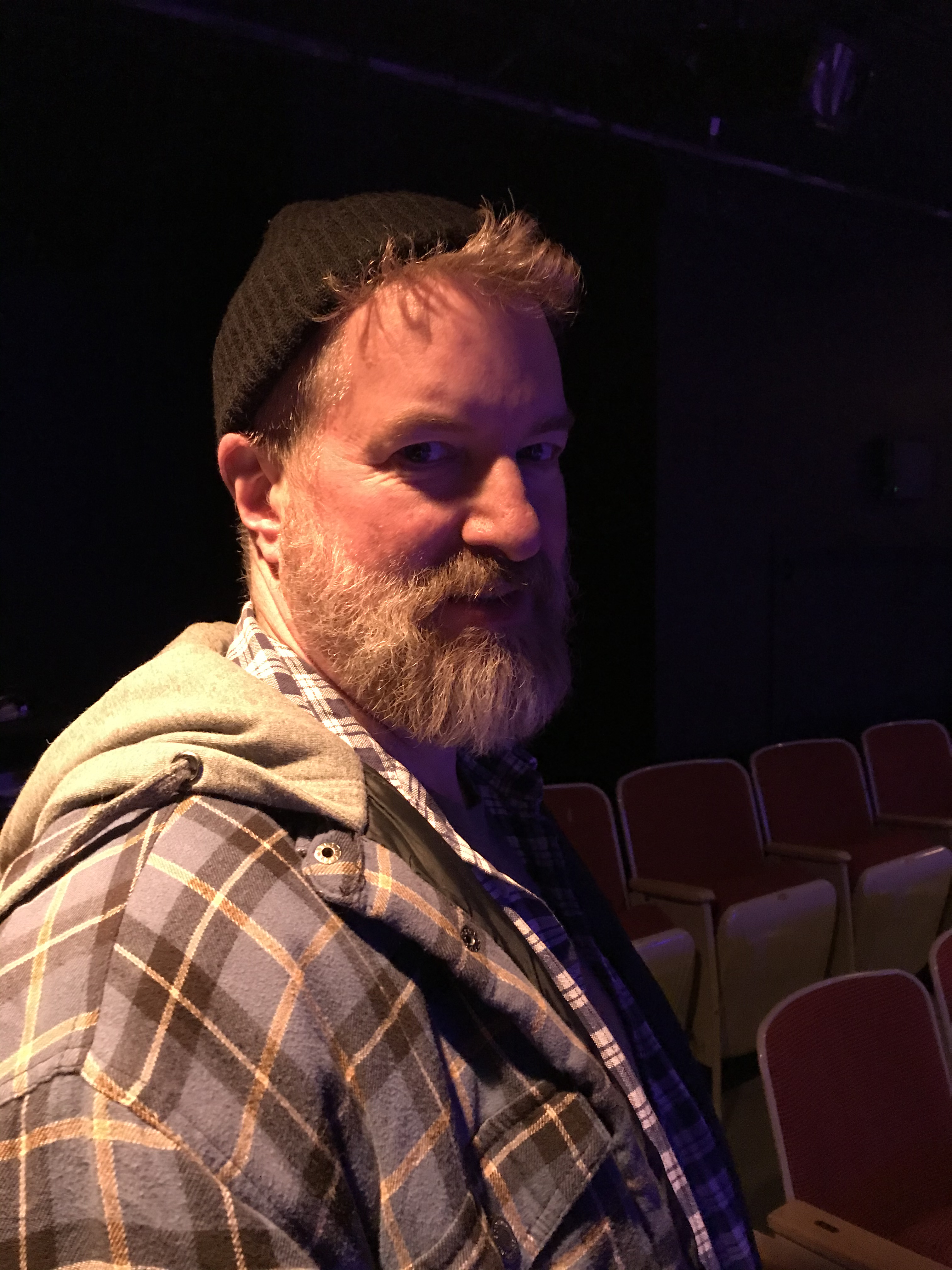
To Make Theater Live Ain’t Easy

Karl Reinhardt: My Hero “Theatre is a series of insurmountable obstacles on the road to imminent disaster.”
Tom StoppardOn March the 12th, 2020, Joe Queenan I were set to audition actors for our second co-written play, Grudges.
March 12th, 2020.
That’s the day the pandemic hit the fan with the NBA canceling its season, ERs overflowing, and travel of pretty much any kind cancelled, cancelled, cancelled. Theater also just stopped. Around the country, whether in Broadway palaces or school gyms, Regional playhouses or East Village cabarets, it just stopped. Dead.
But we couldn’t bear to give up. So, hatching our tagline #maketheaterlive, we produced Grudges on Zoom followed by Within The Context Of No Context by George W S Trow, and my solo effort, the Swedish screwball comedy, Keeping Right.
And then this year, we got to actually make theater really live again through the gracious coproduction of our third play, Genealogy, with Broom Street Theater in Madison WI. Because that’s what’s important about theater: it’s live. You have to remember the lines right then. The lights have to go up at the right time and the sound effects have to go off at the right time. And the audience is right there. Breathing, coughing, laughing, groaning: right there.
Other arts amaze me, but theater is the one where you are least likely to know what’s going to happen. Oh, yes, there is a script, a text that the playwrights created and of which upon that foundation the director has formed a production. But every night the connection between the actors and the audience and even among the actors themselves can differ.
The Irish critic Fintan O’Toole put it very well recently:
“Live performers …make their own decisions, here and now, in this moment. In a filmed performance, the performer loses that power. It belongs to others – the director, the editor. But this also applies to us as members of the audience. At a live event, we choose where we look and how we listen. In a virtual event, other people are – sometimes heavy-handedly, sometimes subtly – making those choices for us. This is what we miss about live performance: the autonomy and integrity of the performer, our freedom to shape our own responses, the sense of our shared presence in space and time.”
That’s one of the reasons why being able to see and feel and hear our wonderful actors perform Genealogy this month awed and thrilled us. But certain events reminded us of the fragility not only of theater, but of life. One of our team, one of our amazing actors, took ill. (He’s doing much better now and we trust on the road to a full recovery) And our astonishing director, Dana Pellebon, approached Karl Reinhardt (who had been doing spectacular work as our stage manager from day one) to ask him if he was willing to step into a role of a character who is on stage from beginning to end of our 95 minute play.
And he did. Karl committed to make theater live. God bless him.
He played the role last weekend and he’s playing it again this weekend including at our live stream performance on November 19th. (Tix are here; choose “11/19 Live Access” from the dropdown menu.) Stepping into a role that another actor has created without having had the benefit of the weeks of rehearsal, the space to learn lines, the experiences to forge connections with the other characters is beyond daunting. Try terrifying on for size. Yet Karl did it and he did it very well. That’s why on Saturday night when I get to see the live stream, I’ll be toasting not just the entire cast and the director and the crew but especially Karl Reinhardt who embodies the commitment to make theater live despite that “series of insurmountable obstacles on the road to imminent disaster.”

The podcast upon which our characters appear in Genealogy 
Quanda Johnson and Atticus Cain Jackson Rosenberry as podcast host, Glenn Weber Share this:
-
Jackson Rosenberry is excited theater is back with Genealogy opening at Broom Street and so are we!

Jackson Rosenberry posted by T.J. Elliott
The combination of the lingering effects of the pandemic and the distance to Madison, Wisconsin from our homes in the New York City area meant that Joe Queenan and I did not meet many of the actors in our Genealogy cast in person when we had our Zoom table reading a few months ago. And then when we were auditioning several actors for the part of Glenn Weber, the former MTV personality now hosting what another character in the play describes as the “tabloid version” of ancestry podcasts, watching applicants on video was the only method available to us. Jackson Rosenberry stood out even on that colder medium for his energy and inventiveness.
Thus, I wasn’t surprised when we asked for his bio after he was chosen for the role to read its very first sentence: “Jackson Rosenberry is very excited to work on this production.” Finally meeting him a few weeks ago in person and watching his work in the first two rehearsals, I realized that this was something of an understatement. Jackson plunged dynamically into the role and I found myself cracking up at the ingenuities of his interpretations. He also read the script so carefully that he caught a mistake we had made in describing someone’s ancestor. I don’t think I will ever get over the sensation of gratification that comes from recognizing someone has read our words very carefully.
As I learned more about Jackson’s work in the theater, I understood the strong foundation that he brings to our work. Since moving to Madison in 2017, Jackson has been involved in multiple productions around Madison including Henry IV Part 2 and The Merry Wives of Windsor, both produced by the Madison Shakespeare Company. He has also been involved with several productions at Broom Street Theater, including Lysistrata, and Hamilton: The Original 1917 Broadway Smash Hit. Having an opportunity to grab a drink at the Weary Traveler after one of the rehearsals with Jackson, it was very clear how very happy he is to return to Broom Street once again to bring the love of theater back to Madison after such a long time. And that long time is now less than a week before Genealogy directed by Dana Pellebon opens at Broom Street Theater Our live stream on the Broom Street YouTube channel will be on November 19 and we are very happy that Jackson Rosenberry will be part of our fine cast.

Jackson in action at Genealogy rehearsal Share this:
-

It’s not so much what you know sometimes, but who you know and whom they know: the good fortune of meeting Atticus Cain, our Mosiah Wilson in Genealogy

Atticus Cain posted by T.J. Elliott
In my own biography, allusions to 35 years away from active work in the theater receive comic treatment: “In those lost years, T.J. produced, directed, and performed among casts of thousands in a mélange of corporate telenovelas and tragic, comic, melodramatic, and semi-absurd organizational performance art.” But as Sigmund Freud pointed out jokes even self-deprecating ones like the above example can camouflage what is very serious in our lives. Freud noted in what had to be one of his lighter moments that “our enjoyment of a joke is based on a combined impression of its substance and of its effectiveness as a joke.” The effectiveness is not just getting people to laugh, but also at times a way for handling something that was uncomfortable or even painful.
In my case, I missed theater terribly, and explaining more than three decades away from it remains slightly difficult. The good news is that all of that earlier theatrical career — writing, performing, producing, directing, pitching, — proved enormously useful in my succession of straight jobs. In a wonderful example of consilience, a concept first introduced to me by EO Wilson of Harvard, a great deal of what I learned in those years of ‘semi-absurd organizational performance art’ enriched my subsequent playwrighting and indeed my understanding (limited though it remains) of how the world works.
I read and learned a great deal about the way the world works: everything from adult development to adult learning, from knowledge management to project management, from leadership to followership, from neural networks to social networks. From that latter domain, academic papers like this one about the concept known as the Strength of Weak Ties introduced by Mark Granovetter proved useful in those corporations and they prove useful today in trying to #maketheaterlive, which is our motto at Knowledge Workings.
Atticus Cain, who plays Mosiah Wilson in our upcoming production of Genealogy at Broom Street Theater opening next Friday, November 5, could serve as a textbook illustration of Granovetter’s points about how the weak ties in our network, the friends of friends of friends if you will, may prove more valuable to us than our immediate circle in many circumstances.
Ed Altman, who first worked with Knowledge Workings in Grudges when that Queenan-Elliott drama went up live on Zoom in May through July 2020, was in another streamed theater piece that summer, The Statement, hosted by Theater for the New City. Ed invited me to see the piece and that was where I first viewed Atticus. Thus, when I was casting my solo playwrighting effort, Keeping Right, for its live Zoom performances in December, Ed recommended Atticus to me for the part of Sven McManus. Perfect. This kind of connection happens all the time in every type of work, but in theater where the usual structures of workplaces are not available or do not apply being introduced to a powerful actor whom you otherwise would not know is a kind of mighty grace. You’re not sure how it works, but you’re awfully glad that it does work is often as evidenced. As Jeffrey Rush famously pronounced in Shakespeare In Love, “It’s a mystery.”
And while we are offering quotes, this one that appeared at the end of Atticus’ bio seems also apt: “I am a series of small victories and large defeats and I am as amazed as any other that I have gotten from there to here” – Charles Bukowski. We are amazed as well and feeling very lucky yet again.
And as to the getting “from there to here”: Atticus Cain was born in Memphis, Tennessee, raised in part in Kalamazoo, Michigan, with his loving grandparents. Atticus lived in a total of thirty-five states while growing up. When he was recruited to substitute for a fellow student in a play, acting arrived in his life. After graduating, he advanced to local theater, appearing in plays ranging from Shakespeare to Guare until he moved to Pittsburgh in 1995. Cain resumed acting with a cameo role on the CBS series The Guardian (2002). Since then, he has performed stage and screen roles in multiple cities, including Chicago, Pittsburgh, and New York, Productions include the aforementioned Keeping Right (2020), Wrong Number (2003), and The Stranger (2004) and his own self-written short feature, Opposition. Some of his favorite roles are Sgt. Waters in A Soldier’s Play by Charles Fuller, Dr. George Washington Carver, in Carver at Tuskegee by Kyle Bass, Alan Beaumont in Deadline, and Dr. Jacob Carter in the original web series Dark Therapy, the story of a therapist who treats supernatural monsters…and a few human ones too. Atticus completed conservatory training in July 2017 at the acclaimed Atlantic Acting school.
Very soon, we will post the link to the November 19th live YouTube stream of Genealogy benefitting Broom Street Theater. With that welcome addition, everyone will get to see how strong our weak ties can be.

Share this: