In our first installment of 13 Ways Of Looking At Self Producing (following up on our introduction to this series, we focused on desire and need as essential prerequisites to a success in such an effort. There’s little sense in pursuing a self-production of your playwrighting work unless you have some measure of those two elements. But the need to self-produce continues to grow, which may turn even more playwrights and actors to self-production. The Dramatists Guild of America states that the organization has over 8000 members and not all writers of plays belonged to the Guild — although they should IMHO. Conversely, the number of theaters available to stage plays continues to wane as the New York Times reported last July. Emailing the theaters registered in the Guild’s resource directory last year recently saw a bounce back of more than one out of every five emails because those companies listed no longer existed. (Community theaters have proved hardier in that there are still 6000 of them according to AACT. While they tend to mount productions of already legitimately presented plays, you should check out their new play festival that will start to accept the next wave of script submissions on May 1st 2024.)
Gotta fill those seats to have theatre
Theatre has always been as Tom Stoppard pronounced “a series of insurmountable obstacles on the road to imminent disaster” but having less stages than ever is an obstacle on an entirely different level; we can’t even find that road to disaster. When Michael Paulson of the New York Times declares in the above linked article that “There is less theater in America these days. Fewer venues. Fewer productions…” this choice to self-produce seems not so much brave as obligatory; “All theater is sharing…”, Michael Hordern argued, “You share with the audience.”. As Simon Callow wrote of Michael Chekhov, “It was vital, he said, to engage with what he called ‘the will of the auditorium’, to reach out to each member of the audience and share the creative act with him or her.” Part of what is being self-produced is an audience to share in this co-creation. No audience, no sharing, and no theater.
Examples of playwrights and colleagues who felt this imperative to self-produce abound in the recent Gothamist article: they’re using basements. dining rooms, and restaurant patios. There are tips on how to produce in spaces such as outside venues and as Sebastiano Spinella of HowlRound noted, “Historically, the time in which performances took place in real theatrical buildings is relatively limited compared to the phases where the stage space was an open space: a market, a fair, a square, a street, or a churchyard.” (Even distinguished performers such as LaChanze felt the need to become a producer although she isn’t forced to resort to “loft theater” to get her show up.) In our case at Knowledge Workings Theater, self-producing though arduous at times accomplished all of our objectives starting with an enormous assist from Orietta Crispino at TheaterLab by placing our first show in TLab Shares. That meant we got to: 1) Create a new piece of theater — #maketheaterlive 2) Provide well-paying work for talented actors and craftpersons 3) Raise the profile of that same group through publicity and social media efforts so they can continue to #maketheaterlive
In Way # 3, we’ll deal with another aspect: the fear that self-produced means self-centered, but until then PLEASE comment, criticize, and/or collaborate with your own take on self-producing.
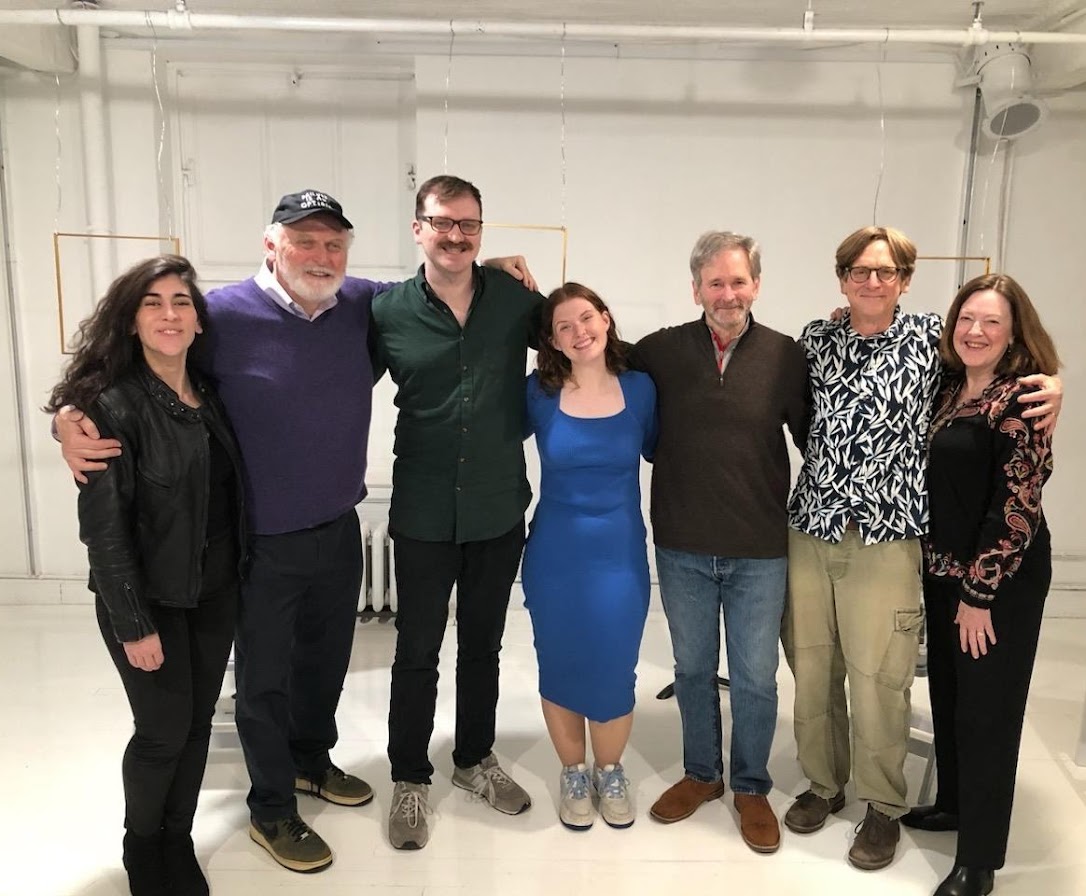
Jasmine Dorothy Haefner, T.J. Elliott, Gifford Elliott, Kat Reeve, Daniel Thompson, Jeremiah Alexander, Marjorie Phillips Elliott at the January 16th, 2025 reading of RETROSPECTIVE at TheaterLab
Retrospective, a new comedy, by T.J. Elliottintroduced at a January 16th reading at TheaterLab
“I can’t understand how anyone can write without rewriting everything over and over again.“ Leo Tolstoy
Readings help rewritings. The generous adventurous people who come to the reading of a new play help to shape its next iteration through both their reactions in the moment — laughs, gasps, silences, even groans sometimes — and what they were willing to tell afterwards. But even before the audience steps into your reading room, the actors and the director have animated the characters in such a way that the idea of the play can never be quite the same as it appeared on the page beforehand. Both groups — creators and observers — prove critical at this stage of making theater live.
At the reading of our new comedy, RETROSPECTIVE, we received a great deal of valuable feedback. At the gathering after the reading, I like to say that I consumed 3 beers and 33 opinions. The play provides an example of the role of readings and rewriting in self-producing a play. I cannot imagine any play that does not benefit from rewriting. But how does that happen in the self-producing process? I’ll show you an example at the bottom of this chapter.
“I am the kind of writer who rewrites and rewrites. I am very eager to correct everything.”
Kenzaburo Oe
This pdf at the end of this post constitutes the thirteenth draft of our latest play, which counting the film we made of scenes for our first play Alms is our tenth production since reentering theater in 2018. And rewriting played an important role in each of those instances, but that’s nothing unusual or new in this field.
In fact, Quote Investigator led me to one of the earliest proponents of rewriting plays: Steele MacKaye, who was a highly popular U.S. playwright and actor of the 19th Century. In July 1889, MacKaye published in several newspapers a piece titled “How Plays Are Written: They Are the Product of Study and Patient Toil”. The first line presented his thesis. Emphasis added:[1]
Plays are not written—they are rewritten. In this lies the advantage of the creative, as distinct from the critical, literature of the stage.
This is not Steele MacKaye
One more time: “Plays are not written—they are rewritten”
QI goes on to note that “by 1894 the saying had been reassigned to the Irish actor and playwright Dion Boucicault, and by 1903 W. S. Gilbert had been assigned a variant referring to comic operas. Yet, the earliest evidence currently points to Steele MacKaye as crafter of the statement.” Of course, others would take credit for this wisdom, which also serves as a caution to beginner playwrights: don’t think this process is like a 100 yard dash. Getting a play into its produceable form is more like an ultramarathon relay race in which you must keep passing the baton to yourself, but there are bathroom breaks.
Let’s trim that quote of MacKaye a little; Plays Are the Product of Study and Patient Toil. This is especially true for self-produced plays, and the rewriting of such enterprises differs from other development schemes for plays. As a bonus way of looking at self-producing, I argue that such work provides more opportunities for a playwright to refine their text through rewriting.
This not to demean the many opportunities to help a playwright revise their new script outside of self-producing: dramaturgs, workshops, New Play Exchange, etc. But when you are the producer of the play, your contact with others is perhaps wider and richer than it would be as someone who luckily has had a submitted script accepted for the next stage of development.
Being the self-producer in my experience rendered me more open to suggestions from actors. Why? Self-producing means self-interest squared. The calculus of how the play can be successful necessitates a collaboration that is authentic. The self-producing playwright may have even greater motivation to have each one of the actors be fully engaged. I don’t think that happens unless the collaboration is sincere, and that means the listening to, exploring of, and responding to comments and suggestions about the play must be real, true, not feigned or pretended.
Our Team: Jasmine Dorothy Haefner, T.J. Elliott, Gifford Elliott, Kat Reeve, Daniel Thompson, Jeremiah Alexander, Marjorie Phillips Elliott
That doesn’t mean that you, the playwright, will take every suggestion; that would be madness and an abdication of the duty to be the final judge of the text. But it does mean that you are in dialogue with these other artists and in doing so learning from their questions and even their complaints. Of course, one of their complaints with me is why do you write so many words? And I always say, I’m just imitating my favorite playwrights like Shaw and Shakespeare and Stoppard. I’m not pretending that I’m as good as they are, but part of what that imitation allows is the courage to let my characters run on, to luxuriate in language, maneuver in making arguments with quality and quantity. And since I have confidence in the eventual audiences that will see the finished product, I’m not afraid of all these things that are said about attention span. I’m willing to hazard that possibility. It drives me to tell a better story, one that will hold each person because they want to know what happens next. But I would be a fool not to ask others what they think about all of this.
Lucas Hnath is a massive rewriter. As D.T. Max observed in a New Yorker piece: “He can sound mystical about his creative process. At workshops, I’ve heard him say many times, ‘This line hasn’t figured out yet what it wants to become.; But he can also be stringently analytical. Playwright’s Input A should result in Audience Output B. … I asked him what he’d be looking out for that evening [of a preview], and he said that it was important that he not look for anything. He wanted to experience the play as if he’d never seen it. This, he emphasized, would be just the start of his process. “You have to watch several performances. Then take a step back and try to understand, on average, how the play works. It’s what remains consistent across many performances that tells me something useful. Tonight is one single data point.” He hoped to next time find “a better spot” in the theatre. Another night found him in the stage manager’s office, listening to the actors on a monitor. He was rewriting their parts as they spoke.”
There are three aspects of rewriting in that story: the intuitive (This line hasn’t figured out yet what it wants to become), the analytical in checking off whether a particular line or passage elicited the desired reaction; e.g., an expected laugh, a thoughtful frown. Isaac Bashevis Singer, a paragon of effective and glorious storytelling, once said: “There’s no great art in confusing the reader.” That holds true for the audience member as well, and that’s the third aspect evident in the passage on Hnath above; he is rewriting in the booth as the actors speak their lines because he is sensing where the audience is finding meaning or getting lost, which is different than the analytical look in which he keeps score of whether the reactions were what he planned. This third look arise from his wanting “to experience the play as if he’d never seen it.”
At least, that’s my take. The next time (first time!) I run into Lucas I’ll factcheck my interpretation and let you know.
“Frankly, I also don’t want to have to listen to everybody’s views since, based on an ignorance of the overall text, they are only going to be prejudices anyway. Of which, with this subject, there are too many already.” David Hare, Acting Up
Before I move on to the planning and unfolding of the reading that will lead to this rewriting, we should hear another take that of David Hare whose book Acting Up is one of my holy texts about how theater and specifically performance really work. From the above quote, you might get the sense that David doesn’t use as many people as aids in his rewriting as we did in this reading. (I do not know Hare either, but I consult his book so often it seems like we would be mates over a pint.) But in that same book, he tells a story about how Louis Malle influenced his playwrighting that describes ne way of rewriting that offers many advantages:
“Louis (Malle) shared my fascination with techniques of storytelling. Once, we were meant to be working together on Damage, the film of Josephine Hart’s novel. But I came into the restaurant for supper usually dissatisfied with that morning’s readthrough of the play of mine called Murmuring Judges. ‘It ought to bloody work,’ I said, ‘and it doesn’t.’ At once Louis asked me to tell him the story of the play. Together we sat for three hours, refining the narrative. Louis isolated every component of the story, and then put them all back together again in the right order. It was like watching a great car mechanic lay out the pieces of an engine on a clean white cloth before reassembling them. He did it for the sheer intellectual pleasure.… (After writing the synopsis of Damage) Every morning he would make me sit down under the vines and go back to the beginning of the story. He did it so many times that I thought I was going to go mad.”
That’s a rewriting occasion at the synopsis stage! You’ll figure out your own way, but if you’re self-producing starting with a reading makes sense for at least four reasons:
$$$
Marketing
Shaping the play
Exploring the acting
$$$: Attendees at a reading might be backers. Such a strategy requires a whole separate chapter.
Marketing: Readings aid this phase of self-producing because through that event you get photo ops, the start of word of mouth, and possible blurbs (e.g., “this is the best work yet from this playwright“; yes, someone said that at our last reading, which made me wonder what was lacking with the earlier plays). Reading attendees may be your repeat customers; If they liked it at the reading they will often be curious enough to return for the full production.
Given the theme of this chapter, the focus here is on the last two items on the list: Shaping and Exploring. We quote Hilton Als all the time to distinguish between the text and the play:
The reading represents the first chance to see what happens when actors speak that text in front of an audience. You realize what’s too long, too short, really funny, really NOT funny. You get the idea. Singer’s dictum becomes critical: is the audience confused; you can tell a lot by looking at faces and listening to breathing. Allan Gurganus notes that, “A crucial verb for writers is revise. Which means, of course, to re-see.” The re-seeing that happens here is quite different than the first seeing that spun out in your mind’s eye. As you re-see, you begin to reshape: lines bend, passages disappear, images appear or disappear.
To re-see, you must engage a director actors who will bring your text to its best possible life at this point. You connect to a director who can make the storytelling consistent and as potent as one can manage in front of music stands with no set. This exploration requires actors who have ideas based upon your primary text, notions about their character’s backstory, relationships with other characters, even the cadence of the language that you gave to them. Their questions about moments that are unclear to them or ways in which the structure seems not to work given their new understanding of the story.
Even before these conversations or rehearsals occur with the actors and your director, other preparations for the reading happen: getting a space, sending out scripts, etc. But the most important of these preparations is to gather an audience that likes theater. To paraphrase Singer; there is no great benefit in torturing yourself by inviting to your Chekhovian comedy an audience of people whose usual entertainment diet is thirty second TikTok parodies.
There is the usual housekeeping to address: pick a time that is convenient, send invites that are inviting and grateful, offer directions and cautions if your venue happens to be down a flight of crumbling steps or has a funky buzzer system to get in the front door. Make sure there are enough chairs and music stands. Be prepared to find the bathroom key and make sure there are paper towels there. Every detail increases the comfort of this audience and you want them in a good mood to focus on your play.
We recommend a place for an after-reading gathering. Make it comfortable and convivial. Work that room to get reactions and note them in your phone or on paper. Then consider them in the next few days because not all of them will be useful. After all, this is still your play and you need to decide which of those comments and reactions will help the story versus what will harm it or make it a totally different work.
And then…
The Fruits of Your Labor: A Rewritten Play
“Everything is there in the sauce; it just needs to simmer.”
B. Huvane
The forty people who DID come to the reading only had this context about the subject of the play:
Retrospective concerns a famous painter who may or may not be dreaming of an encounter with his first wife amidst a retrospective of his work and the appearances of others from his past.
With that sparse framework, the rest of this chapter will offer examples of the rewriting. Knowing the whole play is not necessary to appreciate the learnings that the reading produced for us.
If you have the luck to persuade some people with experience in the theater as producers to attend your reading, then you are very lucky indeed. And I must claim humbly that status as at each of my readings experienced Off-Broadway, Broadway, and West End hands have attended and offered substantial constructive reactions. But I’ve also gained critical ideas from causal theatergoers who wanted to see what a new play reading was like. Having this variety is an advantage: listen to everyone. That’s particularly important for self-producers as we need all the support we can muster.
One of those old hands was lavish in his praise of RETROSPECTIVE based on the reading, but wondered what it would be like if the main female character addressed some of her bouts of confusion directly to the audience. I found this compelling and thus our opening notes reflected this change. Will it stick as the play moves to production? Impossible to tell, but whoever reads it next will have the advantage of this context.
Having sat in on the three pre-reading rehearsals, I didn’t need anybody to tell me that the play was too long, but several people did so anyway. You have to develop listening skills; hold the play at arms length for good perusal, don’t let the play hold you. Don’t take criticism personally. A common theme ran through those kind but ‘cutting’ comments: get the secondary female character on to that stage sooner. In fact, one of the people who told me that was the actress who played the secondary female character who is also a collaborator with two of our previous plays. Trusting her, we realized that there was too much business around the beginning and as you can see from the image below of the first page we cut, cut, cut as if this was a slasher movie.
And cut some more…
Rewriting is not just about cutting. Paying attention to the audience lets you know that their attention flags at times. One cause of this is excessive wordplay. In the change pictured below, the shift to emphasize one character’s discomfort with his reflexive taunting of the other combines with her need for ‘the right word’ as a poet. We are still establishing their identities and relationship, but that must happen economically.
Some of the many changes made are like Hnath’s analytical takes described above: Input A (a joke in this case) did not get Output B (a laugh from the audience). So we swapped in other repartee that should work better.
Our goal became losing ten minutes of runtime, which with this 14 point font means ten pages. One way to do that is to look scrupulously at how you can have more show and less tell in the exchanges and action. The cuts below resulted form that feedback.
A pleasant surprise from the audience reactions in the reading was the enjoyment expressed for the poems written and read by the main female character, Pippa. In this case, rather than cutting, we decided to expand one of her poems a little bit. This had the dual advantage of clarifying her personality through her poetry and also allowing the audience more chuckles at these rhymes. Nothing wrong with chuckles in this play.
Two motives manifest in this next illustration of rewriting. The first one is familiar to any writer and was initially offered by a literary savant with a wonderful name for a comic character: Arthur Quiller-Couch. In his still highly relevant book, On The Art of Writing, Q, as he was known, advised, “Whenever you feel an impulse to perpetrate a piece of exceptionally fine writing, obey it—whole-heartedly—and delete it before sending your manuscript to press. Murder your darlings.” Rewriting may involve multiple murders. The one below was justified because a) we need to cut 10 minutes and b) it’s a clever digression that the character, the acerbic critic self-named Z, doesn’t need as by this point everyone knows she is devilishly clever .
One last example of the changes made is a confession to a weakness. I think most playwrights have conversations with their characters or at least become eavesdroppers on such dialogue. In a first draft, the talk goes on and amuses the playwright. But a reading reveals the prosaic nature of some of those exchanges. Cutting them makes things move and that is necessary to have your audience be moved. That’s what happened here.
And with decisions like that, we cut our ten minutes. The process isn’t over, but the shape of the play satisfies, and its overall idea now has passed a test. Self-producing gave us both additional input and added urgency for our rewrite. Want to see for yourself how it turned out? Click on the PDF below and read through the current version.
And, yes, we’re always interested in having talks with folks who want to be producers or co-producers or investors helpng Knowledge Workings Theater get this play out in front of more audiences. The reading? The rewrites? The capturing of the lessons from self-producing? It’s all about pursuing our impulse, following our motto: make theater live.
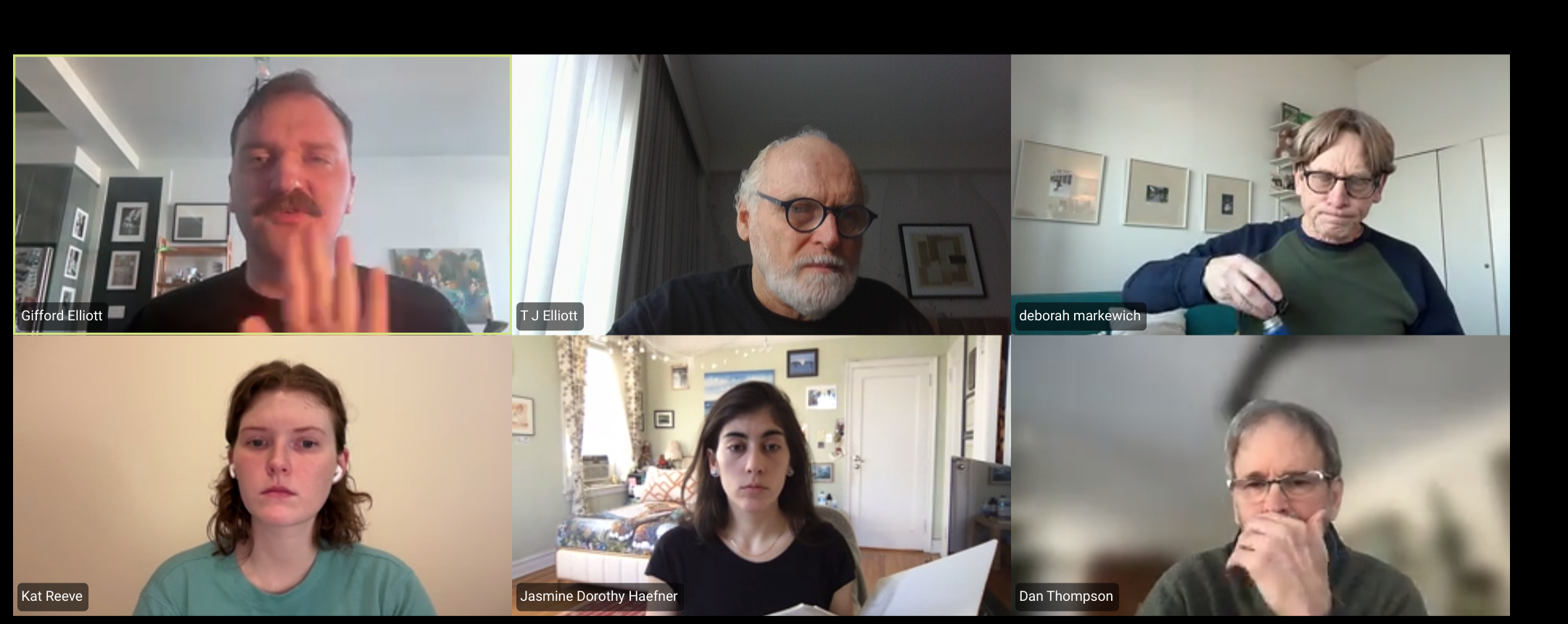
Top (l-r) Gifford Elliott [Director], T.J. Elliott [Playwright], Jeremiah Alexander [Clint]
Bottom (l-r) Kat Reeve [Pippa], Jasmine Dorothy Haefner [Z], Daniel Thompson [Rory]
And so it begins: fine actors working with an astute director starting the transformation of text to performance, figuring out how to make theater live. The Hilton Als quote about theater seems both instructive and inspiring:
We have a new play, Retrospective, but at this moment it’s still that primary text and even that continues to shift. After our first rehearsal yesterday, January 12th for its first public reading that will take place on January 16th 2025 at 7PM in Manhattan, our playwright, T. J. Elliott spent several hours in his hotel room in midtown Manhattan trimming and altering that text. The after effect of the reading will likely be even more editing and tightening. Past happy experiences have taught us that the quality of the audience at a first reading provides significant and actionable insights into the further development of a play. If you’d like to be part of that audience, just ping us at knowledgeworkings@elliotttj
Retrospective concerns a famous painter who may or may not be dreaming of an encounter with his first wife amidst a retrospective of his work and the appearances of others from his past. We are lucky and gratified to have Gifford Elliott directing our cast of Daniel Thompson, Kat Reeve, Jasmine Dorothy Haefner, and Jeremiah Alexander. (Jerry and I first worked together as actors in 1978; Dan and I met in theatre in 1979!)
If you would like to attend what will be about a ninety minute reading, then just email knowledgeworkings@gmail.com and we will send you a Google calendar invite. If you attend, you will part of the process of production as noted in another essential quote below:
“The play does not exist in the theater as a written text until it has been absorbed in the process of production. Drama is ‘translated’ or transformed into the person of the actor — “the body of the art of the theater”, as Stark Young put it.”
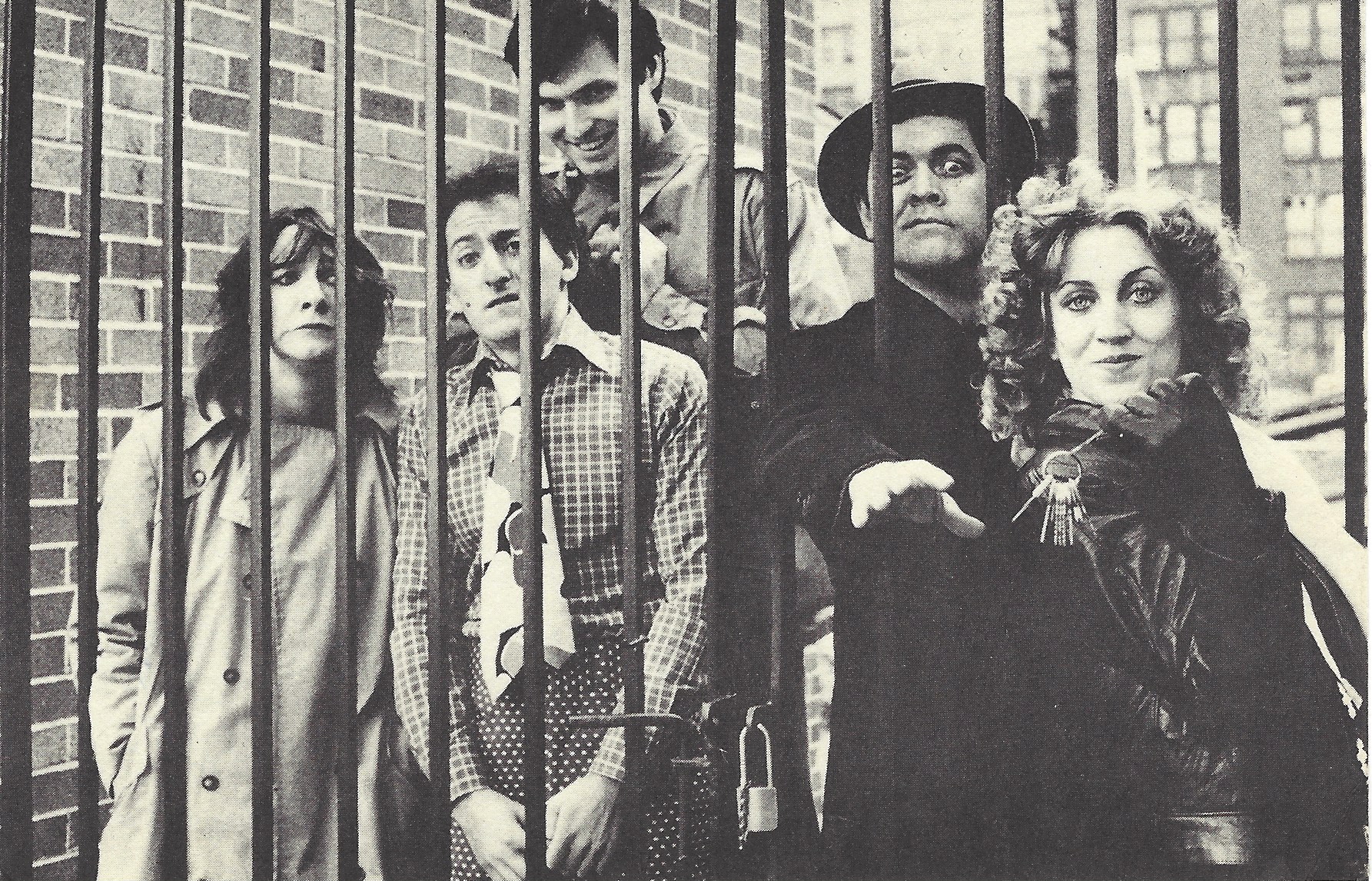
Captive Audiences 1982: (L-R) Beth Rake, Phil Ruskin, Brendan Elliott, John McCarthy, & Georgia Harrell.
Rem tene; verba sequentur. Grasp the subject, the words will follow. Cato the Elder
Cato the Elder, whose other notable quote is ‘Delenda est Carthago ‘or ‘Carthage must be destroyed!’, gives good advice for playwrights here: nail the story from spine to skeleton to full body and the dialogue will flow.
It’s appropriate guidance for a website makeover as well. The subject for us there is making theater live. And we promote that purpose through this website with its blog and other features. The new look to our website courtesy of the effort and skills of Gifford Elliott reminded us not only of all the KWT productions since 2018, but also of the story from over forty years ago that coursed through two of the KWT founders — Marjorie Phillips and T.J. Elliott — a passion to make theater live. We were lucky then to have such able collaborators and we are similarly fortunate now.
Our new design celebrates the work of our collaborators, and highlights some of our more recent moments of live theater via our YouTube channel. We hope you check out those videos and other stories as well as 13 Ways of Looking at Self-Producing, which will soon be available as an e-book on Amazon. Coming up in January: a staged reading of RETROSPECTIVE, a new play.
We seek producers for that play and other planned works, collaborators who wish to join us on this journey of theatre making. Interested? We’ll buy the beverage for an in-person discussion. Just email KWTto start the connection.
Ed Altman, Alinca Hamilton, and John Blaylock make the story sizzle
Okay, one more plea to see HONOR at The Gene Frankel Theatre before it closes on October 6th, but this time the recommendation comes from reviews for which we are SOOOO grateful
1) “Written and superbly directed by T.J. Elliott…All of these actors are first-rate in their performances.”
2) “The play masterfully takes what appears to be an apparent disagreement over a value interpretation of an issue to a place that reveals the complexity of not only the interpretation of the issue but also each of the participant’s values. The ending provides an excellent explication of the complexity of human character in the interpretation of what constitutes personal honor, leaving one with intriguing ideas to contemplate.”from Scotty Bennett, TheaterScene.Net Did that work?
3) “Eloquently and dramatically skewers the current business culture… provocative entertainment.” “Elliott also directed and his physical staging is crisp, well-paced and contains momentum. The personable and talented cast of Ed Altman as Don, and Alinca Hamilton and John Blaylock,as the lawyers, all deliver energetic and authentic performances. This trio shines in the concluding sequence… “
4) “Technical and artistic director Gifford Elliott contributes smoothness to the production with balanced lighting and sound. The realistic,simple scenic design consists of a long table, wheelie chairs, a white board on an easel, and a large running wall clock which add a cool real-time dimension to the stated 45-minute proceeding.”from Darryl Reilly, Encore! Come on, you like theater and this is a well-reviewed relevant piece.
Click here for tickets to a show that is rollicking and relevant Not good enough? How about what…TimeOut says “In this dark corporate comedy by writer-director T.J. Elliott, three executives chew over—and perhaps spit out—the results of an investigation into a case of harassment that has been brought against by one of them. Alinca Hamilton, John Blaylock and Ed Altman play the compromised trio.”You need a night out so go to this link for those tickets 70 minutes of fast-paced fun that surfaces realities all too familiar for many of us in a grand historic theatre in the lively NoHo neighborhood at 7 PM (Sunday at 1 PM)
We’ve been fortunate enough to have the pleasure of Darryl Reilly reviewing 3 of our Knowledge Workings Theater productions and we are grateful for his considerate criticism of HONOR that you can read in full at this link
And then this morning we discovered that Time Out magazine has a featured listing for our play. The good news for us is that more people will learn about the opportunity to see 3 excellent actors — Alinca Hamilton, Ed Altman, and John Blaylock — lavish their talents on storytelling that is funny, sharp, and timely. We are only running until October 6: get your tickets now at our.show/honor
We are grateful to Broadway World for its interview of T.J. Elliott, Playwright & Director of HONOR, which opens September 19 at the Gene Frankel Theatre and runs until October 6. You can read the full interview here as Joshua Wright talks to T.J. about his journey from theater to the corporate world and back again to theater in 2018. T.J. also speaks about the importance of Joe Queenan, his collaborator on the plays alms, grudges, genealogy, and the Oracle, in his return to playwrighting as well as the circumstances that prompted him to write this latest play, HONOR. Tickets to honor are available at our.show/honor
Thank you to all of those who have already responded to our invitation to participate in an open and free discussion about playwrights so producing. Our convening (after that night’s performance of HONOR at the Gene Frankel Theatre, 24 Bond Street in Manhattan) is a follow-up to the T.J. Elliott’s online series of brief essays, 13 Ways of Looking at Self-Producing, published in March 2024.
If you haven’t signaled your attendance yet, you can so by clicking here for this discussion on Playwright Self-Producing taking place 8:30 PM Wednesday September 25 th after the 7PM performance of HONOR at the Gene Frankel Theatre in Manhattan.
(There is NO fee for attending this playwright community gathering. If you wish to attend HONOR at 7PM that evening, go to our tickets site here and enter the discount code ‘playwright’ for $10 off the ticket price.)
We feel extraordinarily fortunate to have the folks below on our panel. The whole point of the session is to share knowledge and offer encouragement to playwrights who either are already self producing or contemplating taking that journey. The experiences of others putting up their work and the conversations arising from these thoughtful exchanges should prove fruitful to all playwrights.
Alinca Hamilton is a New York born and bred actor, writer, and creator. Select acting credits include To All the Black Girls Who’ve Waited (Ars Nova AntFest); Clyde’s (Alabama Shakespeare Festival); Mud Row (Premiere Stages); Audelco Award-nominated Gong Lum’s Legacy (New Federal Theater); Julius Cesar (Classic Stage Company). After obtaining her MFA in Acting from Columbia University, Alinca doubled down on making her Jamaican immigrant parents happy, and added writing to her artistic pursuits. Under the guidance of the Sundance Collab Program, her first pilot “Rinse. Repeat.” was a semi-finalist for the 2021-2022 NYSCA/NYSFA Artist Fellowship Program and 2021-2022 Fresh Voices Competition. alincahamilton.com
John has an undergraduate degree in painting from Guilford College in Greensboro, NC, and a Masters in painting from New York University, in NYC and Venice, Italy. He lives and works in New York City. Diva Therapy is his first play. For tickets to this fun and affecting play running in November at to Theater for the New City, click here
A playwright in residence at Theater for the New City, Claude Solnik has written plays seen by thousands, earned favorable reviews and brought memorable characters and stories to life. His work also has been performed Off Broadway, in Paris, Philadelphia and on regional stages.
Janani Sreenivasan is a writer, director, actor, composer, and musician originally from Corvallis, Oregon. She has prioritized art since her early training as a classical violinist (both solo and orchestral repertoire) and pianist. In 2006, while earning an M.F.A. in nonfiction at the University of Iowa, she wrote and directed nearly 40 comedy sketches for the late-night showcase No Shame Theatre. In NYC, she has directed for the Tank’s Rule of 7×7 and the Chain Theatre’s One-Act Festival, as well as acting with Rule of 7×7, Manhattan Repertory, WOW Café Theatre, and Living Room Theater. Short films have screened in the L.A. Comedy Festival and the Iron Mule Short Film Festival (Audience Award w/Lee Jutton) and her jokes have appeared in Reductress and The New Yorker. Her short play “Get Leo” depicted her hunger for Leonardo DiCaprio to portray her onstage and was staged and published by the Bechdel Group. At Under St. Marks Theatre, Janani’s recently directed and produced The Importance of Being Earnest and A Midsummer Night’s Dream infused with Indian classical dance and music and featuring Odissi dancer Jeevika Bhat.
An actor and produced playwright in the 1980s (Lazy Eye, Captive Audiences), T.J. spent the next three decades away from theater making sure his children always had food and clothes – well, most of the time — before returning to Off-Broadway as co-writer with Joe Queenan of the SRO hit play Alms in 2019. In those lost years, he produced, directed, and performed among casts of thousands in a mélange of corporate telenovelas and tragic, comic, melodramatic, and absurd organizational performance art. Since his playwrighting re-emergence, T.J. and Queenan have penned three other problem comedies produced by Knowledge Workings Theater: Grudges, Genealogy (at Broom Street Theater in Madison Wisconsin), and The Oracle. His recent solo works include the mostly fake Swedish screwball comedy Keeping Right, the September 2023 premiere in New York City of The Jester’s Wife and most recently HONOR presented in 2024. Born in the Bronx, T.J. now lives in Princeton, NJ with his wife, Marjorie Phillips Elliott.
Sign up by clicking here for this discussion on Playwright Self-Producing taking place 8:30 PM Wednesday September 25 th after the 7PM performance of HONOR at the Gene Frankel Theatre in Manhattan.
Given that I’ve been in rewriting mode around my latest play, I found this piece about Lucas Hnath, which originally appeared in the New Yorker, very helpful. I don’t know if I’m mystical about rewriting but at times the process does seem to require a metaphysical approach; i.e., is this thing being created acquiring a coherent existence?
🙂
“He can sound mystical about his creative process. At workshops, I’ve heard him say many times, “This line hasn’t figured out yet what it wants to become.” But he can also be stringently analytical. Playwright’s Input A should result in Audience Output B. That side was in evidence at the Golden, as the seats began to fill. (The preview was sold out.) I asked him what he’d be looking out for that evening, and he said that it was important that he not look for anything. He wanted to experience the play as if he’d never seen it. This, he emphasized, would be just the start of his process. “You have to watch several performances,” he went on. “Then take a step back and try to understand, on average, how the play works. It’s what remains consistent across many performances that tells me something useful. Tonight is one single data point.”
He hoped to next time find “a better spot” in the theatre. Another night found him in the stage manager’s office, listening to the actors on a monitor. He was rewriting their parts as they spoke.”