We started with Alms four years ago, persevered through the pandemic with Grudges, Within the Context of No Context, and Keeping Right on Zoom, landed back on stage at Broom Street Theater in Madison, Wisconsin with Genealogy and then returned to Off-Broadway at THEATER FOR THE NEW CITY (they insist on all caps) with a fine run of The Oracle last May. And now we are pushing for a revival of Alms and the opening of The Jester’s Wife. All in four years and like any four-year old we can be a little hyperactive but also charming as long we get enough sleep. Thanks are owed to sooooo many for helping us keep on keeping on to #maketheaterlive:
Saint Dymphna with head still attached informs our play but inspiration came from considering her companion, The Jester’s Wife
Our Cast & Team for Thursday April 20th Reading at TheaterLab
In Order of Appearance
Xander Jackson (Stranger)
Xander Jackson is an on stage & camera actor who recently began his journey with the Barrow Group. Past on stage productions include Proof (Greenwood Lake Theater), Sweat (Cultural Arts Playhouse), and Smartphone Love (The Tank). He has continued his training in the classroom, in front of the camera, and on stage throughout the tristate area.
In his free time, he enjoys a multitude of activities including Baking, Snowboarding, Skydiving, and Martial Arts Training to name a few.
Steven Weatherbee (Jester)
Steven Weatherbee (Jester) is making his off-Broadway debut in The Jester’s Wife. An MFA graduate from Texas Tech, Steve is an actor and educator who daily relishes the chance to learn from others — artistic craft, philosophy, and pedagogical approach all especially. Born and raised in California, he is thankful to his supportive and ever-inspiring friends and family. Steve is honored to take part with the talented people Knowledge Workings LLC have brought together to make vibrant this story.
Winnie Stack (Wife)
Winnie Stack moved from LA to NY in 2019 to pursue comedy and acting, and has found that subway rats are her best audience. Shortly after moving she was cast in the Upright Citizens Brigade Maude team “Peaches,” and now collaborates on two comedy sketch groups “One Bad Egg” and “Sleepover.” While she isn’t performing sketch comedy, she is performing her one woman show “@Jenna” to sold out crowds in NY and LA. Winnie is thrilled to be working on another T.J. Elliott play, and is eager to share this unique and hilarious story with audiences!
Ed Altman (Narrator)
With Workings Knowledge Theater: The Oracle, Keeping Right, Grunges (Narrator). Recent stage: Two Swans, Nowhere Man, Victoria Woodhull (both at Theater for the New City). TV/Streaming: The Good Cop (NTD/Epoch TV), The Vow (HBO), Foodthat Built America (History Channel), Dragon Meets Eagle(Amazon). Recent film: Biff & Me, Oatmelio’s, Thumbwrestler II, Jazz John, all making the international film festival circuit. Ed was a member of the comedy group Prom Night with whom he wrote and performed at the Westbank Café back in the days of Lewis Black and Rusty McGee. He is also a voiceover artist for commercial and corporate work, and has voiced several audio books. (Ed is also our invaluable Associate Producer for The Jester’s Wife)
T.J. Elliott (Playwright & Director)
Wrote Alms, Grudges, Genealogy, & The Oracle w/ theJoe Queenan — directed the latter May 2022 at Theater for the New City; solo playwrighting: Keeping Right, Honor, The Jester’s Wife. His 2019 Alms SRO comeback ended a 35-year hiatus from Off-Off-Broadway. In those lost years, T.J. produced, directed, & performed among casts of 1000s a mélange of corporate telenovelas & tragicomic, melodramatic, & absurd organizational performance art. (VP Chief Learning Officer at ETS for half that time.)
Marjorie Phillips Elliott (Executive Producer)
Marjorie’s work as Executive Producer & Co-founder of Knowledge Workings Theater arises from deep roots in the arts. A theater major at Skidmore College and grad student in photography at the Fashion Institute of Technology, Marjorie brings to producing a wide array of talents and experiences including her work in the film industry in the 1980s at New Line Cinema. Her support of our productions ranges from strategy to prop design to photo retouching to publicity consultation and beyond. Marjorie is also the Chair of the Board of Chamiza Foundation, a nonprofit helping to ensure the continuity & living preservation of Pueblo Indian culture and traditions, and serves on the Members Committee of the Phillips Collection in Washington, DC
Gifford Elliott — Artistic & Technical Director
A graduate of Cal Arts acting program, Gifford has served as Post-Production Coordinator on Bupkis, the 2023 Pete Davidson series, and The Best Man — Final Chapters, both streaming on Peacock. He was also on the postproduction teams for Queen’s Gambit on Netflix and Divorce (Season Three) on HBO. He has worked as a director of theater and film as well as the host of the very popular Srivia at Singers Bar in Brooklyn.
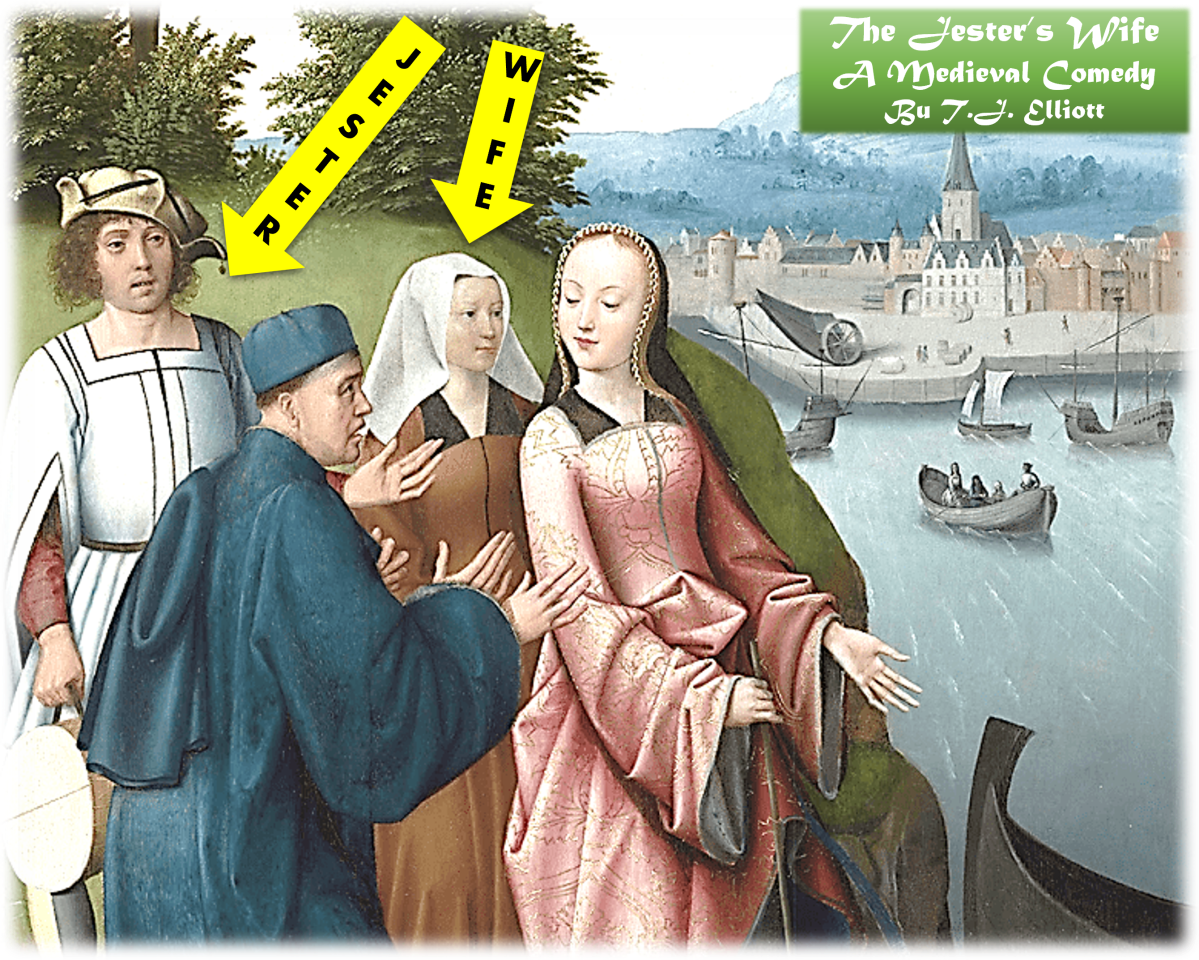
Goossen van der Weyden (1455-1543) The Escape of Saint Dymphna, Father Gerebernus, The Jester and…The Jester’s Wife (Phoebus Collection)
“You miss 100% of the shots you don’t take.”
My friend, Eddie Powell, said that to me after a horrendous first half of a basketball game in which I could not find the Backboard with any shot let alone the rim or the net. I like that philosophy and I have preached it to others. Now once again I am practicing what I am preaching as we embark upon our next production: The Jesters Wife.
THE JESTER’S WIFE
A Dark Ages Comedy by T.J. Elliott
Synopsis
The image above is one panel of the famed 16th Century altarpiece by Goossen van der Weyden that depicted the life of Dymphna, legendary medieval Irish Saint. The most famous of those panels shows her along with her confessor, jester, and the jester’s wife escaping her father, (described in the 17th Century Acta Sanctorum, or Lives Of The Saints), as a King of Ireland (who) grieving over his beautiful dead wife, turned his attention and lust upon Dymphna.” Spoiler alert: that king pursues and beheads Dymphna “because she refused to consent to their brutish passion.” Yet none of these stories explain what became of the Jester and his Wife. Apparently, they survived to impart Dymphna’s legend, but no one has told their story. Until now.
Can you guess which figure is the Jester’s Wife?
The Jester’s Wife, a Dark Ages comedy, follows this surviving couple as confronted by evil and still afraid for their lives they now encounter a stranger afflicted with madness. Contemplating questions of survivorship, responsibility, and who gets to tell a story, the play blends and bends the medieval Irish world into a riotous mingling of myth-making, martyrdom, machinations, and magic all too familiar to our present lives.
There’s that spoiler alert again: Dymphna loses her head but The Jester’s Wife keeps hers — for now
What’s Next?
We have assembled a superb casting for the three roles, Stranger, Jester and Wife as well as our staged reading narrator. See their details at this post. — — APRIL 20 staged reading at our good friends TheaterLab in NYC that will lead to a September production.
And now we are looking for have found a set designer, costume designer, rehearsal assistant, stage manager, and a fight coordinator. Yes, a fight coordinator: don’t worry no actors or playwrights or most importantly audience members will be injured in the course of this play. And we are seeking a PR representative and marketing consultant for this planned Fall production.
Looking for tech friends
Our loyal and marvelous supporter, Ed Altman, follows up his stellar acting in last May’s The Oracle at Theater for the New City this time to serve as Assistant Producer and Marjorie Phillips Elliott will again serve as Executive Producer. Want to help? Let us know!
Thanks to the superb skills and extraordinary efforts of our actors, crew, producing and directing partners, and just splendid friends, the last two Knowledge Working Theater shows — Genealogy & THE ORACLE — succeeded powerfully in their objectives; we sold out houses, got good reviews, showed off talent, and prepared for possible expanded productions. Feeling lucky and happy, we now move on (bravely? rashly?) to what’s next.
In the parlance of New York theater, Knowledge Workings is referred to as an ‘itinerant theater company‘; in other words, we don’t have a space of our own. We have not yet been arrested for vagrancy, but we have used living rooms, the parlor of the Ukrainian Institute, the back of a bar, and Zoom among other venues for auditions, rehearsals, and productions. Now we seek to find a theater for extended runs of Genealogy and The Oracle in the New York City area.
That is why we turn here to the wisdom of crowds and the kindness of strangers (and those splendid friends yet again) for suggestions of and referrals to possible theater spaces. Genealogy with the original cast from its successful premiere at Broom Street Theater in Madison Wisconsin as directed and produced superbly by Dana Pellebon is scheduled to go up in the first weeks of January 2023. The Oracle doesn’t have a set date, but our actors and crew had signaled their desire to continue work that garnered praise for them from our audiences at the Theater for the New City last month.
If you have an idea for a theater space, please email me tjell2010@gmail.com by doing so, you would aid the primary cause of our group, which is to make theater live. Thanks in advance for your consideration and good luck, good health, and good times to you and yours this summer.
“You never know what you’re really doing. Like a spider, you are in the middle of your own web.” —James Salter http://bit.ly/1Dj1NED
L’écrivain est en situation dans son époque: chaque parole a des retentissements. Chaque silence aussi. Je tiens Flaubert et Goncourt pour responsables de la répression qui suivit la Commune parce qu’ils n’ont pas écrit une ligne pour l’empêcher. Ce n’était, pas leur affaire, dira-t-on. Mais le procès de Calas, était-ce l’affaire de Voltaire? La condamnation de Dreyfus, était-ce l’affaire de Zola? The writer is situated in his time. Every word has consequences. Every silence, too. I hold Flaubert and Goncourt responsible for the repression which followed the Commune because they did not write one line to prevent it. One might say that it was not their business. But was the Calas trial Voltaire’s business? Dreyfus’ condemnation Zola’s? Jean Paul Sartre, translation into English appeared in the 1982 book “The French Left: A History & Overview” by Arthur Hirsh
The play does not exist in the theater as a written text; it has been absorbed in the process of production. Drama is ‘translated’ or transformed into the person of the actor — “the body of the art of the theater”, as Stark Young put it. Harold Clurman, On Directing
“Acting is not truth.… One of the key things GBS took from Ibsen is the way in which people on stage are not just actors imitating people. They are actors playing people who act.” Fintan O’Toole, Judging Shaw
“Asked recently by a student what he expected from an actor, he had replied (as he always did), ‘clarity of utterance,’ and been met with a nervous laugh of reproach. But, he said, it ‘really is the first thing I ask for.’” Hermione Lee, Tom Stoppard biography
“Theatre is not about the writing, it’s not about the directing. It is about that, but in the end it’s really about the actors and the audience and most audiences – aside from the cognoscenti who sit there being experts – come to watch a bit of acting. I’ve had some unsophisticated audiences in my time and I hear them asking the actors whether they made it up? They go, ‘no, it’s all written down.’ It’s a mystery and why should you solve it . Stephen Joseph always taught me that you serve that wonderful moment between actor and audience. And that is the precious moment that live theatre has that no other media has quite to that extent and that is why I stick to theatre.” Alan Ayckbourn
“My sort of play would be impossible unless I endowed my characters with powers of self-consciousness and self-expression which they would not possess in real life. You would not have Esop’s fables unless the animals talked.” GBS
To me the play is only the means, the end being the expression of feeling by the arts of the actor, the poet, the musician. Anything that makes this expression more vivid, whether it be versification, or an orchestra, or a deliberately artificial delivery of the lines, is so much to the good for me, even though it may destroy all the verisimilitude of the scene. GBS
“Well, the way of paradoxes is the way of truth. To test Reality we must see it on the tightrope. When the Verities become acrobats we could judge them.” Oscar Wilde, The Picture of Dorian Gray
[And with the above comment it is useful to recall the OED definition of a paradox: “An apparently absurd or self-contradictory statement or proposition, or a strongly counter-intuitive one, which investigation, analysis, or explanation may nevertheless prove to be well-founded or true.” Emphasis added by T.J. Elliott Your play is that investigation.]
“’… The play’s atmosphere by which I mean the feeling of being encapsulated in the situation… The play works because no one is telling the audience precisely what to make of it… I feel it would be fatal to break down the ambiguities and give them to the audience on a platter to make it easy for them… The next thing which might need saying is that the play [Rosencrantz and Guildenstern] is above all funny. I mean it was written to be funny… [And] the concrete limits of the stage are very much a part of the play structure and discipline; the stage is as it were a cinema screen beyond whose borders a character is not allowed to trespass.” Tom Stoppard quoted by Hermione Lee in her biography of him from 1972
One is tempted to imagine a play — to be written in desperate defiance of Aristotle — from which doing would be eliminated altogether, in which nothing but being would be left. The task set the actors would be to interest their audience in what the characters were, quite apart from anything they might do. Harley Granville-Barker:
Always be escalating. That’s all a story is, really: a continual system of escalation. A swath of prose earns its place in the story to the extent that it contributes to our sense that the story is (still) escalating. … What is escalation, anyway? How does a story produce the illusion of escalation? … One answer: refuse to repeat beats. Once a story has moved forward, through some fundamental change in the character’s condition, we don’t get to enact that change again. And we don’t get to stay there elaborating on that state.
George Saunders
In a good story, the writer makes energy in a beat, then transfers this energy cleanly to the next one (the energy is “conserved”). She does this by being aware of the nature of the energy she’s made. In a bad story (or an early draft), the writer doesn’t fully understand the nature of the energy she’s made, and ignores or misuses it, and it dissipates.
The preferred, most efficient, highest-order form of energy transfer (the premier way for a scene to advance the story in a non-trivial way) is for a beat to cause the next beat, especially if that next beat is felt as essential, i.e., as an escalation: a meaningful alteration in the terms of the story.
George Saunders
Making causality doesn’t seem sexy or particularly literary. It’s a workmanlike thing, to make A cause B, the stuff of vaudeville, of Hollywood. But it’s the hardest thing to learn. It doesn’t come naturally, not to most of us. But that’s really all a story is: a series of things that happen in sequence, in which we can discern a pattern of causality. For most of us, the problem is not in making things happen (“A dog barked,” “The house exploded,” “Darren kicked the tire of his car” are all easy enough to type) but in making one thing seem to cause the next.
This is important, because causation is what creates the appearance of meaning.
[…]
Causality is to the writer what melody is to the songwriter: a superpower that the audience feels as the crux of the matter; the thing the audience actually shows up for; the hardest thing to do; that which distinguishes the competent practitioner from the extraordinary one.
Any intelligent fool can make things bigger, more complex, and more violent. It takes a touch of genius—and a lot of courage—to move in the opposite direction.” —E.F. Schumacher
“It was [my teacher John Gardner’s] conviction that if the words in the story were blurred because of the author’s insensitivity, carelessness, or sentimentality, then the story suffered from a tremendous handicap. But there was something that must be avoided at all costs: if the words and the sentiments were dishonest, the author was faking it, writing about things he didn’t care about or believe in, then nobody could ever care anything about it. A writer’s values and craft. This is what the man taught and what he stood for, and this is what I’ve kept by me in the years since that brief but all-important time.” Raymond Carver, https://d.docs.live.net/bdc1f311ae670521/Documents/current%20writing/playwriting-notes-to-read-over-and-over.docx
“He (Shaw) learned the order of the two important questions: first, what do I want to say?; Then — and only then — how should I say it? The form of his writing always followed its function. To the aspirant critic Reginald Golding Bright, he wrote, ‘Always find out rigidly and exactly what you mean, and never strike his attitude, whether national or moral or critical or anything else… Get your facts right first: that is the foundation of all style, because style is the expression of yourself; you cannot express yourself genuinely except on the basis of precise reality.’” Fintan O’Toole on George Bernard Shaw in Judging Shaw
Only Einstein could explain why it’s clarity which shaves time, not speed. Author unknown
“Another piece of advice: when you read proof, cross out as many modifiers of nouns and verbs as you can. You have so many modifiers that the reader has a hard time figuring out what deserves his attention, and it tires him out. If I write, ‘A man sat down on the grass,’ it is understandable because it is clear and doesn’t require a second reading. But it would be hard to follow and brain-taxing if I wrote, ‘A tall, narrow-chested, red-bearded man of medium height sat down noiselessly, looking around timidly and in fright, on a patch of green grass that had been trampled by pedestrians.’ The brain can’t grasp all of this at once, and the art of fiction ought to be immediately, instantaneously graspable.”
Hassan Hope as Bart chats with Alyssa Poon as Aisling in THE ORACLE
Hassan Hope is an actor of Caribbean descent from Brooklyn, NY. He has played a multitude of roles portraying the many facets of life in Black America. Examples include Our Lady of 121st Street, Sweat, and Pipeline. He is proud to have a never-ending curiosity for acting and has expanded his knowledge base and skills throughout his years. Every time that Hassan takes on a new role he makes a point to learn and embody the character. Hassan is very proud to be a part of The Oracle team and wishes that you enjoy the show. For all inquiries, please reach out to Hassan.Hope@gmail.com
Bart (Hassan Hope) learns how to sort things out from Micky (Jasmine Dorothy Haefner)
From left Jasmine Dorothy Haefner, Hassan Hope, and Alyssa Poon as respectively Micky, Bart, and the mysterious intruder, AislingDon’t miss the dynamic and witty performance of Alyssa Poon in THE ORACLE
We are very grateful that our friend and colleague, Ed Altman has been with us every step of the way on this journey to opening night of THE ORACLE — including Associate Producing. Ed is “Thrilled to be finally performing LIVE with KWT. Last seen as Roy Moab in “Keeping Right” and as the Narrator in “Grudges”, his other recent appearances include “Adjust the Procedure” (online); “The Statement”, “Nowhere Man,” and “Victoria Woodhull” all at Theatre for the New City; and “Time to Leave” at NY Theatre Festival.
On screen, Ed currently recurs as NYC Mayor Wilt Lazzo in the NTD/Epoch TV series “A Good Cop.” Recent film work includes “Biff & Me”, “Oatmelio’s”, “Thumbwrestler II”, “Jazz John” all making the international film festival circuit. Ed was a member of the comedy group “Prom Night” with whom he wrote and performed at the Westbank Café back in the days of Lewis Black and Rusty McGee. He is also a voiceover artist for commercial and corporate work and has voiced several audio books.”