Welcome to Knowledge Workings Theater. Below is our blog giving updates on our work, the art of self-producing, and the theater world at large. Check out our book on self-producing, 13 Ways of Looking at Self-Producing and stay tuned for our new projects. – KWT
Clockwise From Top Left: Adara Totino, Jeremiah Alexander, Jasmine Dorothy Haefner, Mark Thomas McKenna
In mid-July, our cast gathered for their “etudes,” a time for the actors to dig into their characters. Edward Albee, one of the greatest English language playwrights once said that “Every good actor does two things: He does exactly what the author intended and he does it his own way.” Etudes are a way of actors figuring out what that way is. The actors with our director, Gifford Elliott, are shaping now during our last week of rehearsals what the world of this play will be with the text as a foundation. Here’s a look at their adventures:
The words of the play describe how famous painter, Rory McGrory, finding himself in a gallery with empty canvases puzzles over whether he is asleep or… in the afterlife? There, Rory encounters his first wife and two other frenemies from his past. This mischievous menage a trois claims they just want to help him get to next while he just wants to wake up. These fine actors create a world out of these words with work that start this week, which we will be documenting here.
Come enter that world August 13th (8PM), August 13th (5PM), August 13th (2PM). Tickets for our performances at AMT theater 354 West 45th Street in Manhattan as part of the Broadway Bound Theatre Festival are available at this link.
RETROSPECTIVE is our tenth production since slip-sliding back into theatre again in 2018, and with Gifford Elliott directing this marvelous cast we think it’s going to be our best yet. So, get your tickets today by clicking this link
Cast of RETROSPECTIVE, clockwise from Center: Adara Totino (PIPPA), Mark Thomas McKenna (RORY), Jasmine Dorothy Haefner (Z), Jeremiah Alexander (Clint)
Mark, actor/teaching artist, was an ensemble member at Touchstone Theater (PA) for over 23 years, specializing in devised and community-based work. He also served as producing/artistic director for half of his tenure. Most recently, he played Jim in the NY premier of A House Divided by Joshua Crone at The NuBox/Night Cook Studios. Select highlights: Steelbound dir., Bill Rauch; Los Locos del Pueblo (the Fools) dir., Chris Bayes; Candide, adapted from Voltaire, with Bill Pope L. and dir., Jim Calder; Frankenstein, in collaboration with The Independent Eye (Philadelphia), adapted/directed by Conrad Bishop. Other roles: Charlie, Stones in his Pockets; Estragon, Waiting for Godot; Sir Toby Belch, Twelfth Night; Weston, Curse of the Starving Class. Film includes: The Forest Hills (Dreznick/Goldberg Productions), AWAKE! (FusionBox Films). As a teaching artist, Mark recently worked two years in residence at Penn State Hershey Medical Center helping healthcare workers build community and listening skills. Training: Graduate, L’École Internationale de Théâtre Jacques Lecoq, Paris; TA Certification, UARTS Philadelphia; HB Studios, Second City (NYC). AEA/SAG-AFTRA
PLAYWRIGHT’S NOTE:Evidence of our luck shows up in the way our director Gifford Elliott (with the help of Jasmine and Adara ) read six superb actors for the lead role of Rory McGrory. That array of talented NYC artists made for a tough choice, but there was no doubt in our minds that Mark Thomas McKenna would be the force needed for that performance as the famous painter who has to deal with a weird reunion with an ex-wife and two frenemies. Call it a ménage à trois with a plus-one
Adara Totino (Pippa)
Adara Totino
Adara Totino is so excited to be a part of the Broadway Bound Theatre Festival and working with Knowledge Workings Theater! Adara attended the Actor’s Studio MFA program, studying under luminaries such as Elizabeth Kemp, Susan Aston and Louis Colaianni. Career highlights include: working with playwright Edward Allan Baker on his DOLORES (ASDS Repertory) and Cyn Cooper’s I WAS A STRANGER TOO (finalist: The Jewish Plays Project 2022, produced by Remember the Women Institute). She can be seen in the upcoming short SLEEPING MOTHER which will screen at LCT in the fall of 2025. For my Mama, Carol, my grandma, Sophie, and also- for Elizabeth. @adaratotino http://www.adaratotino.com
PLAYWRIGHT’S NOTE:Jasmine introduced us to Adara Totino who will be playing Pippa in this production’s Festival performances on August 13th, August 15th, and August 16th (Yes, tickets are available at this link. Go buy a few!) That feeling when you are wowed by the way someone makes your text come alive and your character more real than you even dreamed? That’s what Adara did when we first met with her. Her scintillating creativity and deep skill astonished us.
Jasmine Dorothy Haefner (Z)
Jasmine Dorothy Haefner
Jasmine Dorothy Haefner is an internationally performing comedic actress, writer, and producer for stage and screen based in NYC — and frankly, you should be ashamed you haven’t heard of her. She even has a credit on SNL! That’s right, WHAT a comedy credit… as Kim Kardashian’s photo double. (You have got to stop telling people that part, DAMMIT!) Her work is fast-paced, madcap, heightened, and usually funny on purpose. She’s currently developing the TV series NOT DEAD, a genre-bending mockumentary loosely based on her life with Crohn’s Disease. Her one-act play 2-Faces premiered at the Edinburgh Festival Fringe after a London preview, and earned great reviews (“If you fancy a dose of what the Fringe is really about, get really drunk and go see this show…”) and crowds six times larger than the festival average. Her film 28 is Great — a meta-mockumentary short about a film crew rife with chaos, which she wrote, directed, produced, and starred in, playing all five roles — won or received nominations for multiple film festival awards, including Best Solo Performance, Best Actress, Best Comedy, and Overall Audience Awards. After working in the entertainment industry for 10 years, she’s done just about every job except lighting fire to the hoop the lion jumps through, and if you come see her work you’re guaranteed “…eccentric and arguably refreshing new writing,” “…multiple characters with wit and physical energy,” and stories that are “…thrilling and provocative.” Her last short film The Counterfeit Moron (co-director, producer, actress) is a 19 minute true one-shot, for which they shot a standard-version and mockumentary version, and just screened at Lighthouse International Film Festival. Next performing: Retrospective (actor) at Broadway Bound Theatre Festival (August.)
PLAYWRIGHT’S NOTE:Some people are lucky charms because they introduce you to other good people. Meeting Jasmine Dorothy Haefner happened because she knew Aaron Long, one of the actors in Alms, the very first play that Joe Queenan and T.J. wrote in in 2018. Jasmine not only came to see the play but told us she wanted to be in one of our plays. Well, Jasmine has now been in three Knowledge Workings Theater productions: GRUDGES, THE ORACLE, and now dazzling as Z in RETROSPECTIVE. Again we’re lucky.
Jasmine appropriately shooting a skeptic stare at Patrick Smith in The Oracle in 2022 at TNC
Jeremiah Alexander (Clint)
Jeremiah Alexander
Jeremiah is delighted to return to the stage after a long career in film, television, and commercials. Select television credits include Mozart in the Jungle, Howl, All My Children, One Life to Live, and The Guiding Light. Film appearances include Inside Man, Goosed, Half Baked, and Unfaithful. A few favorite New York stage credits are Enter a Free Man, Lone Star, and Gentile of the Top Percentile. Jeremiah is thrilled to be working with such a “heavenly” gang! Many thanks to T.J. and Knowledge Workings Theater.
PLAYWRIGHT’S NOTE:T.J. created the character of Clint Belinsky in RETROSPECTIVE with Jeremiah in mind because “his timing and verve make the laughs flow and the truths resound.”They first worked together in 1978 as the leads in a regional production of The Devil’s Disciplein Saratoga Springs, New York. Talk about ‘luck as the residue of design’: how about this reunion 47 years later from a feeling that T.J. had back then about wanting to see Jere work in one of his plays. Their connection is one of the very special aspects of this production
PLAYWRIGHT’S NOTE:Of course, the evidence for luck being in our corner is best exemplified by Gifford Elliott as director who got to make these casting decisions along with Marjorie Phillips Elliott who is both producer AND production designer on this show.
Gifford Elliott (Director)
Photo by Bill Wadman
Besides serving as Director, Co-Producer, and/or Technical Manager for many of Knowledge Workings Theater’s plays since 2018, Gifford has played many other parts in their eight productions: maker of publicity Instagram reels, mover of massive sets, magician with sound design, and mender of props. This stack of work led to his co-authoring with T.J. Elliott 13 Ways of Looking at Self-Producing
Besides this wide and wizardly work, Giff served in recent years as a post-production coordinator on such hit series as Bupkis (the Pete Davidson comedy), The Best Man — The Final Chapters, Queens Gambit, and Divorce (Season 3). Prior to those assignments, he was a manager at LightIron, one of the premier firms in the movie and television industry specializing in post-production workflows. A graduate of the Cal Arts acting program, Gifford is also a director of a variety of theatrical events including Srivia, the weekly fun trivia extravaganza at Singers in Brooklyn.
Marjorie Phillips Elliott (Production Design)
Marjorie’s work as Executive Producer & Co-founder of Knowledge Workings Theater arises from deep roots in the arts. Having studied theater at Skidmore College and photography at the Fashion Institute of Technology, Marjorie brings to her role at Knowledge Workings a wide array of talents and experiences including her work in the film industry for New Line Cinema in the 1980s. Her support of our productions ranges from strategy to prop design to photo retouching to publicity consultation and beyond. Marjorie is also the former Chair of the Board of Chamiza Foundation, a nonprofit helping to ensure the continuity & living preservation of Pueblo Indian culture and traditions, and on the Members Committee of the Phillips Collection in Washington, DC.
Myles Platt (Stage Manager)
Myles Platt is an artist from Rockford, Michigan. He is thrilled to be welcomed back to stage management after his retirement in 2017. Myles has a bachelor’s in arts from Wayne State University where he studied literature. He has appeared in and produced various independent films and productions over the last 12 years. And he is honored to join in sharing the sacred winds of “Retrospective” with its audiences.
Kaye Loggins (Lighting Design)
Kaye Loggins is a New York multi-instrumentalist, producer, filmmaker & actress. Her compositions as Time Wharp cover the range of ambient jazz, kosmische, dance music, and minimalist composition. She produces the internet broadcast project New York Television and hosts the bizarro multimedia talk show KAYE NITE LIVE. . More info is at her LinkTree
Jonathan Leonard (Choreographer/Movement Coach)
Jonathan’s background in professional theatre spans over a decade in repertory dance. He is a classically trained dancer who started in the Joffrey Ballet School Trainee Program, a scholarship awardee. Upon graduating, he immediately thrusted himself into the professional sphere, starting small in the studio companies of both The Sarasota Ballet (FL) and Ballet Hispanico (New York City). His breakthrough was at New York Theatre Ballet, where the marriage of dance and theatre was paramount. Under the esteemed direction of Diana Byer, Jonathan worked meticulously in a rare syllabus form of the Cecchetti Method which highlights gesture, musicality, and theatricality. With careful guidance, he rose to principal dancer, dancing some of the finest works of 20th century masters including Jerome Robbins, Antony Tudor, Jose Limon, Merce Cunningham and Agnes de Mille. His focus shifted to coaching later on, leading to his promotion to rehearsal master of NYTB. He helped stage some of the major ballets in the company’s repertoire including The Firebird and The Nutcracker. Now retired from performing, Jonathan is excited to devote more of his time to expanding his reach as a dance instructor, movement coach, and repetiteur.
Short Part #1: If you — like famous painter Rory McGrory — suddenly found yourself in a curious art gallery with nothing but empty frames only to be greeted by your dead ex-wife and two other old ‘frenemies’, would you think you were dreaming or were… you know.
That’s the quandary at the heart of RETROSPECTIVE where these past lives form a manic menage a trois plus one in this new comedy about art, attachments, and eternity.
Even Shorter Part #2: Buy tix here and feel free to forward, repost, and otherwise spread the word. Theater is nothing without an audience. Thank you!
T.J. Elliott, our writer-in-charge, will be on a new episode of Dr. Madelyn Blair‘s podcast Unlocked which airs 12 PM ET on YouTube. Alongside StorytellerLoren Niemi, T.J. talks about the writing and storytelling process and how to identify which stories are ‘worth telling.’ We hope you’ll tune into Madelyn’s podcast this Thursday and we hope it’ll encourage you to purchase a copy of 13 Ways of Looking at Self-Producing, our book for playwrights on how to get those stories on stage! You can also see T.J.’s new play Retrospective this August as part of the Broadway Bound Theater Festival.
OED 3.b. c1400 To mingle in carnal intercourse. c1400 (?c1380) & fylter folyly in fere, on femmalez wyse.
Similar words?
meddle @1398
felter c1400 intransitive. To mingle in carnal intercourse. company a1425– intransitive. To have sexual intercourse or a sexual relationship. Chiefly with with. Also figurative. Cf. company, n. 2b. Now archaic and rare. swive c1440– intransitive. To copulate. jape a 1450–1589 intransitive. To have sexual intercourse. Obsolete. mell c1450–1832 intransitive (in Middle English also reflexive). To copulate; to have sexual intercourse. Frequently with with. Obsolete.
Latest (but definitely NOT final) version of RETROSPECTIVE
Congratulations! We would like to invite you and your play Retropective to participate in Broadway Bound Theatre Festival 2025. We’re excited to begin working alongside you to ensure your production’s success.
Please let us know within 24 hours by sending us the back page of the contract that is attached to this email. Your signature indicates that you will be a part of this year’s festival.
A non-refundable payment of $1000 will secure your slot in the festival. Once we have received your signatory page, we will send you a link to make your payment.
Please note that you have not secured your play’s slot in the festival until we have received your signed contract and participation fee.
If you don’t want to accept this offer, please be kind enough to let us know ASAP out of courtesy for another playwright who does want to participate.
Feel free to share this good news with family and close friends, but we ask that you don’t post anything on social media or other websites until we’ve officially announced our 2025 lineup. We will notify you when you can make your good news public.
We’re dedicated to providing playwrights with a professional venue and all the tools they need to effectively and affordably produce the Off-Broadway premiere of their play. This includes workshops, access to our interactive online forum, full time support from BBTF staff, an audience talk back, rewriting sessions and dramaturgy.
We’re most proud of the support we at BBTF give our playwrights. If a production is selected to participate in BBTF, we promise to never put our stamp on it should it go on to be a successful post festival. BBTF neither requires any acknowledgment of its festival in future productions, nor does it take a percentage of any future revenues or require the distribution of producer points, nor will it instigate negotiations for credit should any participating production be approached with financial interest during or after the festival.
OUR CRITIQUES – BBTF is a festival where playwrights take center stage. Toward that end, everything we do within the festival framework is to help educate and support the playwrights to produce their own shows.
OUR FORUM – All playwrights are expected to join BBTF’s private Facebook community, which serves as a sounding board and a social forum for our participants, their directors and technical crew. In the past, we’ve used this forum to host digital workshops, to enable expedient distribution of materials, to communicate directly with playwrights about time sensitive topics, to discuss our prop/set sharing lists, to share videos of our festival light plot channel check, venue tour, and to promote each other’s projects as well as get to know each other.
OUR WORKSHOPS – Every season we host a number of Zoom workshops during which our playwrights have the opportunity to interact with working industry professionals and discuss things that both relate directly to the festival experience and to the theatre industry overall.
OUR TEAM – We limit our seasons to up to 15 plays so that personal relationships can be maintained with each of our playwrights throughout the production process.
○ Our Festival Director is readily available to discuss the development of your script and work with your one-on-one throughout the rewrite process, as is the rest of the writing team ○ Our General Manager handles cross promotion, ticket sales and box office, including comps and industry invites
● OUR VENUE – Right on 45th Street, nowhere could be more exciting (or impressive) to present your Off-Broadway premiere. Participants and their SMs and Design Teams are expected to attend a pre-festival tour of the theater followed by Q&A with the festival staff. This site tour is scheduled for Monday, July 21st, 2025 after load-in. (Tentatively from 5:00 to 8:00 PM) ● OUR TALKBACKS – Every playwright has the option of Audience Feedback Forms after every show, and one sit-in audience talkback. We know the future of theatre is the collaboration between theatre-makers and an actively engaged audience. ● OUR COMPS – All our playwrights are given up to 15 complimentary tickets (one for every other show in the festival as well as their own) and all festival participants (including actors, directors, stage managers, operators, etc.) are invited to see any participating production without charge on a standby basis. We’re committed to creating a community of encouragement where theater professionals can meet, discuss, collaborate, and freely network with their fellow theatre makers. ● OUR PROGRAM – Each playwright and play is showcased on the BBTF website, social media as well as in multiple email blasts. Every production is given a page in the BBTF program, which includes the title of play, playwright name, list of actors and crew, show dates/times, show synopsis, and production artwork. Productions are encouraged to print their own handouts if they so choose, in order to highlight their individual casts and acknowledgments. ● OUR PARTNERS – BBTF participants reap the benefits of our staff’s industry network in hiring their technical crew and creative teams. We facilitate the process by offering you lists of proven professionals familiar with the Festival and its restrictions and within budget.
● OUR STAFF AND TECH SUPPORT: Our festival staff is experienced in the festival tradition and commercial theatre: Festival Director Lenore Skomal, professional playwright/producer and festival founder, General Manager Rick Sayers, co-founder, and our professional technical team of seasoned Production Manager Sarah Schetter, and award-winning Sound Designer and Coordinator Kimberly O’Loughlin.
BBTF is responsible for marketing the festival as a whole and will feature all participating shows in its marketing material. (Notable past listings include: The New York Times, TimeOut New York, Playbill, The Huffington Post, and The Village Voice, among many others.)
BBTF’s responsibility is to build interest in the festival and our marketing is geared toward this goal. We were established in 2016 and have developed a strong network in the community and throughout the industry. However, it is the responsibility of each individual production to build interest and attract an audience for their specific play and their publicity should work in conjunction with ours toward that goal. Promoting your work is the business side of playwriting. Publicity is the playwright’s responsibility. BBTF does not endorse any NY-based freelance publicists or industry professionals.
The BBTF organizers will coordinate all press announcements regarding the general Festival and will provide playwrights with notice of such announcements if necessary. Festival organizers reserve the right to refuse any media opportunity. Only when festival press announcements have been released may applicants begin to share their press releases.
Playwrights are not to use the name “Broadway Bound Theatre Festival” or any other trademarks or logos of the Festival without prior written approval from the Festival.
What BBTF provides III
Our email is monitored 24-hours. This ensures that no question is left unanswered.
Our Festival Production Manager will attend your tech, to facilitate and troubleshoot, ensuring it will go smoothly
Our Festival Sound Designer will work with your production’s Sound Designer to ensure that the quality of your production is top notch
One of our inhouse Technical Directors/Board Op will run your lighting and sound (straight plays), so you will not need to hire your own
A fully outfitted Theatrical Lighting System. This includes:
■ An ETC Element 2 Lighting console
■ A Repertory Lighting Plot consisting of dimmable RGB LED fixtures
Our qualified staff on site for each performance ● Light Board Op/Lighting Programmer ● Sound Engineer/A1 ○ Festival Repertory paperwork and files: ■ Lighting and Sound Plots ■ Lighting Magic Sheet ■ Sound Input-Output Sheet and Signal Line Diagram ■ EOS Show File ■ Sound Console and QLab Files ■ Example Tech Schedule
● PROFESSIONAL STANDARDS: BBTF is a professional environment and we hold our participants to a professional standard from your signing of the contract. We expect open communication during the rehearsal process as well as permission to visit rehearsal to ensure you will confidently present a quality finished production, completely off-book, and in adherence to BBTF festival rules. ● ENGAGEMENT: By choosing to participate in BBTF, you’re choosing to be active in our community. Collaboration is one of our cornerstones. Once accepted into BBTF, playwrights become part of something much bigger than just themselves and their plays. Playwrights are expected to attend multiple workshops, participate in the interactive online playwrights forum, as well as attend other shows in the festival and their talkbacks, creating a supportive and constructive environment. ● ADHERENCE TO DEADLINES: Deadlines include, but are not limited to: ○ LOGLINE/SYNOPSIS/ARTWORK FINALIZED: Monday, June 10, 2025. We will work with you to create the ideal logline and synopsis. If you are providing key art for your play, this must be submitted in a final form by that date as well.
○ REHEARSAL VISIT: MID TO LATE JUNE, 2025. Submit rehearsal schedule and expect a BBTF staffer to attend your rehearsals. ○ BRING-IN LIST FINALIZED: Monday, June 17, 2025. A complete list of all equipment (props/set/costumes) you intend to bring into the building must be provided to BBTF. Please note you will be given dimensions for a plastic tub that you will have to adhere to with no exceptions. Storage is very limited at NYC theatres, and AMT is no exception. BBTF is built on scripts alone. We vigorously enforce our minimal sets and costumes rule. ○ CAST/CREW/DESIGN TEAMS FINALIZED: Monday, June 30, 2025. Your final cast, crew and designers list must be submitted for security and standby lists. ○ PROP FIREARMS/WEAPONS DUE: Two weeks before Tech. ○ FIREPROOFING AFFIDAVITS DUE: One week before Tech. All productions must fireproof all necessary production pieces, if applicable (soft goods and flats). Productions shall provide the proper affidavits attesting to the fireproofing of its stage scenery, equipment and paraphernalia and make the proof of fireproofing available at all times said items are in the theater building. ○ MANDATORY SOUND & LIGHTING DESIGNER ZOOM MEETINGS: Week of Monday, July 14, 2025. ○ MANDATORY SITE TOUR AT VENUE: Monday, July 21, 2025 from 5-8:00 PM.
TECH is August 12th at 9AM at AMT 354 West 45th Street
PREPARATION FOR TECHS: Each performance gets a 4-hour tech. Before your tech, you are required to prepare. ○ A dry/paper tech is mandatory. You should make sure that you’ve integrated the lighting, sound, etc. efficiently so you are prepared ○ Our Production Manager will follow up to ensure that you have thoroughly rehearsed your show on paper prior to your tech. ○ THIS IS IMPORTANT
TICKETING
TICKETING
Box Office and Prices: ● AMT uses an outside vendor to handle ticket sales for your shows, which will be utilized by BBTF for the sale of your tickets. ● Productions may not sell tickets directly. ● Tickets are priced at $30 online (playwrights will be informed when sales go live on the BBTF website — probably around Memorial Day). Only tickets purchased through the box office, or through the online ticketing service provider shall be valid for admission to the plays. ● All audience members must be ticketed. No audience members will be granted entry to the theater without a ticket, electronic or printed, unless cleared by the General Manager ahead of time via BBTF’s comping system. ● Videographers must be confirmed with the General Manager at least 24 hours prior to the performance being filmed.
Comp Tickets:
● Participating playwrights are provided with 1 complimentary ticket to every other production in the festival (a total of up to 15 comp tickets per playwright). Participants may select which of the three performances they would like to attend from each production and must confirm attendance with the General Manager at least 24 hours before the scheduled performance so a seat can be held. ● Playwrights and directors are comped into all three performances of their own production. ● All BBTF 2025 participants, including actors, directors, stage managers, operators, etc., are invited to see any participating production without charge on a standby basis. To be admitted, their name must appear on their production’s pre-approved cast/crew list and show ID at the box office. ○ No ID, no ticket, no exceptions. ● BBTF makes no guarantee to have any essential industry attend performances, though this is a priority for the Festival. The producing playwright is responsible for soliciting industry interest, if this is one of their festival goals. BBTF will keep open communication with the playwright if/when we are approached by an industry member wishing to attend a performance. Playwrights will be notified if reviewers and/or other essential members of industry attend their shows in advance of the performance. (Please note: the comp policy is limited to industry professionals who can advance the playwright’s work, such as producers, reviewers, angel investors and the like.) All names submitted are vetted ahead of time by BBTF and must be approved. ● If a playwright or production member purchases a block of tickets to be distributed, BBTF must be provided with a full list of names of the individuals to whom those tickets will be distributed, in writing, at least 24 hours in advance of the performance for which the block was purchased.
Here’s a synopsis of our new work for those who were not at our January 16th reading:
Famous painter Rory McGrory thinks it must be a dream. Why else would he find himself transported to a large space filled with blank frames and his dead ex-wife, poet Pippa LeFebvre? As she engages him in conversations about the tumultuous end to their marriage and narrates the paintings of his career retrospective she claims hangs in those frames, he is bemused — until Pippa states that he is not asleep but dead. Dismay and denial deepen as further witnesses from his past appear attesting that he is now resident in the first stop of the afterlife, evidently a place where detaching from past resentments is a prerequisite to moving to ‘next’, whatever ‘next’ turns out to be. But who is still ‘malattached’ to whom — and why — becomes the question all members of this mixed-up merry ménage à quatre must try to solve.
BBTF “is a boutique festival of live theatre that focuses on developing playwrights into self–producers. BBTF has an unwavering commitment to professionally producing new works, working hands-on with playwrights to make producing their own work a fulfilling and successful experience. And presenting these works to a theatre-savvy community. Since our inception in 2016 in New York City, we’ve been devoted to the evolution of our artists and their work to create great theatrical experiences that continue to live long after their premieres. “
We are thrilled and grateful that they chose our play, which will have three performances:
Our artistic director Gifford Elliott looks at recent writing that rang true to us about the state of theater making and the rewards of self-producing.
Brownlow-Calkin’s article takes a look at the corner that academic institutions has backed themselves into when preparing students for a ‘constantly changing industry.’ She asks what would be most helpful for students making the jump from school to career. As a holder of a BFA in acting, I particularly enjoyed the beginning allusion of a ‘professional preparedness’ talk to actors resembling a high school Sex-Ed talk. It took me back to my last year of school where some talks of the outside world felt more like, lovingly, a waiving of liability. There was much emphasis in the curriculum on a bottom line that your career “is what YOU make of it.
That was in 2015 and it saddened me a bit reading that not much has changed in the past decade. (Give the article a read to hear from recent grads and teachers who bring hope to the discussion but also harsh realities.) One suggestion in the article, strength in community, was an impetus to making this post as it overlaps with our writing about self-producing: Network to net resources: The Strength Of Weak Connections which is also Way #5 in our new book 13 Ways of Looking at Self-Producing.
A letter response from Scott Walters, Emeritus Professor of Drama at University of North Carolina Asheville expands on the article in a way that rang true to our collective experience as a theater company in the contemporary world of theater. His words are what my fellow grads and I have been shouting since we graduated:
The prescription—that students ought to be taught things like “how to shoot a self-tape or build a website” and how much rents are in NYC—fails to acknowledge that the system itself is dysfunctional and exploitative. Anyone who spends even a few minutes with the employment numbers published by Actors Equity should be deeply disturbed that more than half of Equity members don’t make a dime from working in theatre. And of those that do make any money, the average annual income is less than six months of rent. Saying “life in the business will be tough” isn’t just an understatement, it is malpractice.“
You can teach a theater artist as many tools as possible to operate within the current boundaries of the industry but teaching them the foundation blocks of self-producing and encouraging them to find their audience and community, wherever that may be, is imperative. Today, many of fellow graduates still working in the performing arts have relocated or found troupes outside of the bicoastal trappings of NY and LA.
If interested more in words and reflections on Self-Producing then we’d love for you to check out 13 Ways of Looking at Self-Producing. As a company that has put on our own shows, we’d love for anyone interested to learn from our successes (and mistakes).
“Oh, I have made myself a tribe out of my true affections, and my tribe is scattered! How shall my heart be reconciled to its feast of losses?” Stanley Kunitz, The Layers
We cannot resist some more celebration of a life well-lived and full of giving whether it be a joyful spirit, a wise instruction, a helping hand, or just pure love. More of and on McKeever here and in his obituary here.
2023 Smith AuditoriumWFG 50thJohn Hinds and McKeever 197619721997 Players ReunionCast of Henry IV, 1969, Manhattan College20-yera WFG revival
My ur-source on self-producing and so much more has died. Requiem in pace, frater meus
He’s the one with the halo; I’ve got the beard… and hair!!!!
It’s March 4, the launch date of 13 Ways of Looking at Self Producing co-authored by Gifford Elliott and T.J. Elliott — me. (The 4th of March is also the day when the Unites States Constitution went into effect. ‘Ha ha ho ho hee hee’ as Tom Robbins used to say.) According to our carefully calibrated project plan, this is the day when we are supposed to send into the electronic universe our Starfleet of blurbs and come-ons even though we know most of them will end up crashing on uninterested (uninhabited?) minds or otherwise sucked into the black holes of social media. And even with that foreknowledge of the futility of advertisement, Gifford and I will launch a thousand ‘ad-ships” tomorrow. But not today, definitely not today. Because my friend of over fifty years Michael McKeever, the long-haired blond lad with the halo above in 1972, died yesterday. It’s time for praise not promotion, memorials not memes.
The Spanish version of one of the ‘holy books’ of early 1970s collegians
I want people to remember McKeever if only for a moment, and even though he was a man who deliberately parried all attempts at draping any recognition upon him. In trying to grok (a word McKeever favored from Stranger in a Strange Land, a label that fit Mac too) all of the emotions and thoughts flowing around this loss, I’m also laughing at the weird coincidence — and trust me, McKeever was the midwife of many a weird coincidence — of this death coinciding with the launch day for a book in which I offer (along with my collaborator Gifford) contemplations, lessons, and admonitions about self-producing theater. I don’t know if McKeever in his last months took a look at any of the source material for the book, which was previously blogged here. I doubt it. His nature was to stave off any mention of his many good deeds, and we made a big deal in our series out of what he taught me about self-producing and myself.
In the summer of 1972, McKeever at 22, the acknowledged and beloved hotshot of our theatrical community and my roommate in the top bunk wedged into our garret apartment, picked me to be co-producer of a touring production of Waiting for Godot. I was also to play Pozzo. Yes, the hubris of the young: a 20-year-old playing Pozzo. For those readers who amazingly have never seen Samuel Beckett’s Waiting for Godot and can’t wait for the upcoming Keanu Reeves version (not a joke), a query to AI this morning states resolutely that “Pozzo symbolizes the arbitrary nature of power and authority, as well as the meaninglessness of human roles.” Obviously, the perfect role for somebody still so wet behind the ears that I dripped. I was told, however, that I was rather good at portraying this bombastic speechifying figure. At the time, I chalked up my ease in expressing things dramatically as probably emanating from trying to get attention at a crowded, noisy, sometimes contentious, always comic dinner table as the youngest of 5 boys. (McKeever was the 2nd of 13 children out of East Falls in Philadelphia and his voice was godlike.)
Or my acting success then could be because as one ex-girlfriend of the time said that I already embodied how her study guide described the character: “Pozzo is tyrannical, cruel, focused only on himself.” Typecasting or tight acting, it really didn’t matter to me as long as people said I was good.
Back in the wings waiting to be Estragon again fifty years on
But nobody told me that I was good at being the co-producer of that play. And there’s good reason for that because I sucked. In the end, I did enough — barely and often badly — and McKeever did everything else not only to avoid disaster but to make the tour a success. But the most important learning of that time was not just about self-producing but about how to occupy my existence. That lesson came when McKeever had the equivalent of an after action review with me a month after we closed not in New Haven but at an all-women’s Catholic college in the leafy Riverdale precinct of the Bronx. He had kept a list of everything that was done, undone, redone, dropped, forgot, and fucked up. I sat there and took it all in. And then he asked me with that blade of a grin, “Tell me, T.J., are you running your life or is your life running you?” That, my friends, is what is known as a rhetorical question attached to a dropped mic and a hand grenade. It changed my life. He changed my life by making me see in one simple equation my misdirection. I didn’t reverse the running of my life immediately, but that’s because life is much harder and slower to turn around than an ocean liner, a starship, or a conspiracy theorist. But that navigational imperative buried in his question started my ‘coming about’, my ‘tacking’ into the winds of the world so that I could reach the jobs, marriage, and satisfaction I wanted including successfully self-producing plays less than a decade later in New York City. The lesson was so important that I enlarged it over the years in my straight jobs and taught it to execs as The Employment of Failure. McKeever had tattooed that advice on my brain: if you want to make something that matters, you start with the making, the shaping, the refinement, the education of yourself.
I came across his wisdom in the words of many others over the years especially Bob Kegan and Lisa Lahey up at Harvard where their theory on adult development produced some very specific exercises in which participants question themselves on what they are doing or not doing that keeps them from achieving their stated desires. I thought it pretty cool that McKeever had figured out that principle and communicated it to me so effectively in 1972. He was much more to me and others, however, than that moment. He was a beloved brother and uncle to that McKeever brood. Mac went on to become a celebrated teacher at Girard School in Philadelphia while still acting in a variety of community theater productions. He told me that he felt better suited for a primary task of service then a profession of acting. I saw him in many plays over the years and June 2023 we got together for the 50th reunion of that production of Godot. And he still sparkled as Estragon. Now his sparkling will be in the sky. As rich as he made me with those words so many years ago, so poor I feel now at not being able to see him, to hear him in person again.
McKeever (Estragon), Steve Garry (Lucky), Peg Garry, Bob Draeger (Vladimir) One last cast party for Godot. The empty chair is for him. We’re still waiting for him to show up
Estragon In the meantime let us try and converse calmly since we are incapable of keeping silent.
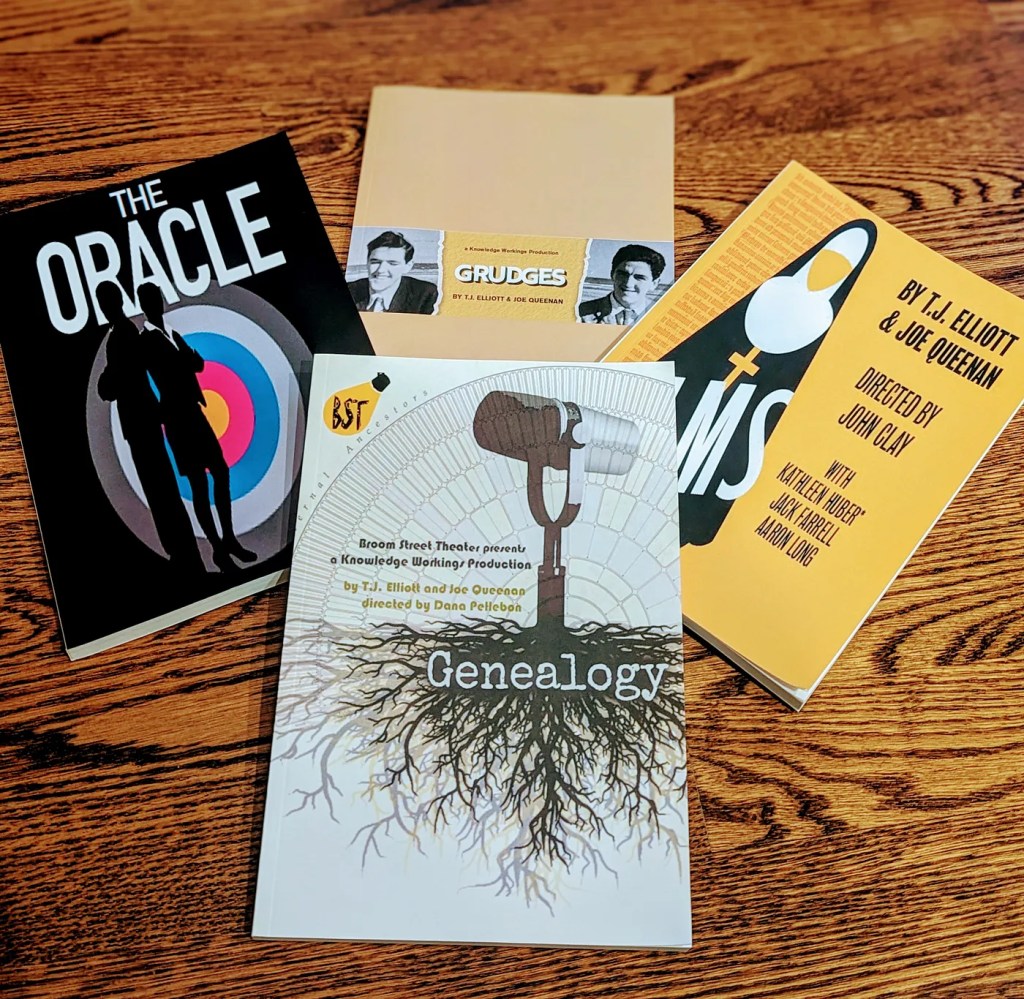
It may be hard to get past the paywall for this Wall Street Journal celebration of theater by Joe Queenan, my old friend and collaborator on four plays — Alms, Grudges, Genealogy, and The Oracle, but it’s well worth the effort. Joe enthuses (a rare occurrence) about putting on a play right now with a young cast and director and felt rejuvenated by people “who were still excited about their futures” and didn’t talk about their orthotics. 🙂
And, yes, of course, I am the old friend referenced in the first paragraph (who wears orthotics and has talked about them — they’re great and with that battered body of Joe’s from our basketball days Queenan should get some.)
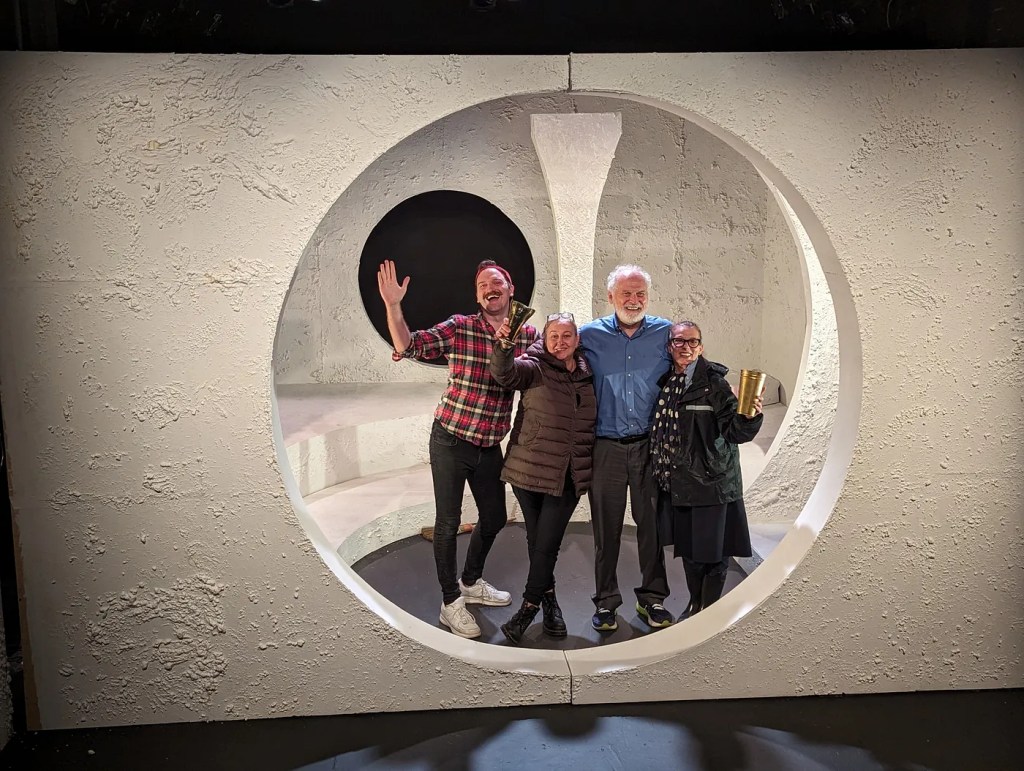
Joe on the far right looking scheming how to turn this photo into one of his WSJ columns Photo Bill Wadman
I owe my 2018 return to theater after over thirty years away in large measure to Joe Queenan and I’m glad to see him succeeding with his latest effort The Counterfeit Moron, which only has one more performance left at 2 PM on March 2 at The Chain Theater as part of their Winter One Act Festival. I’m not sure if it’s sold out — the first 3 shows were — but The Chain often has last-minute walk-up tickets usually if you happen by 36 Street and 8th Avenue on Sunday. Terrific performances by friends and colleagues Ed Altman and Jasmine Dorothy Haefner as well as newcomer and star of Joe’s upcoming film Top Hate Tut Gregory Go Joe!